



When “Stranger Things: The First Shadow” opened on Broadway last spring, it occupied an unusual position: a lavish stage prequel to a television series that hadn’t yet finished telling its story.
The production existed in the shadow of an unresolved narrative, encouraging audiences to experience it not as a closed work but as part of a mythology still in motion. Now, with Netflix’s “Stranger Things” having concluded its fifth and final season, that ambiguity is gone—and with it, much of what once gave the stage show its dramatic charge.
What remains is a clearer understanding of what “First Shadow” is designed to be.

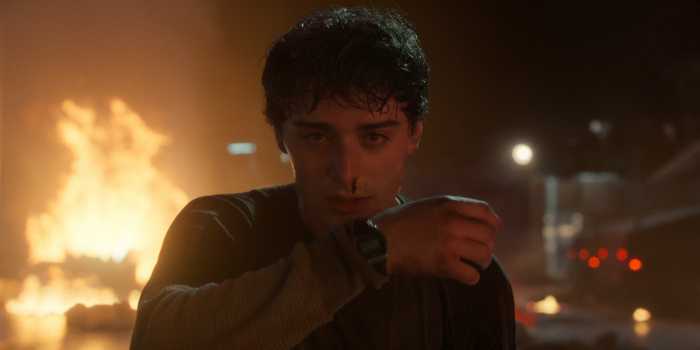
Last spring, the production drew much of its energy from uncertainty. With the fate of Hawkins unresolved, scenes involving Henry Creel—the troubled boy who would later become the series’ central villain—felt charged less because of what they explained than because of what they withheld. The play functioned as a speculative companion to a living story, and that proximity supplied its tension.
With the television narrative complete, “First Shadow” now plays differently. Its destination is known. Rather than generating suspense, the production offers context: an anatomy of how familiar pieces were assembled, not a question of where they might lead.
For viewers who loved the series and wish it had continued, “First Shadow” now operates as a theatrical coda—another immersion in Hawkins, another encounter with recognizable forces, another chance to delay the goodbye. It doesn’t extend the story so much as preserve its presence.

That sense of familiarity is deliberate. The fourth and fifth seasons of the Netflix series had already gestured toward this territory, offering brief glimpses of the Creel family settling into their new home and of Hawkins High School in 1959. “First Shadow” doesn’t invent new mythology so much as expand moments the show had already planted, transforming fleeting images into full-scale theatrical environments.
The production’s design makes its allegiance unmistakable. From the opening title sequence and synthesizer score to its episodic rhythm and chaptered structure, “First Shadow” adopts the visual and sonic grammar of the Netflix series wholesale.
This is theater that doesn’t merely adapt a television property—it behaves like one, aligning itself with Broadway’s growing slate of brand-forward spectacles rather than narrative-driven plays.
As theater, “First Shadow” remains unapologetically engineered. Directed by Stephen Daldry with industrial precision, the production overwhelms the senses with levitations, jump scares, thunderous sound design, fog-filled aisles, and a giant spider that looms over the audience like a demonic chandelier.
The Marquis Theatre itself is transformed, its lobby remodeled into a replica of the Creel House. The experience often resembles a haunted attraction more than a drama—an approach that thrills some viewers and exhausts others.
That emphasis on craft is where the show has earned its strongest praise. “First Shadow” won multiple Tony Awards for its technical achievements, a deserved recognition of its scale and visual sophistication. Those honors, however, arrived alongside mixed reviews that questioned whether the storytelling beneath the spectacle justified such ambition. And despite the strength of the “Stranger Things” brand, box office performance through much of the run was muted, particularly given the production’s capitalization.
The recent surge in attention therefore feels less like a turnaround than a convergence. Following the launch of the series’ final season—coinciding with the lucrative holiday period—the Broadway production posted its strongest numbers to date, including a nine-performance house record at the Marquis Theatre with a weekly gross exceeding $2.5 million. A surprise cameo by Jamie Campbell Bower, who plays the adult version of Henry Creel on the Netflix series, further underscored the show’s function as a live extension of the franchise rather than a standalone theatrical work.
Whether that renewed attention signals a durable second life or a brief crescendo remains an open question. Broadway history is full of IP-driven productions that burn brightest when cultural relevance peaks.
It would not be surprising if Netflix eventually films the production and makes it available for viewing, confirming what “First Shadow” now makes clear: that Broadway here is not the destination, but one platform within a broader content ecosystem.
Marquis Theatre, 1535 Broadway, broadway.strangerthingsonstage.com.