


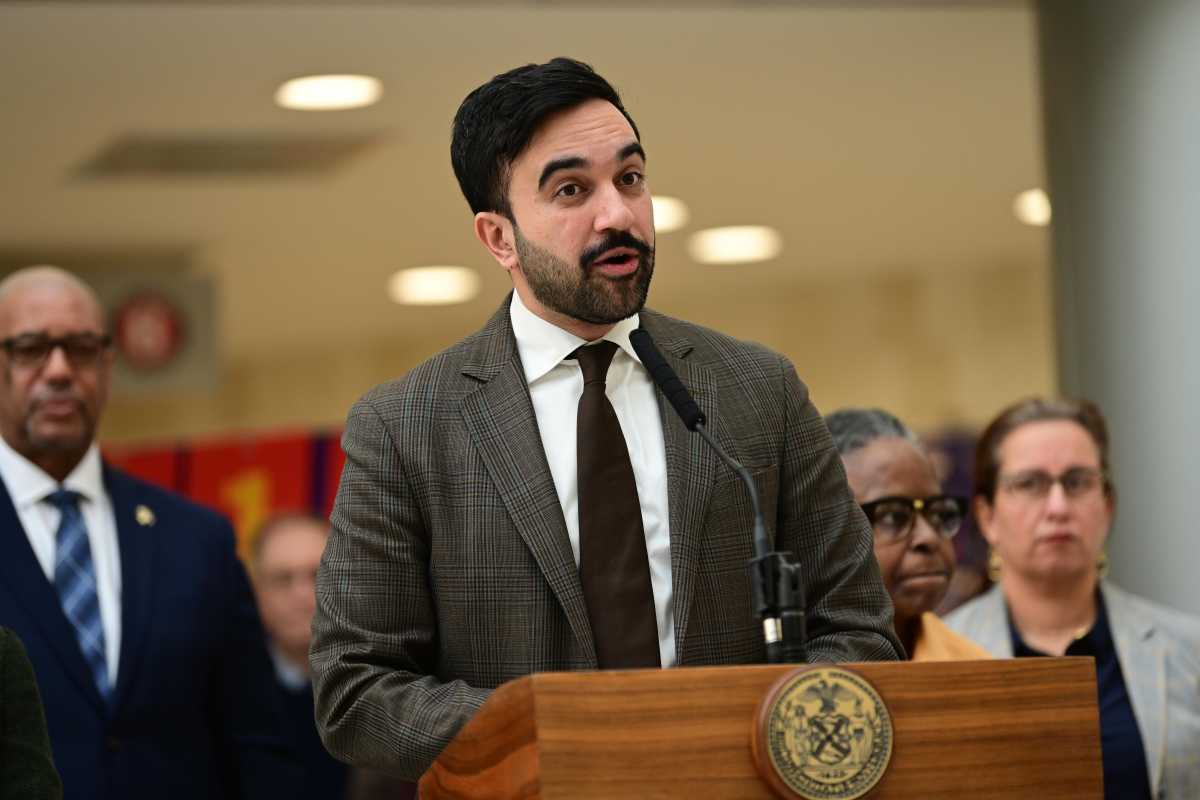
Mayor Zohran Mamdani sharpened the stakes of New York City’s budget negotiations Tuesday, warning that property tax increases could be unavoidable unless Albany agrees to raise taxes on the city’s wealthiest residents and most profitable corporations.
Hours before releasing his first preliminary budget, Mamdani said the city is facing a $5.4 billion budget gap and laid out what he described as two paths forward: state-level tax increases to address a long-standing fiscal imbalance, or city-level measures that would shift the burden onto working New Yorkers.
“After years of fiscal mismanagement, we’re staring at a $5.4 billion budget gap — and two paths,” Mamdani wrote in a statement posted ahead of the budget’s release. “One: Albany can raise taxes on the ultra-wealthy and the most profitable corporations and address the fiscal imbalance between our city and state. The other, a last resort: balance the budget on the backs of working people using the only tools at the City’s disposal.”
Budget documents reviewed by amNewYork show that the mayor’s February 2026 Financial Plan balances the city’s budgets for fiscal years 2026 and 2027, but does so by relying on one-time actions, reserve drawdowns, and increased revenues, while projecting multibillion-dollar gaps in later years.
The plan assumes billions of dollars in additional property tax revenue beginning in fiscal 2027, totaling roughly $3.6 billion to $3.8 billion annually through 2030.
Despite that assumption, the plan still projects out-year shortfalls of $6.7 billion in 2028, $6.8 billion in 2029, and $7.1 billion in 2030.
Mamdani, who has repeatedly said he inherited a much larger deficit from the previous administration, has made raising taxes on wealthy residents and profitable corporations a centerpiece of his broader fiscal strategy. He urged state lawmakers last week to adopt a 2 percent personal income tax increase on those earning more than $1 million a year, alongside a corporate tax hike, as a “fair” way to preserve city services without deep cuts.
Hochul repeats opposition to tax increases
Such changes would require Albany’s approval, and Gov. Kathy Hochul has so far resisted new taxes, even as she approved $1.5 billion in additional state funding to help close New York City’s budget hole.
Speaking at an unrelated press briefing Tuesday morning, Hochul voiced her opposition to a possible property tax hike and emphasized that the mayor’s budget release marks the start, not the end, of negotiations.
She also said updated revenue data has already improved the city’s fiscal outlook.
“That picture is now complete,” she said, citing sales tax revenue as well as income taxes tied to stock sales and bonuses. “So it looks like the deficit came down to about $7 billion, down from $12 billion. That’s progress, but I know there’s a long way to go.”
Asked specifically whether she would push back on a property tax increase, Hochul said, “I’m not supportive of a property tax increase. I don’t know that that’s necessary, but let’s find out what is really necessary to close.”
She added that such decisions ultimately fall to city leaders. “That’s between the City Council and the mayor,” Hochul said. “That’s their prerogative to look at that as an option.”
Property tax hike would be ‘crushing’ blow for homeowners
The mayor’s projected property tax hikes have drawn immediate backlash from small rental property owners. Ann Korchak, board president of Small Property Owners of New York (SPONY), said in a statement that raising property taxes while freezing rents would be “crushing to small owners, driving us into foreclosure and bankruptcy.”
She added, “Owners of small rental properties are sick and tired of being treated like ATM machines every time the city needs to balance the budget… A Mayor who has never run a business knows nothing about the economic struggles and daily grind of small immigrant property owners.”
Mamdani’s preliminary budget also includes early cost-containment measures, such as projected agency savings of $710 million in fiscal 2026 and roughly $1.1 billion annually in subsequent years, along with healthcare savings and staffing adjustments.
Still, the mayor has argued that those steps alone cannot resolve what he calls a structural fiscal problem.
With reporting from Ethan Stark-Miller
This is a developing story. Check back for updates.