
With its sailors, barges, and fogbound saloons, “Anna Christie” is very much a waterfront play, so staging it along the Brooklyn shoreline has its appeal. But St. Ann’s Warehouse’s revival starring Michelle Williams also makes clear why the play itself is so rarely seen.
Even among Eugene O’Neill’s plays, it is one of those titles that looms large in reputation while rarely appearing on New York stages. Overshadowed by O’Neill’s later, weightier masterpieces like “Long Day’s Journey Into Night,” “The Iceman Cometh,” and “A Moon for the Misbegotten,” “Anna Christie” tends to resurface only when a revival can promise something extra. Directed by Thomas Kail (“Hamilton”), the new Off-Broadway production certainly supplies star power and pedigree. Whether it supplies a compelling reason for revisiting the play itself is another matter.
For many theatergoers, “Anna Christie” is known primarily through a handful of famous reference points—most notably the Greta Garbo film adaptation and the 1993 Broadway revival with Natasha Richardson and Liam Neeson—rather than through regular stage exposure.
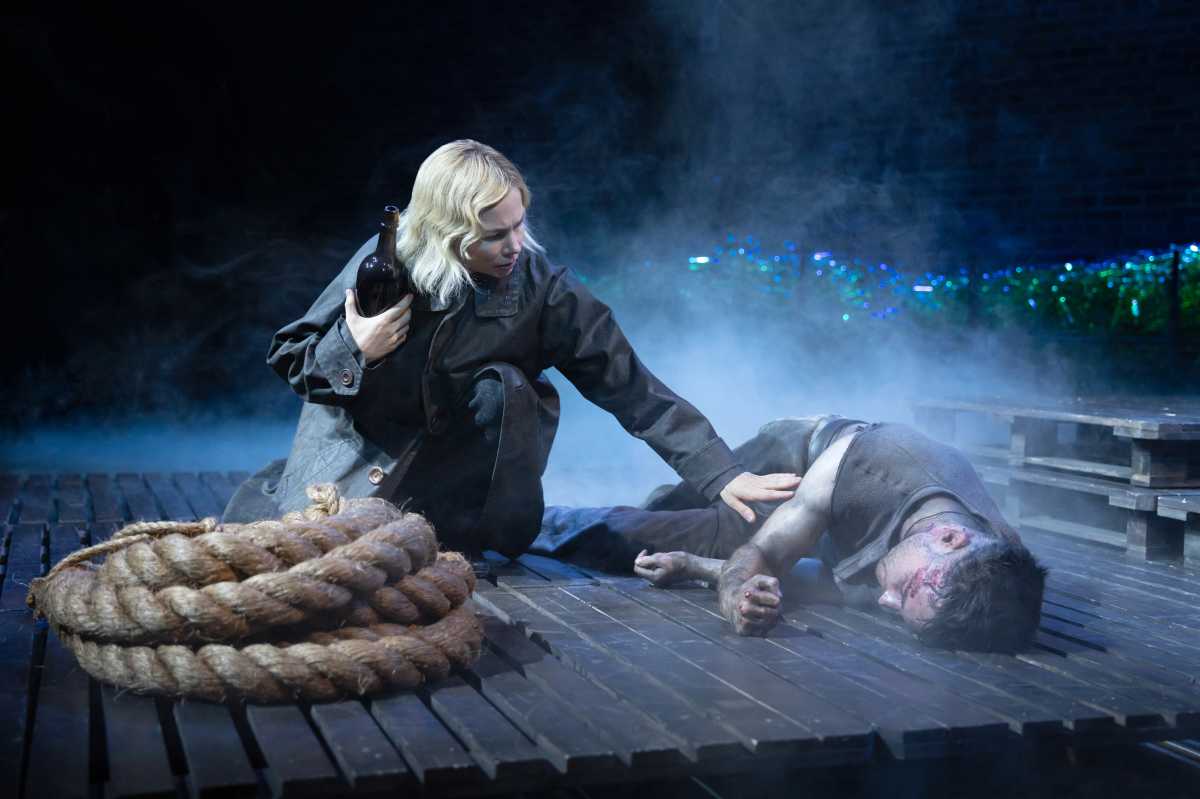
First staged in 1921 and now in the public domain, “Anna Christie” is a slow-moving four-act melodrama that builds almost entirely toward a single confession scene. In its time, the play’s frank sympathy for a young woman abandoned by her father, driven into prostitution, and later judged by the man who claims to love her must have felt bracing.
O’Neill’s moral perspective remains clear—Anna is emotionally honest and resolute, while the men around her are fearful, self-serving, and hypocritical.
The confession, which arrives in the third act, remains the play’s dramatic centerpiece and its most effective stretch. The surrounding acts largely serve to position the characters around them. The first act does at least deliver one of O’Neill’s most memorable entrances, as Anna enters a waterfront saloon and demands, “Gimme a whisky—ginger ale on the side, and don’t be stingy, baby!”
After that jolt, the play settles into a deliberate rhythm that tests patience over its two-and-a-half-hour running time, including intermission. The production might feel sharper if the text were pared down into a leaner, uninterrupted arc.
Scenic designers Christine Jones and Brett J. Banakis create a flexible environment of wooden platforms and industrial metal supports that shift fluidly between a bar, barge, and ship cabin. A wall of bottles briefly evokes the sea itself, while movement by Steven Hoggett adds a ghostly sense of transition, though these gestures remain more atmospheric than illuminating.
Natasha Katz’s lighting bathes the stage in shadowy tones that evoke fog, fatigue, and emotional wear. An original score by Nicholas Britell provides a low, moody undercurrent.
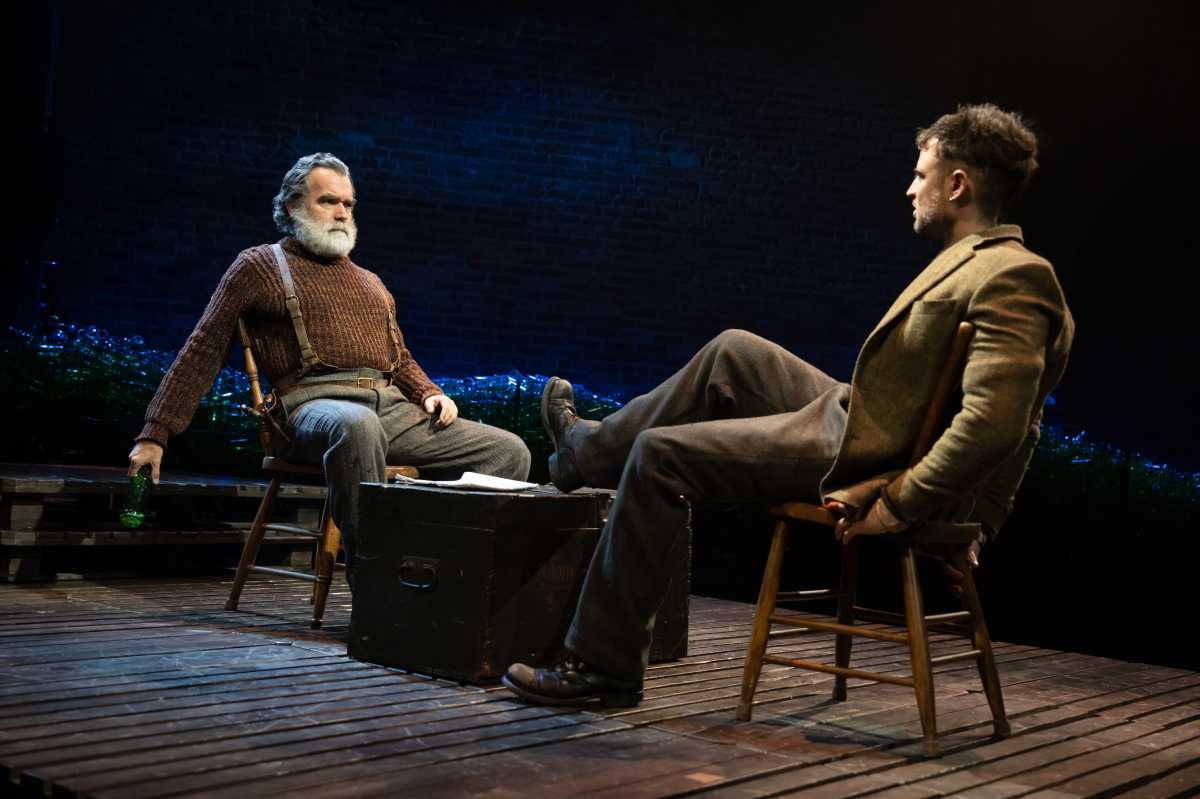
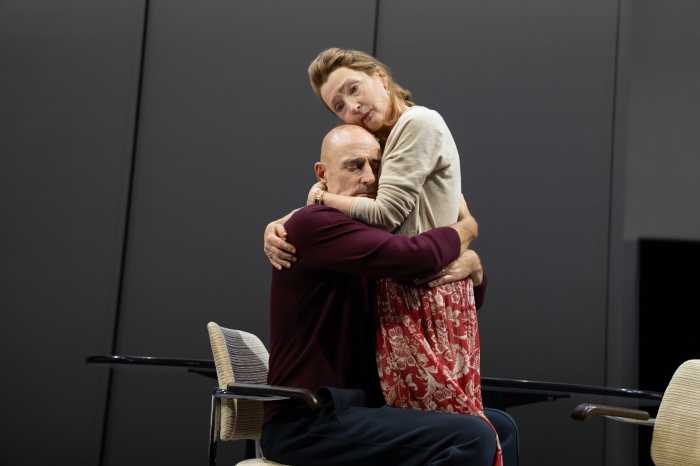
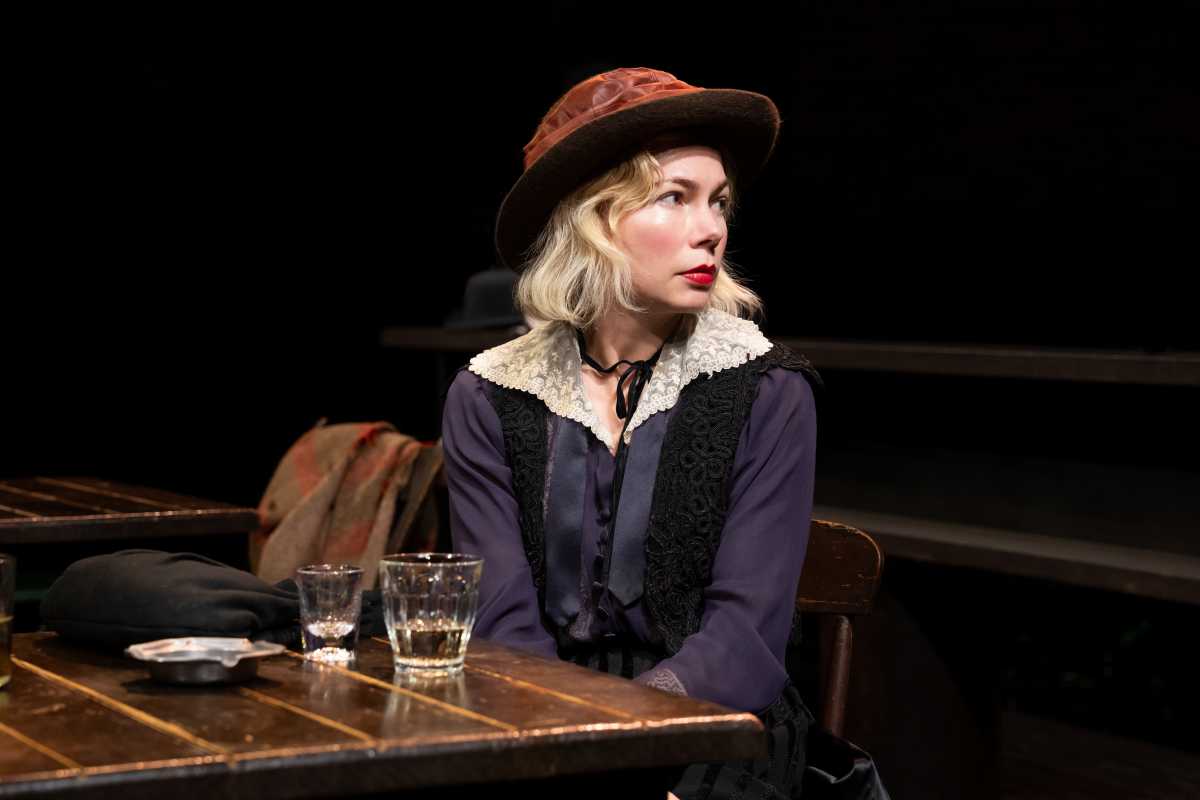
The performances are consistently strong, even when the material resists them. Williams, though clearly older than the 20-year-old Anna, brings focus and emotional transparency to the role. Her Anna is brittle, guarded, and perpetually braced for disappointment—a woman shaped by experience rather than sentimentality. The production plays directly to Williams’ strengths as a performer, even when those strengths can’t compensate for the play’s dramatic inertia.
Brian d’Arcy James gives Chris Christopherson a gentle sadness, avoiding caricature and emphasizing the character’s regret and self-delusion. Mare Winningham brings unexpected warmth to Marthy Owen, softening a role often written as purely coarse.
Tom Sturridge’s Mat Burke is the production’s most overtly physical presence. Played in a raw, almost animalistic vein, Mat’s swagger collapses into moral outrage once Anna’s past is revealed, reinforcing the play’s critique of male hypocrisy. Both Sturridge and d’Arcy James lean heavily into thick accents that occasionally verge on distraction.
The production ultimately feels less like a fresh interrogation of “Anna Christie” than a respectful showcase for Williams—who is married to Kail—and a museum piece. It honors the play’s legacy, but stops short of making a compelling case for its return.
St. Ann’s Warehouse, 45 Water St., Brooklyn, stannswarehouse.org. Through Feb. 1.