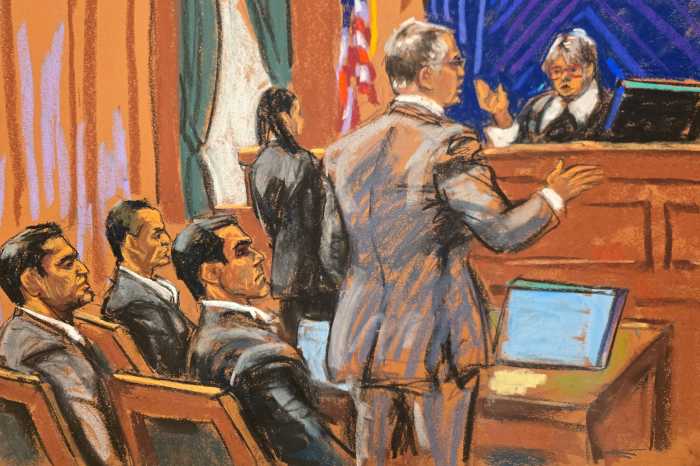




Rebuffing a defendant’s argument that his trial judge allowed inappropriate testimony about gang signs and slang, among other complaints, the New York State Appellate Division, First Department on Tuesday affirmed the lower court’s denial of Brandon Vilella’s motion to vacate his attempted murder conviction.
Prosecutors say Vilella and a co-defendant sought revenge on a man who had testified in another criminal case, and in January 2013, attacked the man outside a deli in Harlem: The co-defendant swung a machete at his jaw and neck, landing a blow that a doctor testified would have killed him had it been an inch or two lower.
Vilella was arrested three years after the incident. Jurors found him guilty of attempted murder in the first and second degrees and assault in the first degree and he was sentenced to 25 years to life in prison.
At trial, in addition to playing surveillance video of the attack and audio from the subsequent 911 call, prosecutors used photographs of the two defendants together flashing gang signs and called a Department of Corrections Intelligence Bureau captain as an expert in “interpreting coded slang and gang affiliation.” He testified about what the hand signals meant and defined words from recorded conversations like “boss,” “peeped,” “lamping,” “MJ,” “type,” “rat,” “caught,” “hit me,” “wrap,” and “waving.”
On appeal, Vilella failed to convince the First Department that the testimony should not have been allowed.
“The evidence of defendant’s gang membership was highly probative of defendant’s motive and his accessorial liability for the acts of the codefendant,” Justice Manuel J. Mendez writes. “The evidence was critical to the jury’s understanding of the relationship between defendant, codefendant, and the person against whom the victim testified.”
Furthermore, Mendez said, the testimony about slang references helped juror understand the conversations they were asked to listen to.
“The expert witness’s testimony interpreting a few slang references that were not within the ken of the average juror was proper,” Mendez writes for the majority.
The appeals court also found that Acting Manhattan Supreme Court Judge Gregory Carro properly admitted the 911 tape and the statements from the victim’s sister describing his injuries — including that his face was split open and she could see inside his mouth — as excited utterances.
For separate reasons, Justice Marsha Michael dissented from the ruling. She did not address the gang testimony or excited utterances, but focused on another complaint Vilella raised: that the trial court failed to read a jury note into the record verbatim, and didn’t confirm on the record that the note was shown to counsel before the judge formally responded to it.
Michael disagreed with the majority’s finding that the trial court complied with criminal procedure law by reading the note “almost verbatim” into the record, and said that error alone entitled Vilella to a new trial.
“No ‘almost verbatim’ exception has been articulated by the Court of Appeals,” Michael writes. “New York’s highest court has consistently held that under CPL 310.30, a mode of proceedings error occurs where the record fails to show the court either presented or read the note verbatim to counsel before responding to it.”
Jonathan I. Edelstein of the firm Edelstein & Grossman represented Vilella. He declined to comment on the ruling.