


New York City’s construction industry, which has a significant foreign-born workforce, now faces potential setbacks for timelines, costs and the local economy as a result of ICE’s ongoing immigration crackdown, according to a new report published on Monday.
The unintended consequences of the Trump administration’s mass deportations can be dire for the industry, as nearly 49% of construction employees in the NYC metro area are foreign-born, according to the Dec. 1 analysis from Construction Coverage, an outlet that publishes construction industry reports.
The potential for increased labor costs to be passed on to developers, buyers, and renters could undermine efforts to address the city’s affordable housing shortage, the report’s researchers suggest.
The NYC metro construction industry employs a total of 288,678 foreign-born workers. Overall, 48.9% of its construction industry workforce is foreign-born, making it the fifth-largest share among any large U.S. metro area, according to the data.
Even across the country, 1 in 4 construction workers are immigrants.
Federal immigration enforcement could force ‘new housing starts to slow down’
If too many of these workers are deported from the United States, it begs the question: Who will do this critical work?
While the recently published report does not directly address this question, it highlights the economic realities that can arise from mass deportations.
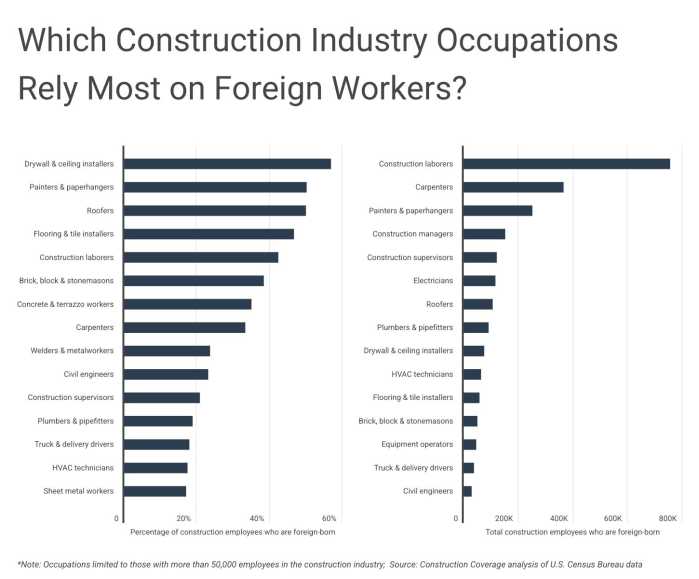
Jonathan Jones, a senior researcher at Construction Coverage, said construction is “labor-intensive and sequential.” This means a sudden shortage in the available workforce would likely create bottlenecks, causing delays in project completion.
“In a worst-case scenario, labor shortages could force new housing starts to slow down significantly as general contractors struggle to staff work sites,” Jones explained.
The potential for project delays caused by a shrunken workforce can possibly threaten the city’s ability to address its affordable housing shortage, undermining initiatives like the City of Yes zoning reform — an effort signed into law last year to overhaul zoning and create tens of thousands of new homes in the Big Apple.
A spokesperson for Mayor Eric Adams, who spearheaded City of Yes into law, said the administration “successfully advocated” for the expansion of Temporary Protected Status and work authorization for people from several countries under the previous federal administration.
“Over the past three years, the Adams administration has also assisted thousands of asylum seekers with applying for Temporary Protected Status and work authorization, and the mayor has been clear that the federal government must provide asylum seekers with a legal path to work so that they can provide for themselves and their families,” the spokesperson said. “While we do not have estimates on the impact of federal immigration policies on specific industries, we continue to advocate for comprehensive immigration reform on the federal level and have not — and will not — cooperate with civil immigration enforcement, in accordance with local law.”
City Council Member Alexa Avilés, chair of the NYC Council’s Immigration Committee, said the study confirms “something we have long known to be true” about the deportations in NYC.
“Crucial industries like construction that rely on the labor of immigrant workers are under threat as workers, their families, and their communities suffer from the violence of unlawful kidnappings,” she said. “Every New Yorker will be affected by this horrific violence, regardless of their immigration status.”
She also described President Donald Trump’s deportation actions as being “deeply destructive” to the city’s economy.
City Council Member Shekar Krishnan, a champion of immigrant workers who is also on the committee, allocated $17.5 million for Elmhurst Hospital enhancements in 2023. The allocation included a new hand surgery clinic which he said treats construction workers.
“We know that immigrants are the backbone of New York City,” he said. “In the construction industry, immigrants are a large part of the workforce. They face grave risks on the job and make great sacrifices for their families. That’s why I’m proud to have funded the first-ever hand surgery clinic at Elmhurst Hospital, specifically so that our public hospital can care for construction workers who were hurt on the job.”
Higher costs for builders, buyers and renters
Meanwhile, the report suggests that a shock to the labor supply typically forces wages higher as firms compete for fewer workers. These increased labor costs would likely be passed on to developers and, ultimately, to buyers and renters, potentially complicating efforts to address housing affordability, industry researchers explained.
“While the extent of future enforcement actions remains to be seen, the data shows that the New York construction industry is uniquely reliant on immigrant labor,” Jones said. “With nearly half of the workforce being foreign-born, any significant reduction in this labor pool would likely strain the industry’s capacity. From an economic standpoint, losing a large share of these workers would make it harder and more expensive to build the housing and infrastructure the region needs.”
Many foreign-born workers also have specialized trade skills and long-standing institutional knowledge, further adding to the enforcement strain on construction, Jones added.
“Replacing a significant percentage of experienced workers rapidly is difficult, which could lead to operational inefficiencies and challenges in maintaining quality control on complex sites,” he said.
Carlo Scissura, Esq., president and CEO of the New York Building Congress, described immigrants as the “backbone” of the local construction industry.
“Our 2025 Workforce Snapshot shows that as our industry grows more diverse, educational attainment is rising right alongside it – proof that diversity makes us stronger,” he said. “As the son of immigrants myself, I’ve seen how people who come here looking for a better life become the essential workers who keep New York building and moving. These are the skilled, dedicated people our industry depends on, and supporting them means supporting our city’s future.”
According to the report, nationwide, the number of foreign-born workers in the construction industry has steadily increased for more than a decade.
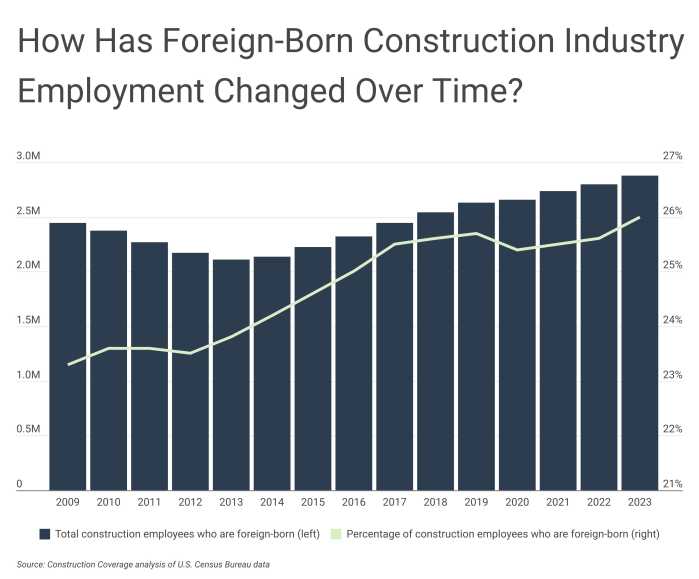
In 2009, immigrants made up 23.3% of all construction industry employees. That share has grown nearly every year since, reaching 26.0% by 2023. Over the same period, the total number of foreign-born employees in the construction sector rose by more than 435,000, from over 2.4 million to nearly 2.9 million.
Other major metro areas that rely heavily on a foreign-worker workforce include Miami-Fort Lauderdale-West Palm Beach at 66.2% and Los Angeles-Long Beach-Anaheim at 53.7 %.