


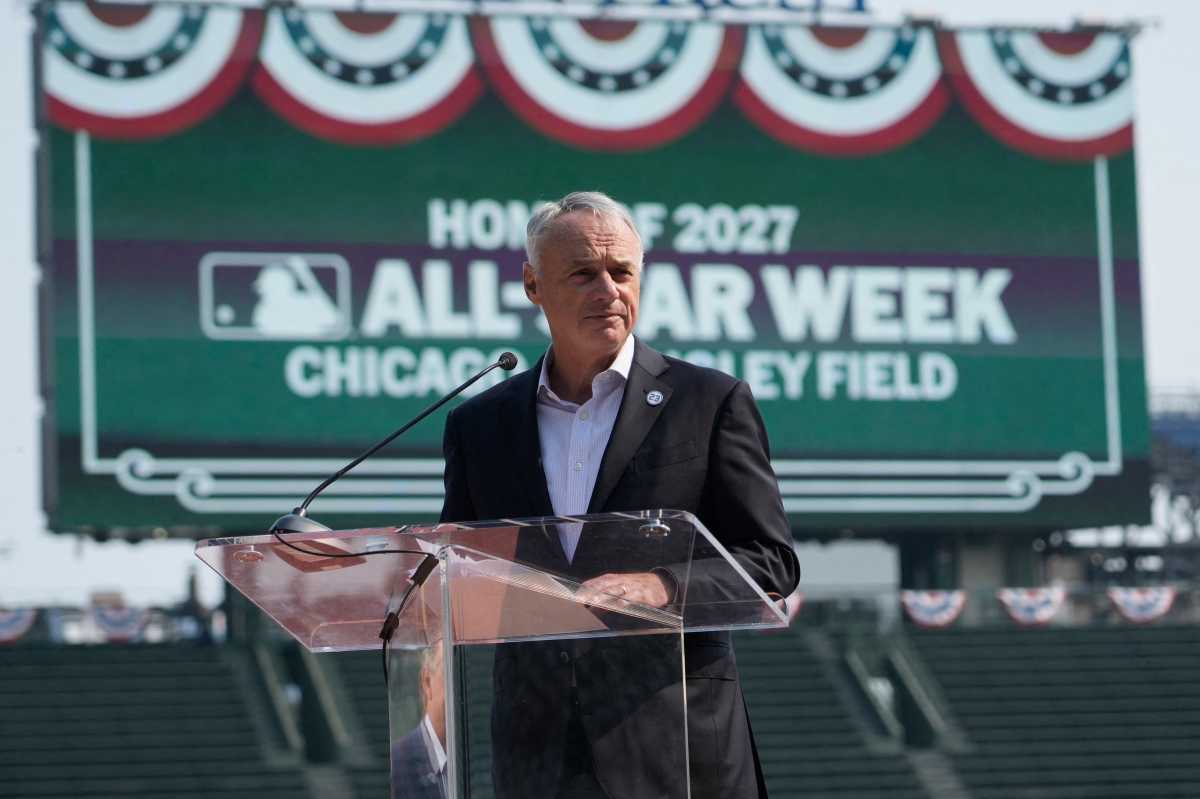
Major League Baseball commissioner Rob Manfred went on WFAN last week, claiming that “there has been a rush to negativity by a lot of the media,” when forecasting future labor negotiations that are on deck ahead of the expiration of the current Collective Bargaining Agreement between the owners and the players’ union.
The media, including this writer, cannot be blamed when the commissioner’s posturing on behalf of billionaire team owners is already in full swing.
MLB Players’ Association (MLBPA) chief Tony Clark has told Evan Drelich of The Athletic that club owners are already “trying to force players” into a salary cap. Manfred has already suggested that he is on the side of the owners, as evidenced by his conversation with WFAN, where he started placing the blame on Clark and the MLBPA.
“That’s a Tony Clark question,” he said when asked about the concept of a salary cap being introduced. “… I’ve never been in a negotiation where, before the first piece of paper went across the table, I, or anyone I represented, was out there saying, ‘This, we absolutely will not talk about.’ I just think it’s a hard way to begin a negotiation.”
Both the league and the MLBPA will begin formal negotiations regarding a new CBA this spring, but both sides appear immovable from their current positions.
A salary cap would limit how much a player earns, despite the continued increases in MLB’s revenue. In 2024, the league hit a record $12.1 billion, and player contracts have reflected that — most notably when the Mets inked Juan Soto to a historic 15-year, $765 million pact two Decembers ago.
These types of contracts, or those that come in at even a fraction of such a dizzying figure that club owners — again, many of them billionaires — refuse to dole out, stressing profit margins rather than building competitive baseball teams. It is somewhat nonsensical, especially because the best way to make money is by putting a competitive product on the field.
Yet Manfred went around to MLB clubhouses throughout the 2025 season, claiming that billions of dollars had been lost because they had not agreed to a revenue-sharing system. That would provide a fixed percentage of MLB’s revenue to both the owners and players each year.
That, of course, is a system found in professional sports leagues with a salary cap. Philadelphia Phillies star first baseman Bryce Harper called Manfred out on it when he arrived in his clubhouse over the summer, claiming that this was the commissioner’s beginning push to institute a cap.
This precarious topic has plagued baseball for decades. It was at the epicenter of the league’s last significant shutdown in 1994, which led to a 232-day players’ strike, the abandonment of that year’s World Series — the first time America’s Game did not have a Fall Classic since 1904 due to New York Giants skipper John McGraw’s protest — and a delayed start in 1995.
It led to a lockout between the 2021 and 2022 seasons before the sides called an audible to work out a deal in mid-March, just a few weeks before the start of the regular season.
There is a way to work around it, but Manfred already hammering the salary cap concept does not bode well for the negotiating table. If he goes to bat for the owners who are unwilling to spend and who want to bring the rest of the league down to their level, it’s fair to prepare for zero baseball in 2027, at least.