

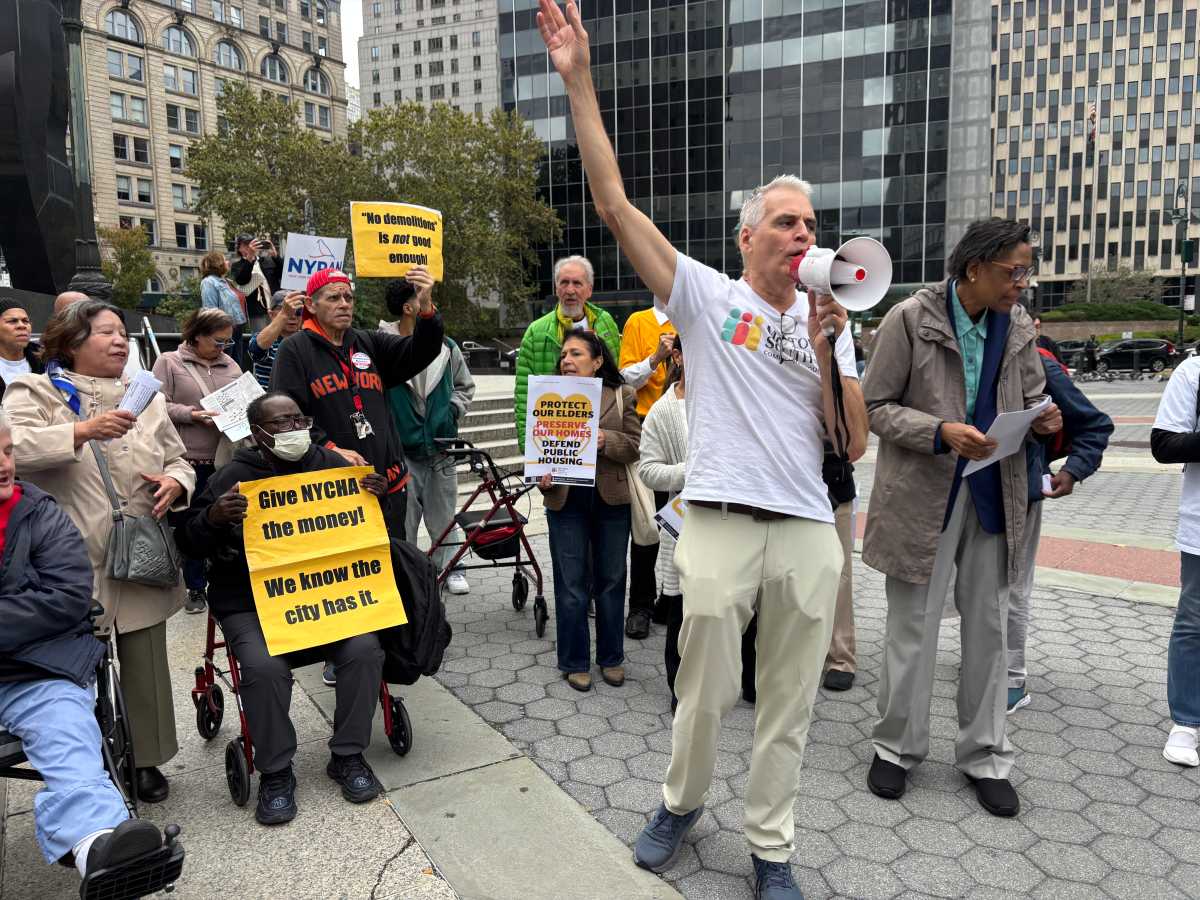
Dorris Ruffin, who lives in the Chelsea Addition of a New York City Housing Authority development for senior citizens at 436 West 27 Drive, calls the apartment “home.” But recently, she heard a knock on the door from people who wanted to relocate her.
The City has agreed to let Related, a developer, tear down that and more than 20 neighboring buildings in the Fulton & Elliott Chelsea Houses, and relocate residents. It would essentially privatize the housing development, rather than depending on the city to maintain and manage.
The project includes rebuilding all 2,056 existing units and creating up to 3,454 new mixed-income units and new community facilities and public spaces.
The City says most tenants can remain in their apartments until new structures are built, and relocations are typically within that community.
Related, they say, will provide nicer, affordable, as well as market-rate housing, and current residents will be allowed to return.
Some residents, however, are elderly, ill and reluctant to leave for several years amid concerns about displacement and whether tenants are being properly informed on top of other issues.
“This project will address over $900 million in mounting physical needs, while maintaining resident rights and protections, including the right to return, and delivering a more equitable living experience for NYCHA residents in Chelsea,” NYCHA spokesman Michael Horgan said.
He added that “nearly every resident will be able to remain in their existing apartments until their new homes are built,” while just over 100 households, or six percent “are being temporarily relocated to refreshed units that meet their household needs on the campus.”
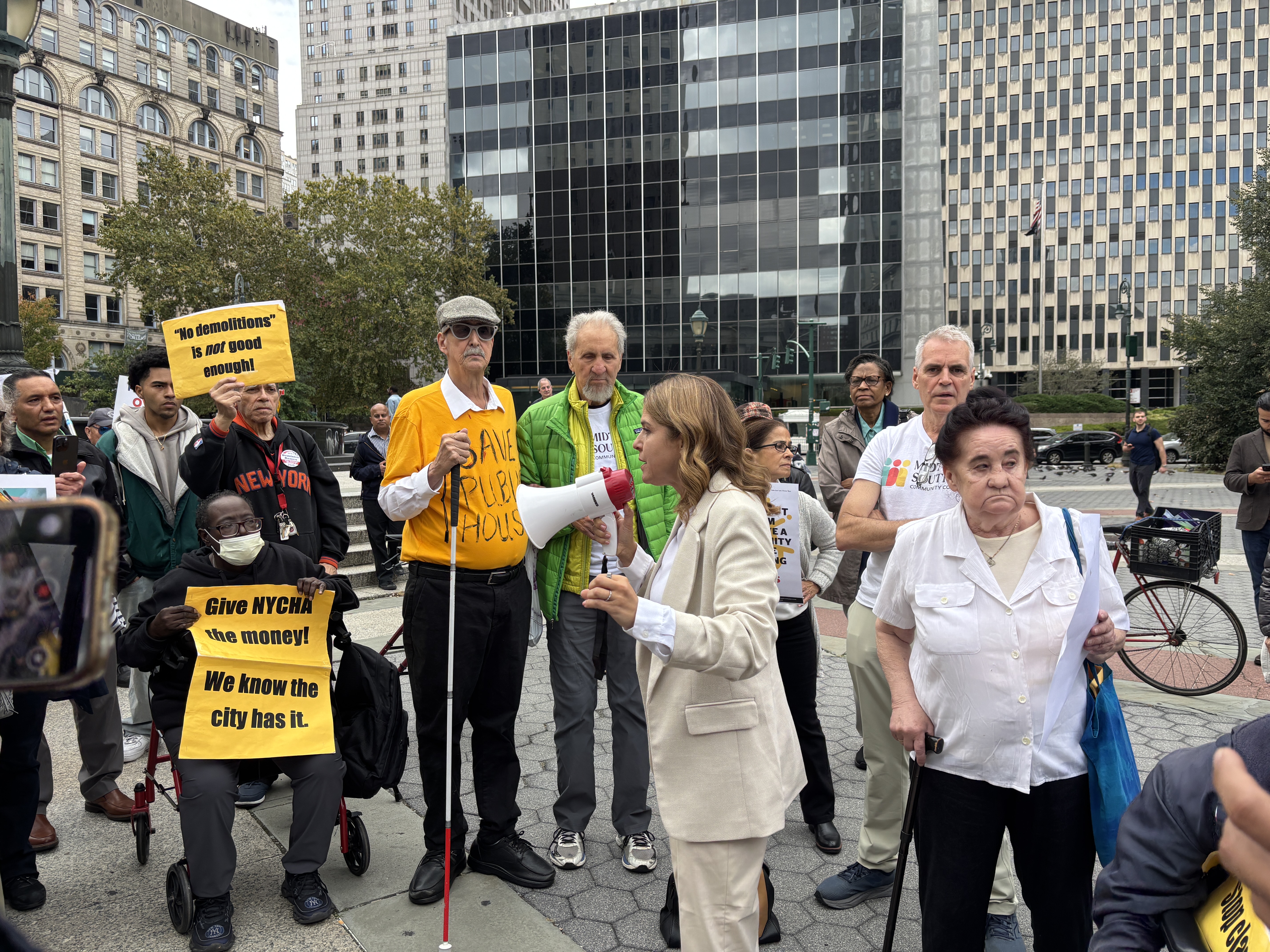
While the City says this is a path to a brighter future, some residents, attorneys and housing activists contend residents are being pressured, the project would take years, and uprooting older people from homes is inherently risky.
Horgan said activists are “attempting to disrupt the relocation process,” while activists said they and residents are acting within their rights. NYCHA said all households who reside in Chelsea Addition or Fulton 11 are required to relocate and received 90-, 60-, and 30-day notices about relocation, but advocates say they have the right to refuse and resist relocation.
“Relocation and eviction aren’t the same thing,” said Thomas Hillgardner, an attorney who represents a tenant who he says has the right to resist relocation letters. “Letters are written strongly. They pray that people are intimidated by their campaign of relocation letters.”

Signing on the dotted line
There are 111 households across Chelsea Addition and Fulton 11, including 35 units at Fulton 11 and 96 at Chelsea Addition, though not all are occupied, according to NYCHA. Over 80 percent of these households have agreed to move or already moved, NYCHA added.
Residents could return to new buildings in approximately three years at Fulton and approximately four years at Elliott-Chelsea, according to NYCHA.
Related and Housing Opportunities Unlimited or HOU, the relocation consultant hired by the developer, are trying to move forward, but housing advocates see this as trying to empty a building amid potential litigation.
“They want me to sign papers,” Ruffin, who is 66, said recently in her apartment. “They gave us the 26th. Now they gave a different day. They’re pressuring me to leave.”
HOU, a relocation consultant hired by Related, has been focusing on the first two buildings that would be demolished.
Horgan said the 2,056 NYCHA households would benefit, including over 80 households that have completed moves or are currently relocating and awaiting the construction of their new homes.”
“This process has and continues to be clearly communicated as we take the next steps to ensure this redevelopment project is delivered as promised,” Horgan said of what the city bills as better housing.
Tenant advocates, though, say tenants may not be fully aware of what they are signing or of their rights.
“They were trying to coerce (another tenant) into moving into another apartment,” Layla Law-Gisiko, Democratic District Leader for the 75th Assembly District and a housing activist, said. “She was not being evicted. She has every right to stay in her apartment.”
Hillgardner said neither NYCHA nor the developer have been trying to evict tenants, who therefore are not required to leave. “I think they know it won’t go well,” Hillgardner said of eviction. “It’s clear NYCHA wants them to move and many tenants don’t want to move.”
Hillgardner said, “Tenant harassment is involved here to get them to sign relocation agreements.”
He said his client signed a document, but isn’t clear as to what it stated and was not given a copy. “We don’t even know what it is,” Hillgardner said. ”We assume it’s a relocation agreement. She doesn’t want to relocate. If they try to enforce it, I’ll step in.”
Right to remain or return?
NYCHA said 94 percent of households will be able to remain in their existing apartments until new homes are built.
Six percent, or just over 100 households, are being relocated to refreshed units on the Fulton & Elliott-Chelsea campus during this phase, according to NYCHA.
Residents will be returning to newly constructed buildings in approximately three years at Fulton and approximately four years at Elliott-Chelsea, according to NYCHA.
“Tenants will be relocated to other apartments,” Law-Gisko said, while NYCHA said they would move to “refreshed” housing. “The issue is that for an elderly person, waiting three to four years is like contemplating their own death.”
Marni Halasa, a housing advocate, said HUD’s Rental Assistance Demonstration program indicates a right to return, but called those “administrative agency policies” and not a “universal legal guarantee” from Congress.
Halasa said under HUD’s HOPE VI program only 25% of residents returned to redeveloped sites, while in Chicago’s Cabrini-Green redevelopment, less than 20 percent returned.
“NYCHA may promise a right of return, but it’s not backed by any federal guarantee,” Halasa said. “And that’s why so many tenants — from Liberty Square to Prospect Plaza to Cabrini Green — get displaced.”
She said at NYCHA’s Markham Gardens in Staten Island, only 16 out of 202 households returned. But in this case, many people would be moving from one building to a new one adjacent.
Reading, writing and removal
Law-Gisiko said when a tenant indicated she didn’t want to leave, HOU called the police and the NYPD 10th Precinct deployed a team who told the tenant to comply with HOU order.
An NYPD supervisor arrived, stating the building has been sold, which Law-Gisiko said it has not, and saying the tenant must comply.
After visiting a location to which the tenant would move, the tenant reported that the unit was unsuitable.
“The elevator door is non-automatic, heavy, and requires pushing/pulling that she cannot perform given her physical condition,” Law-Gisiko said. “She also reported the building smells of urine and that she would not feel safe. She refused to move and asked that boxes be returned to her apartment.”
Law-Gisiko said the tenant acknowledged “she may have signed a form but believed it was her annual renewal paperwork” and “did not knowingly consent to relocation or packing of her belongings.”
Law-Gisiko said this could be “constructive eviction and tenant harassment,” including packing a tenant’s belongings against her wishes and deploying police to compel compliance, absent a court order of eviction.
She has written to the New York State Attorney General’s office, asking them to look into and take action to stop what she believes are improper practices.
Law-Gisiko wants to suspend any reliance on purported “consents” obtained from tenants until the state verifies they were “knowing, voluntary, and not procured by misrepresentation.”
And she wants “HOU and relevant ownership/management” to be informed that “misleading statements about sales status, eviction, or required compliance must cease” and “communications to tenants must be accurate, written, and legally compliant.”
Meanwhile, some tenants worry there will be knocks on their door as people try to move them out, even though they want to remain.
“They say they have a designated space for me. I don’t like it. It’s regular housing,” Ruffin said. “I live where seniors live. There’s a guard here at night to make us safe. Now they want me in a building with everybody.”
Reading, writing and renovation
Tenants and housing advocates argue renovation is possible, while NYCHA believes that rebuilding is better for all around.
“What was agreed upon in 2019 and what the tenants negotiated was there would not be demolition,” Law-Gisiko said. “They do not wish the building be demolished.”
She said renovation is possible and, in her view, desirable, “It’d be much cheaper and faster to refurbish the buildings than to demolish them,” Law-Gisiko added. “It’d be better for the tenants and community to refurbish the buildings.”
Hilgardener said Section 9 housing such as this, although there is an effort to convert this to Section 8, provides a permanent guarantee where leases can only be terminated for cause.
“This is a fight for Section 9 housing. People are trying to preserve the right of Section 9 housing,” he said. “It’s going to be hard for them to argue this person should be evicted. Deciding to tear down the building is not the cause. The buildings don’t need to be torn down.”
Law-Gisko also pointed to actions that, she believes, are improper and don’t respect the rights of existing tenants.
“The entry buzzer directory appears to have been erased, as if the building were vacant,” Law-Gisiko said. “Many tenants still reside in the building. This creates a serious safety hazard (emergency medical access, deliveries, family and caregiver access).”
Horgan said they are looking into how that happened and seeking to address it, but NYCHA did not authorize any action regarding the register.
“This implicates obligations under fair housing and disability rights laws to provide reasonable accommodations and an accessible alternative,” Law-Gisiko said.
NYCHA says it’s simply trying to build new, better and more, which benefits current tenants and those who could move into new apartments. Hilgardener, however, said the existing tenants don’t want to be displaced for years.
“Let people decide what’s better for them,” Hilgardner said. “NYCHA shouldn’t decide on their behalf.”