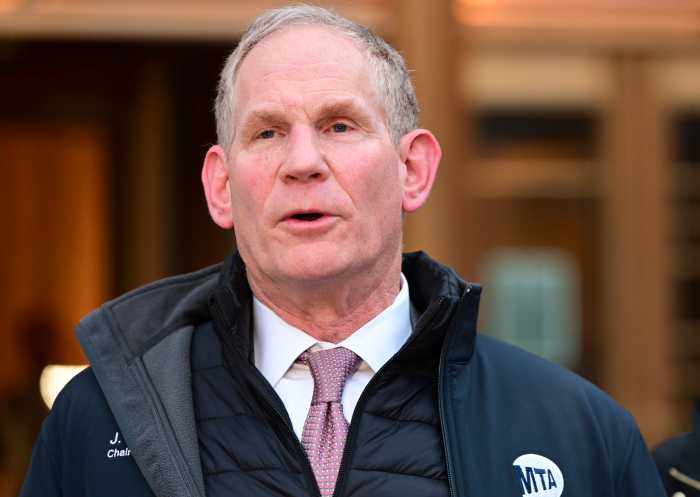



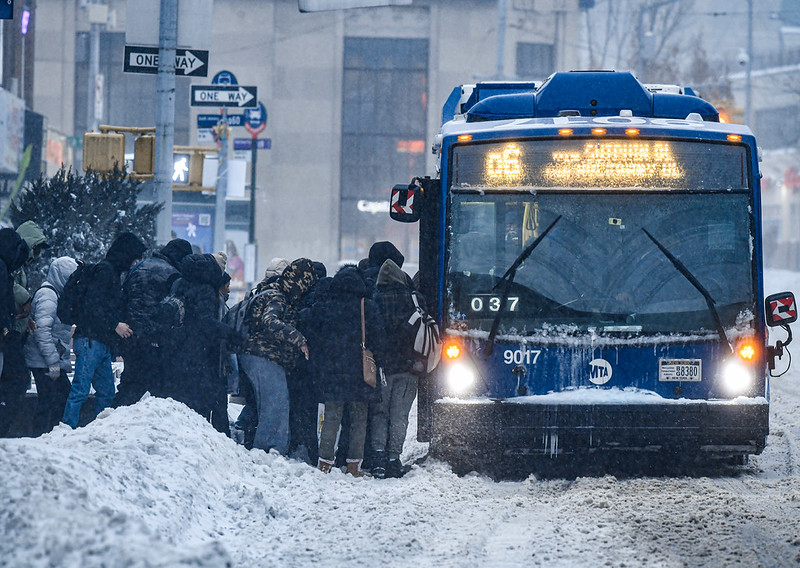
The MTA will only move towards introducing all-door boarding on city buses after it has rolled out a promised “European-style” approach to fare evasion enforcement aboard the vehicles, Chair and CEO Janno Lieber said on Tuesday.
Lieber, while testifying during a Feb. 3 state legislative budget hearing, made clear that the MTA will not activate OMNY tap-and-pay readers in the backs of buses until after it has established its new fare validation system on them. The reason for the delay, he has said, is that buses are still accepting MetroCards and coin payments for the time being, which cannot be checked via the digital devices the agency plans to use to verify OMNY payments.
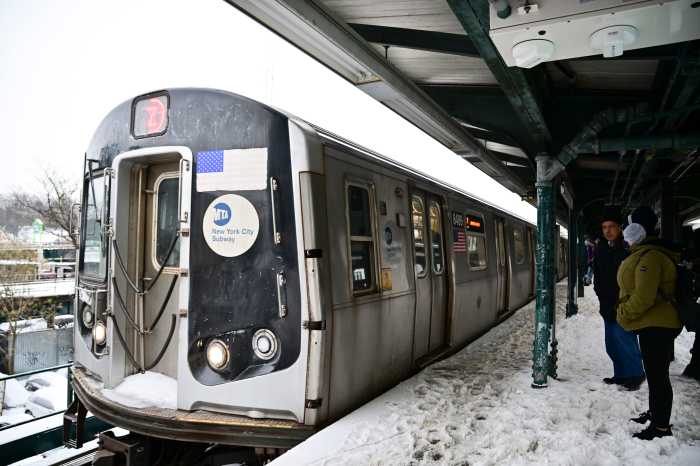
For the past couple of months, Lieber has pitched the new system of fare enforcement on buses as European-style because it is similar to how many European countries verify riders’ payments on transit. It involves having civilian fare agents hop on buses, check rider payments with handheld devices, and hand out tickets to those who didn’t cough up $3.
The transit boss made Tuesday’s comments in response to Assembly Member Emily Gallagher (D-Brooklyn), who asked why the MTA has not already allowed all-door boarding on its bus fleet as it seeks to make the vehicles a faster mode of transit.
“We need to get to full tap-and-ride so that we can do validation of tickets for fare enforcement purposes,” Lieber told the lawmaker. “Then I think we’re in a position where we could move in a reasonable timeframe towards all-door boarding.”
Transit advocates have pushed the MTA for years to introduce all-door boarding on local buses, but the agency has so far resisted. Advocates believe all-door boarding would speed up service by cutting the time buses spend at each stop — known as “dwell times” — in half.
The MTA does have all-door boarding on its Select Bus Service routes, where riders pay fares at kiosks before hopping on the buses.
In his resistance to allowing all-door boarding in the past, Lieber has argued that it would only add to rider confusion around paying the fare. Specifically, he has said riders were confused by the MTA allowing them to board for free through back doors, to avoid spreading COVID-19 to drivers, during the pandemic and its pilot program testing free bus service on five routes in 2023 and 2024.
On Tuesday, Lieber said all-door boarding could lead to more fare evasion if there is no way for the MTA to validate if riders paid at the OMNY reader in the back of the bus.
“It doesn’t work if you have people getting on the back, and then you can’t really know whether they paid up front or not,” he said.
Lisa Daglian, executive director of the MTA’s Permanent Citizens Advisory Committee (PCAC), said that while it is vexing that the MTA has yet to allow all-door boarding, it is understandable.
“Is it frustrating that we can’t do all-door boarding? Yes,” Daglian said. “We see that that works well on Select Bus Service. But we also know that the back door is a sieve for people to just jump on without paying. So it would be great to see there be a quicker transition to this kind of onboard validation.”The MTA contends the enforcement is necessary because it loses hundreds of millions of dollars to fare evasion each year and buses are particularly vulnerable to fare-beating.
Currently, the MTA combats fare evasion on its buses with squads of ex-law enforcement officers dubbed “EAGLE teams.” Similar to the new style Lieber is pitching, the teams issue tickets on Select Bus Service routes and local buses to those they find to have skipped the fare.
With assistance from the NYPD, the teams are also present at select and local bus “hubs” they have identified as rife with fare evasion.
Daglian said she sees what Lieber has been referring to as a new style of fare enforcement more as a rebranding and expansion of the EAGLE teams.
“If you say EAGLE team to someone, it sounds like Eagle Scouts, right?” Daglian said. “If you say European style of onboard fair validations, then that is much more widely understood by a lot of people, like you and me. So I think it is a repackaging, but it’s not a wholesale change of what they’re trying to do.”