


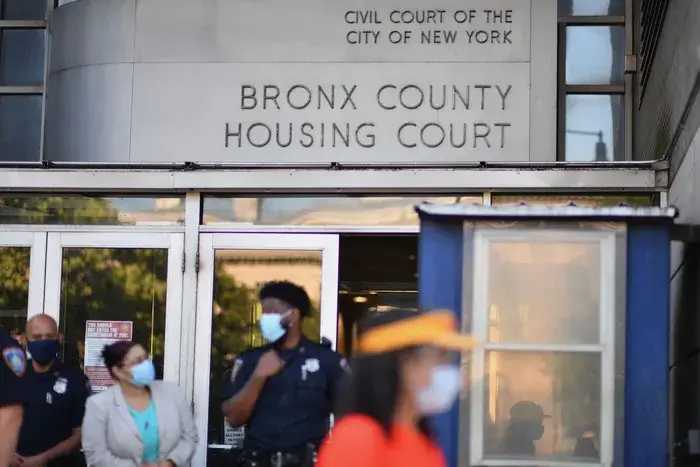
In 2017, New York City became the first jurisdiction in the nation to guarantee free legal representation to low-income tenants in eviction cases. Fast forward to this month when Bozeman, Montana made news as the 27th jurisdiction in the U.S. to adopt a similar “right to counsel” program.
The right to counsel movement has become national in scope, opening up a burgeoning new sector of public interest law that has policymakers in a mad dash to find a new generation of housing attorneys to meet the post-pandemic boom in eviction filings.
“The lead-up to New York City becoming the first jurisdiction, there was really a recognition that one huge way to disrupt evictions is to have an attorney by someone’s side,” said Erica Braudy, a supervising housing attorney at Manhattan Legal Services.
Five states, 20 cities and two counties now passed right to counsel programs providing tenants free legal representation in eviction cases. The number of pilots — often predecessors to full coverage — has spread to cities like Milwaukee, Nashville, Boston, Akron, Cincinnati, Tulsa and Richmond.
While the expansion of these programs marks a huge policy win for housing advocates and policymakers, it’s collided with a level of eviction filings that surged and remained high as pandemic-era rental protections have ended, creating a growing need for more attorneys to handle the cases; along with an increase in funding to hire more lawyers.
In 2023 landlords filed over 100,000 more cases than were filed in 2022 and over 500,000 more than in 2021 in the dozens of cities where the Princeton Eviction Lab tracks such data.
“When the eviction numbers go up like that, it definitely makes right to counsel more expensive, and it makes the challenge of getting enough lawyers… also difficult,” said John Pollock, a staff attorney and coordinator of the National Coalition for the Civil Right to Counsel.
When local governments enact a right to counsel policy, legal aid programs often have difficulty maintaining a steady pipeline of new attorneys — a problem created by a lack of public service law funding and the failure of law schools until recently to prioritize training new housing lawyers.
Some of those trends are shifting as law schools have taken notice. New York Law School recently authored a report examining law schools’ role in the right to counsel movement that found 60% of all housing justice clinics were founded since New York City’s law passed in 2017. The report documents mounting interest in housing clinics, which can give students hands-on experience and plug some of the staffing holes in right to counsel programs.
The data comes as part of an outpouring of studies that came out recently measuring the impact of right to counsel programs in the places they’ve taken root.
“I call it the year of proof,” said Pollock. “We’ve gotten so much more momentum out of the fact that these studies are continually showing the right to council is delivering in a variety of ways.”
A Kentucky study substantiated what housing advocates have long argued: slower eviction proceedings lead to lower eviction rates and that tenant representation significantly increased case length.
Other studies found housing representation intersecting with physical health. One study showed that in NewYork City, right to counsel led to healthier pregnancies for affected mothers. Others found broader health improvements in states like Connecticut and Washington that adopted a version of the policy and in cities like Cincinnati.
‘A Tremendous Amount of Forward Momentum’
While the high level of evictions create headaches for implementing new right to counsel programs, it also accounts for the political momentum that the programs have. As of 2023, the number of rent-burdened households, spending more than 30 percent of their income on rent, hit an all-time high of 22.6 million, roughly half of all renters.
“Frankly, a big factor is the growth in homelessness over the last few decades and the inability of the people in political office to come up with effective solutions and keep people in their homes by preventing eviction,” Andrew Scherer, a director of New York Law School’s Housing Rights Clinic.
That trend became even more evident at the worst of the pandemic when the right counsel programs multiplied at an unprecedented level. In 2021 alone, 10 jurisdictions passed new programs, helped by a flood of federal dollars, Pollock said.
Scherer, whose group the Right to Counsel Project played a critical role in pushing for New York City’s version of the program, said that here as in other locales, a strong tenant movement led the way.
“Even since the late 1800s, there were rent strikes being organized, but I think it’s more strategic and it’s more goal-oriented around making change,” Scherer said of New York’s tenant advocacy.
But once New York’s program began its phased expansion to cover all of the city, staffing bottlenecks emerged that forced groups like Legal Services NYC and the Legal Aid Society attorneys to take on a limited amount of new cases per month.
Staffing is important on two levels. One is that attorneys can’t deliver effective representation if they’re overloaded. And two, the attorneys have a much better chance of burning out if their caseload is too overwhelming.
The top suggestion that the New York Law School report found is to strengthen the pipeline of housing attorneys is better pay and benefits.
“The ability to attract and retain talent depends in large part on the salaries that we can pay, and the current funding structure it’s consistently not allowing us to pay on par with government agency jobs or people going into public defense positions,” said Rosalind Black, Legal Service NYC’s citywide director of housing.
Another barrier for housing law education is cultural. Pollock said that law schools need to introduce the concept of housing proceedings early and support clinics. Required property law courses rarely teach housing justice or landlord-tenant law. Pop culture trains students to consider criminal law as a form of public defense before they think about housing court.
“When I went to law school, the first thing they tell you is ‘Forget everything you saw in Law and Order.’ Whereas they don’t have to warn you about that for Legal Aid because there is no [equivalent],” he said.
The fact that many of these new right to counsel programs are brimming with open positions makes a great business case for law schools to create housing clinics, Scherer said, because “law schools are in the business of turning out lawyers who get jobs.”
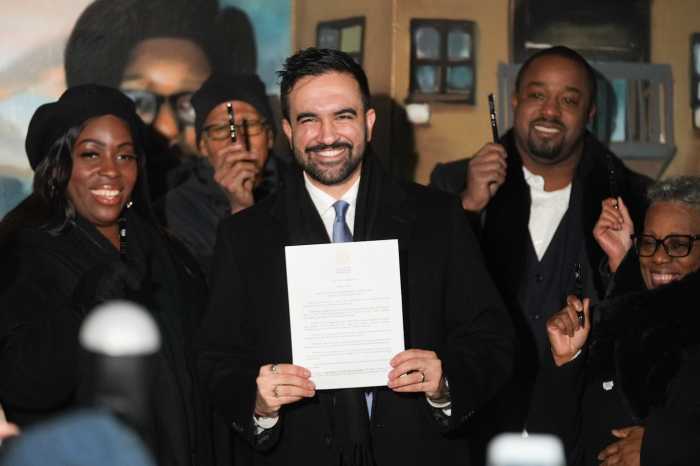
In New York, the election of Mayor-elect Zohran Mamdani, who worked as a housing advocate prior to becoming a state legislator, has provided hope for the public defense bar that he will prioritize funding, and invest in staff for the right to counsel program.
On a fiscal level, right to counsel programs have a compelling argument. Studies estimate that investing in housing counsel saves government money on the down-the-line costs of eviction like homelessness, emergency medical care, foster care and unemployment.
“You need to invest in housing at this end to ensure that people’s apartments remain affordable… because the other end is more expensive,” said Braudy.
This is not just true for New York but for the dozens of cities, according to Pollock, that have launched right to counsel pilots — a sign that the movement will continue to grow in the near future.
“We still see just a tremendous amount of forward momentum,” Pollock said.