



Government watchdogs Citizens Union and Common Cause say they oppose the New York City Council’s plan to raise salaries of its members and other top city officials, not because of the proposed increases themselves — but because of the way the council wants to enact them.
Under the proposal, city council members, the mayor, the public advocate, borough presidents and comptroller would get 16% raises, and district attorneys would see a 6% salary increase.
Introduction 1493 would have council members give themselves their first raise since 2016, from $148,500 to $172,500. The council based that figure on cost of living, increased job expectations and increases to private, nonprofit and other electeds’ salaries in comparable cities, like Chicago.
Grace Rauh, executive director of the organization Citizens Union, raised concerns that the council making its own recommendation without independent input could deteriorate public trust in government at a Tuesday Committee on Government Operations hearing on the bill.
According to Rauh, the plan also goes against the city charter, which requires the mayor to convene an independent commission to study and make recommendations for changes in elected officials’ salaries every four years — something Mayors Bill de Blasio and Eric Adams both neglected to do.
“For more than 50 years, every increase in the salaries of elected officials in New York City has followed the work of an independent compensation commission, which has conducted reviews and issued recommendations on pay,” Rauh said. “The current proposal before the city council breaks from that precedent, offers no supporting analysis for the proposed 16% increase and is being advanced in an 11th-hour manner to work around the very clear prohibition in the city charter that bars the council from raising pay during a lame duck period like the one that we are in.”
“The approach that you all are considering undermines public trust and creates a troubling precedent,” she added.
The city charter prohibits the council from passing bills to increase their salaries during the lame duck period between Election Day and Jan. 1, the start of a new term. Though the council is only preparing the bill now and plans to vote in the new year, Rauh said she believed it was disingenuous to the charter’s intent, and even potentially legally dicey, to hold hearings on the bill in the lame duck period to set it up for a quick vote as soon as Jan. 1 passes.
“We think that if the city council goes forward with this legislation…in January, that there could be legal challenges to the pay raise because of the timing,” Rauh said. “By holding the hearing today and introducing the bill and again in January as a pre-considered bill, they may actually be opening themselves up to potential legal challenges.”
“Regardless, the lame duck period in particular reeks of self-dealing,” Rauh added. “There’s something that feels particularly fraught about immediately winning reelection and then working on a pay raise [during] the one period of time where you can’t actually vote through a pay raise.”
New York Law School professor Stephen Louis said the council preparing and holding hearings on the bill didn’t break the law, because as long as the bill is reintroduced and voted on in the new year outside of the restrictive lame duck period, it wouldn’t go against the charter.
He said one could call the bill “inappropriate,” but given the mayor not appointing the commission as required, it didn’t “seem that outrageous,” and would not be inconsistent with the charter.
Rauh and Samantha Sanchez, policy manager at the group Common Cause, emphasized during Tuesday’s hearing that they believed the public officials deserved a raise, and should seek one through other legislative means..
Rauh suggested the council pass a bill requiring Mayor-Elect Zohran Mamdani to set up an independent commission to consider salary increases within his first month in office; pass a bill allowing the council to establish an independent commission of its own to make salary recommendations; or amend the law to ensure another elected official establishes an independent compensation commission if the mayor fails to, preventing a lapse in salary review and increase in the future.
She said the council could also consider seeking a court order compelling the mayor to appoint an independent compensation commission.
“The council has sued mayoral administrations in the past for failing to carry out local laws,” Rauh said. “That option has been available for several years and remains available today. None of these options require abandoning half a century of precedent of rushing through flawed legislation.”
But, these things take time, something the bill’s sponsor, Council Member Natasha Williams, and cosponsor, Council Member Lincoln Restler, said they felt was of the essence. Both said they wanted the council to vote on salary increases as soon as possible because of the near-decade members have worked without a raise and to ensure “the best and brightest,” not just the wealthiest, continue to be attracted to public service.
Additionally, because city council members are term-limited, if the mayor established a committee to create a salary increase recommendation, members raised concerns that the time it would take for a recommendation to be provided, voted on and enacted might result in more council members not once getting a raise while in office.
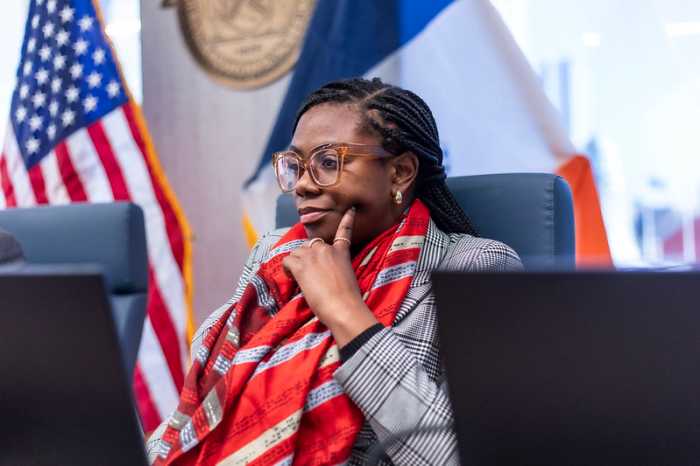
When asked about whether the groups’ testimony and suggestions impacted her position on her bill, Williams told amNew York Law she “appreciated” the testimony and intended to work with the incoming speaker and her colleagues on “a plan that works best” to increase salaries.
“I look forward to working with the incoming speaker to craft a plan that supports a cost-of-living adjustment,” Williams said.
If the bill passes next year, the mayor’s salary would increase from $258,750 to $300,500; the public advocate’s salary from $184,800 to $215,000; all five borough presidents’ from $179,200 to $208,000; the comptroller’s from $209,050 to $243,000; the city council speaker’s from $164,500 to $191,000; and all five district attorneys from $232,600 to $247,500.
The bill would also require the mayor to convene an advisory commission to review and make recommendations regarding the compensation levels of elected officials before the end of next year, which Williams said demonstrated the council’s intent and desire for an independent commission to make salary recommendations going forward after this.
The bill will likely be one of the first that comes across Mamdani’s desk in the new year. His press secretary did not immediately respond to a request for comment on whether he would support the bill.