


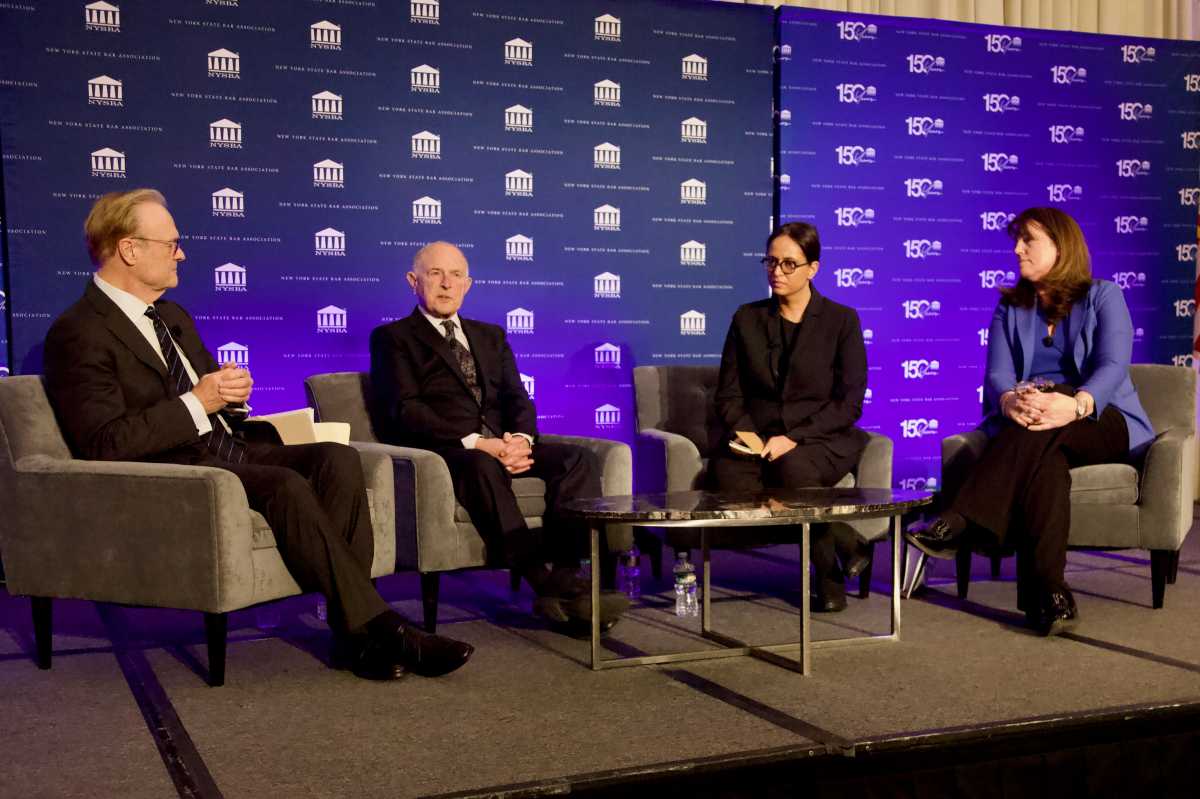
Constitutional experts made the case that the United States has left a phase of mere constitutional crisis for one of “failure” at the presidential summit of the New York State Bar Association’s 2026 annual meeting.
Historian Jack Rakove and former Jan. 6 prosecutor Sonia Mittal said Wednesday that it’s important for the legal community to grapple with the idea that our system of justice has shifted from a temporary inflection point under President Donald Trump to a more systemic collapse of its institutions.
“We hold up the United States Constitution as a paradigm example of a constitution that endures. And we are officers and stewards of that Constitution,” Mittal said. “But if we are unwilling as a community to even broach that language — if that language is so uncomfortable to us that we have difficulty thinking about it — it means that we’re going to be unequipped to have the freedom of mind to respond.”
Rakove said the government’s reaction to the Jan. 6, 2021, attack on the U.S. Capitol was the moment he realized that he was seeing the system’s failure. He saw institutions like the Senate during Trump’s second impeachment trial as not performing their duties.
In the debate during the impeachment, Republicans and legal scholars asserted that the Constitution prevented the Senate from holding an impeachment trial of Trump after he leaves office — analysis Rakove fundamentally disagrees with.
The Senate voted 57–43 to convict Trump of inciting insurrection, which came short of the threshold the Constitution requires.
“In the end, the impeachment mechanism failed,” Rakove said.
Besides the Senate’s role, Rakove said systemic failures in all three branches of government have led to his conclusion. He and Mittal said that in the executive branch, violations of the emoluments clause and the abuse of the pardon power to shield political allies are areas where the system has broken down.
Mittal, who previously served as an assistant U.S. attorney in the section responsible for handling the prosecutions of about 1,600 people involved in the Jan. 6 siege on the Capitol, also discussed the concept of “prosecutorial capture,” where the administration uses the Department of Justice to target opponents and protect supporters. She cited the mass firing or demotion of career officials involved in Jan. 6 prosecutions as evidence.
The panelists also criticized the U.S. Supreme Court for its 2024 decision in Trump v. United States in which it determined that presidential immunity from criminal prosecution presumptively extends to all of a president’s “official acts.”
In response to the collapse of these norms and institutions, Mittal framed the moment as a call to action for the legal community, and said lawyers must “sit with that discomfort” of the system failures in order to individually find a way to uphold the rule of law.
“It can be producing a piece of art … It can be donating to nonprofit litigation organizations like the Washington Litigation Group,” Mittal said. “It can be exercising your First Amendment rights … It can be joining pro bono efforts.”
Asked whether a future administration should “fight fire with fire” or attempt to restore the old norms, Mittal said she leans toward rebuilding expertise and independence, though she admits it is a “tall order.”
“I think this problem is going to be here for a while, it’s not going to be fixed over the course of a particular election. And so within that context, I tend to think that we need so much institutional expertise,” Mittal said.