


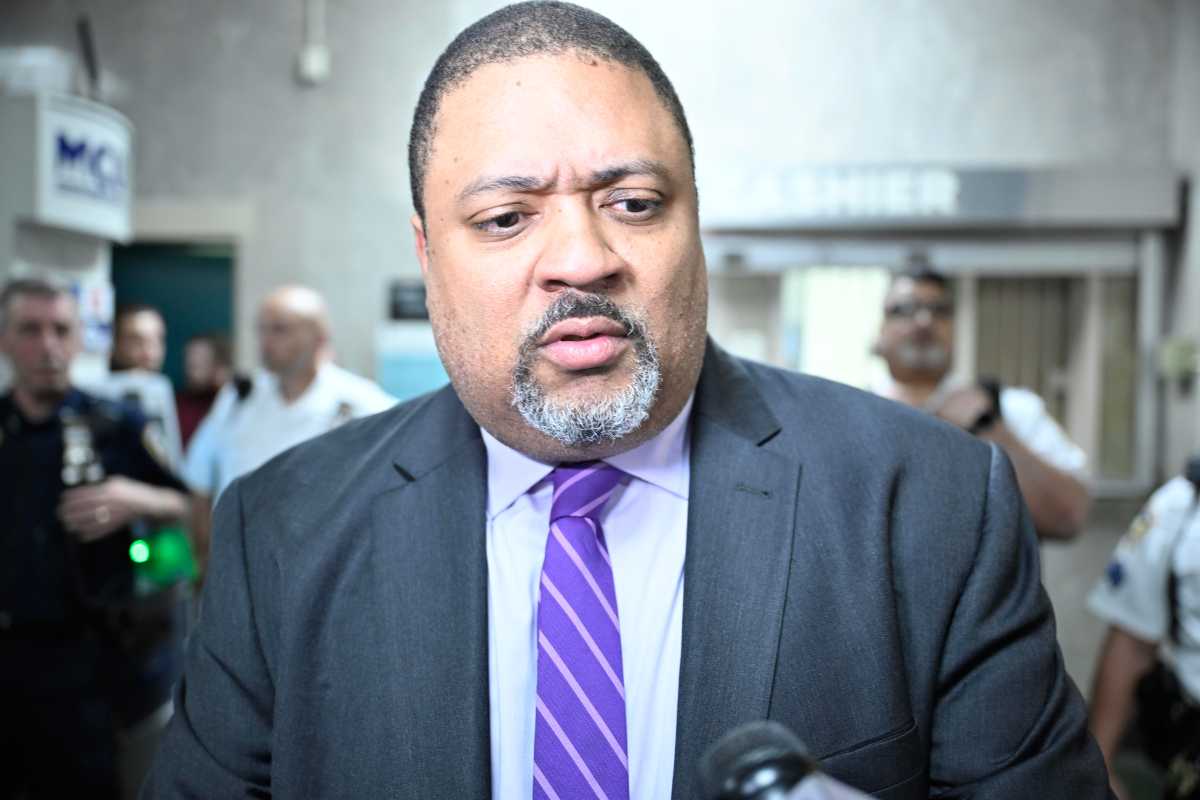
Manhattan District Attorney Alvin Bragg started off 2025 with rocky news. After his successful hush money case against Donald Trump, the president was sentenced to an unconditional discharge.
The case made him into the highest profile district attorneys in the country and a boogeyman for conservative pundits.
It also teed Bragg up in overwhelmingly Democratic Manhattan for a strong shot at reelection after a first term marred by controversy and numerous calls for the governor to take the extraordinary step of removing from office. After easily defeating tough-on-crime candidate Patrick Timmins in this year’s Democratic primary, he coasted to a second term after winning a three-way general election race with 73% of the vote.
“I love democracy,” Bragg exclaimed on election night as the result came in showing him the winner at the Harlem Tavern on election night.
Throughout his tenure Bragg has shown that he can take a hard line on violent crime. In an interview with amNewYork Law earlier this year, Bragg described the city’s public safety as his “North Star,” citing his efforts to curb violence and street crime.
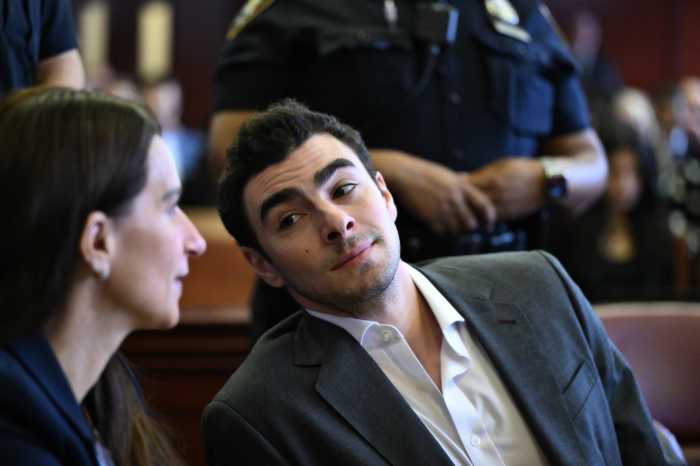
His profile is unlikely to fade over in 2026 as his office continues its prosecution of Luigi Mangione, who stands accused of gunning down UnitedHealthcare CEO Brian Thompson outside the New York Midtown Hilton in Manhattan.
The starpower of his office, along with a stabilizing level of violent crime in the borough, allowed Bragg to draw a wide margin of electoral support for a first-term that was defined by a set of new progressive policies and a hard line on violent crime. His reelection motto: “safety and fairness.”
In the general election, he trounced both the Republican candidate, Maud Maron, who received 21% of the vote, and the independent, Diana Florence, who received 6%.
Bragg’s re-election cakewalk might have been difficult to foresee back in 2022, a decidedly turbulent first year for his tenure. Just three days after taking office, Bragg released a “Day One Memo” distributed to his office indicating he would stop prosecuting a host of low-level crimes and that he would not seek bail for others, drawing swift backlash from critics and fueling suspicion that the newly minted DA would be soft on crime as homicides and shootings were on the rise in the Big Apple.
In February 2022, Bragg backtracked on some of the directives laid out in the memo. But that same month, he faced fresh controversy when the lead prosecutors in his office’s investigation into Donald Trump’s business practices resigned after Bragg expressed doubts about chances of success in a case against Trump.
Bragg’s office ultimately prosecuted Trump on 34 counts of falsifying business records and won a jury conviction. Throughout the jury trial — and in the aftermath — Bragg weathered racist attacks from Trump and death threats from his supporters.
And throughout Bragg’s term, there were numerous calls for Gov. Kathy Hochul to remove the Manhattan DA from office, including from some in his own party. Tom Suozzi, who unsuccessfully challenged Hochul in the 2022 Democratic gubernatorial primary, made a campaign promise to send Bragg packing.
But Bragg soldiered on. And with steadily declining rates of violent crime over the past three years, by 2025, Bragg had numbers on his side to rebut his critics.
“Now we’ve had a body of work that shows, for example, Manhattan has had two years in a row of index crime being down, and the beginning of this year following course,” he told amNY in a wide-ranging interview in March.
Over the summer, amNY Law also got a chance to look behind the hood of one of Bragg’s signature policies, the Post-Conviction Justice Unit, which reviews past cases prosecuted by the Manhattan DA’s office for evidence of misconduct and wrongful convictions.
Bragg established Manhattan’s PJCU — the fifth in New York City — soon after he came into office in 2022. The unit has grown to a staff of 14 and has successfully reversed 13 convictions, including seven homicides.
The unit uses advances in technology and new consensus over faulty police methods to investigate cases where years later the convicted is still claiming innocence.
In so doing, it avoids a punitive form of justice some would expect from a district attorney. Terri Rosenblatt, the unit’s former chief who led the unit’s creation and now works as its general counsel, said that it fits within the conceptual frame of what a DA’s office should be doing.
“It fits in quite naturally to the work of any prosecuting office,” Rosenblatt told amNY. “Our mandate is to do justice and to do the right thing and to follow the facts. And that’s no different whether you’re investigating an open case or whether… you’re investigating a credible claim of wrongful conviction or innocence.”