

The story of Elise Stefanik’s political rise and fall is a parable of a young woman’s all-consuming drive for political stardom and her crushing downfall at the hands of a despotic tyrant.
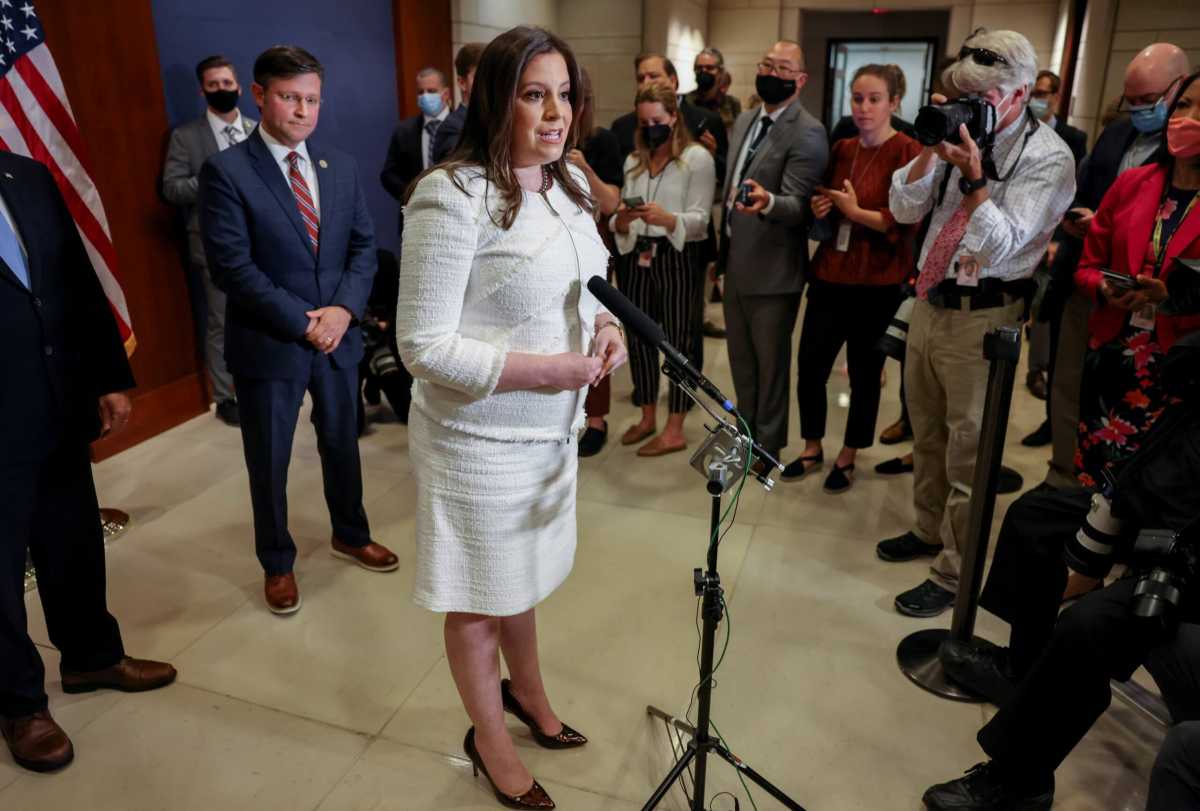
Stefanik was the youngest woman elected to the U.S. House of Representatives. A Harvard educated liberal with political ambitions, she was skilled at impressing people with her intelligence and work ethic. She made herself into a moderate millennial Republican who played down her support for abortion rights and gay marriage to attract voters in her upstate conservative New York district. She was elected in 2014 at the age of 30 with a slogan about “new ideas and new generation of leadership.”
Stefanik was regaled by the Republican party’s national establishment. She was profiled in Glamour. She was admired for her brains and diligence by a new crop of young Republicans elected to Congress. Local papers reported that admirers had registered SrefanikForPresident.com and other Stefanik domains.
She detested Donald Trump. She thought the man was too awful and ridiculous to be taken seriously as a candidate for president in the 2016 election. She thought the release of the “Access Hollywood” tape in which Trump talked about groping women was horribly offensive and she drafted a statement calling for him to drop out of the race. She planned to vote for John Kasich in the primary. She said she could never vote for Trump. After Trump won she expressed shock and worry.
During Trump’s first two years as president, Stefanik supported most of Trump’s initiatives but voted against his tax cuts and funds for the border wall. She also supported climate initiatives and legislation providing a path to citizenship for “Dreamers,” young immigrants brought to America as children. She strongly disapproved of Trump’s denunciation of immigrants coming from “shithole” countries.
But as Trump’s presidency evolved Stefanik found herself somewhere in the middle — seen by many as a rising star but unsettled by the behavior of her harder-right colleagues. Although she was increasingly frustrated and unhappy, she saw validation in winning the 2018 midterms by the largest margin of any Republican in New York. She thought about positioning herself as a bipartisan leader. Still, she knew the president’s hard-right base was ascendent.
An unusual event gave her an idea for the future. Trump joined her at the military base at Fort Drum, in her district, to mark the signing of the defense bill. Trump heaped praise on her work. For the moment she tasted the influence she dreamed about.
And Stefanik decided to make another radical transformation. Trump’s first impeachment hearing was upcoming, and Stefanik planned to defend Trump. She argued that Ukraine received the money it was promised and there was no investigation of Biden. But her sharpest attacks were on U.S. Rep. Adam Schiff, a California Democrat and chair of the Trump impeachment panel, whom she continued to berate with theatrical objections.
Stefanik’s friends and mentors hated her performance. But Trump loved it. Huge amounts of money flooded into her leadership PAC, and she now had a nationwide base of MAGA fans. Stefanik became a rising star with visibility and power. She even got to fly on Air Force One with Trump. She was ubiquitous on Trump’s social media platform. And when Trump lost the 2020 presidential election, she was one of the first officials to support his lie that the election was stolen. To former friends Stefanik had lost her way; she had chosen personal ambition over the values she had lived by. But she saw the brightest future as an ultra-MAGA acolyte of Trump. There was even talk of her joining Trump’s 2024 ticket as vice-president.
Loyalty to Trump paid off. With Trump’s patronage Stefanik was ascendent. After Trump’s election in 2024, Stefanik became third most powerful official in the House of Representatives. She saw herself in a cabinet post. Trump nominated her to serve as U.N. ambassador.
But suddenly things went terribly awry. She had climbed to unimaginable heights. Now came the fall. First, Trump wanted to preserve the razor thin Republican majority in the House and yanked her nomination to the U.N. Second, Trump dismissed Stefanik’s incendiary rants about New York Mayor-elect Zohran Mamdani as a “jihadist” and heaped praise on Mamdani. And third, after Stefanik announced she would run for governor of New York, Trump, who notoriously doesn’t like to support losers, refused to endorse her in the Republican primary.
After these public humiliations, Stefanik announced she’s finished with Congress and won’t seek reelection.
What is the moral to this pathetic story. Only an ignoramus or Trump cultist would be unaware of the risks of sucking up to a despicable tyrant who demands loyalty and then throws you under the bus. Maybe Stefanik thought she was special. She wasn’t.
To Stefanik’s former friends and mentors: Ambition often annihilates ideals, morality, and integrity. It’s in Shakespeare. Read it. Or just follow American politics.
Stefanik willingly sunk herself into the mud of Trump’s corrupt swamp. And she paid the price. Don’t cry for her.
Bennett L. Gershman is a distinguished professor at the Elisabeth Haub School of Law at Pace University