



Luxury real estate brokers and brothers Alon, Oren and Tal Alexander have been on trial for sex trafficking and assault in Manhattan’s federal court for a month. Their attorneys have been using that time for lengthy cross-examinations, pressing victims on timelines of alleged assaults and what they said to the brothers afterward, pushing back against evidence the men drugged or raped anyone by painting them as party boys who simply “liked hooking up” with women and requesting the judge grant their clients a mistrial.
So far, cross-examination of roughly a dozen victim witnesses by the Alexanders’ high-profile defense team — which includes attorneys who defended Sean “Diddy” Combs — has centered on diminishing the credibility of women accusing their clients of rape.
“They’re nitpicking every little thing to try to find an inconsistency, to have an ‘aha’ moment,” said Thomas Giuffra, who’s represented women in civil sexual assault and trafficking suits against Combs and Harvey Weinstein. “They’re trying to create reasonable doubt in the jury’s mind.”
For example, attorneys questioned one witness — who accused Alon and Oren Alexander of drugging, raping and assaulting her and her friends during a 2017 trip they took to Aspen, Colorado, in their senior year in high school — on how the time and altitude differences between Aspen and their hometown, Philadelphia, may have made the girls feel tired and act differently than they otherwise would have.
Defense attorney Deanna Paul pressed another witness — who said Tal Alexander and another man drugged and raped her in the Hamptons in 2011 — on the fact that she provided additional information to the government each time she met with prosecutors, allegedly not sharing exact details on the physical act of rape until the weekend before she testified.
“You want to show that their story changed over time,” said Steven Greenberg, a criminal defense attorney who worked on R. Kelly’s sex trafficking case in the Eastern District of New York. “If this is such a traumatic event, it’s burned into your memory. Wouldn’t you tell the government what happened when you first talked to them? If their story keeps changing, or gets more and more details … It’s usually the only impeachment you have in these cases.”
Another line of questioning the defense team has employed to question the victim’s credibility has been on why the women didn’t contact the police immediately after the alleged assaults — and why some remained in contact with the brothers afterwards.
In the case of the witness who testified about a Hamptons assault, Paul pressed her on why she didn’t run to the police after what she called a “horrible” assault — especially because the witness said she saw two girls who told her they were 14 years old walking into the Hamptons house who said they were there to “take her place” as she was leaving.
“You saw these girls talking to the man you say brutalized and raped you … and you didn’t think it was important to call the police?” Paul asked, continuing with: “In 2011, you were not moved to come forward due to [seeing the girls], but were in 2024?”
“I just wanted to get out,” the witness responded.

When questioning Avishan Bodjoud, a woman who said she saw the brothers and other men rape a woman in a jacuzzi when she traveled to the Hamptons with them in 2009, defense attorneys asked why she didn’t tell anyone, and instead only wrote “rapists” and “you need to apologize” on the house’s doors and walls in eyeliner, the only writing tool she had on her.
Bodjoud said she had been intimidated out of reporting the assault by a friend of the Alexanders, who called her and directed her not to go to the police, adding through tears that she’d hoped her hurried graffiti would be “used as evidence” one day.
A third victim witness testified that Tal Alexander brutally raped her in a shower until she bled when she took him up on a 2015 offer to fly from Nevada to the Hamptons. Defense attorneys suggested through a line of questioning that nothing untoward had really happened, since the witness texted him after the alleged assault that the weekend was “fucking amazing.”
That witness said she remained polite afterward out of fear that Tal Alexander was wealthy and powerful enough to “ruin” her life if he suspected she’d report the rape.
Some prosecutors say witness impeachment of alleged sexual assault victims isn’t always the most convincing approach to jurors anymore. Societal consciousness surrounding believing rape victims is shifting, and people understand how few assault victims report attacks immediately. It’s also common for trial jurors to hear from experts who testify that people regularly act in ways that seem “irrational” after experiencing assault.
“I think that as a society, we have really evolved, especially since ‘Me Too’ … We understand more about sexual violence,” said Shea Rhodes, a Villanova Law School professor and national expert on sex trafficking statutes. “There seems to be more of a general cultural understanding that it happens to people, and we should believe survivors … The defense’s strategy could backfire.”
Rhodes and other legal experts emphasized that the number of people who run to police to report rape is incredibly low, and society tends to understand that people who experience trauma typically don’t remember every detail of it because they’re focused on survival.
Two of the women testifying said they’ve filed civil suits against the Alexanders, but both have denied doing so because they’re out for the brothers’ money, an argument defense attorneys made in their opening statements. One noted her father is a billionaire, and the other said she’d put anything she won toward a foundation to support women who are victims of sexual assault.
Marathon cross-examination
Defense attorneys’ cross-examinations have frequently exceeded three hours.
Throughout the roughly five-hour cross-examination of the witness who described the Hamptons assault, she repeatedly told defense attorneys she was trying her best to answer their questions and didn’t want to come off as “not being truthful,” it was just “difficult” for her to respond.
“I’m sorry if I’m not answering your questions,” she said through tears at one point in her testimony. “It’s not a very easy thing to talk about …When you’re drugged and raped, there’s flashes of memory. Your body is melting.”
U.S. District Judge Valerie Caproni has made it clear the lengthy cross-examination is annoying her. She’s repeatedly admonished the defense team for the length of their questioning, going so far as to suggest their strategy is not only ineffective, it’s hurting their clients.
“I beg the defense to think about their cross,” Caproni said after the jury left the courtroom one day. “You’re spending a lot of time on things that just aren’t moving. I don’t think they’re moving the jury.”
Telling attorneys “less is more,” almost every day, she’s repeatedly said she hopes to understand the value of the extensive questioning by the time closing arguments are made. Giuffra said the value may simply be “wearing down” witnesses until inconsistencies show up in their stories.
“When you have a witness on the stand for that long a period of time, they get tired,” Giuffra said. “They don’t think their answers through as well as they would, because they just want to get it over with.”
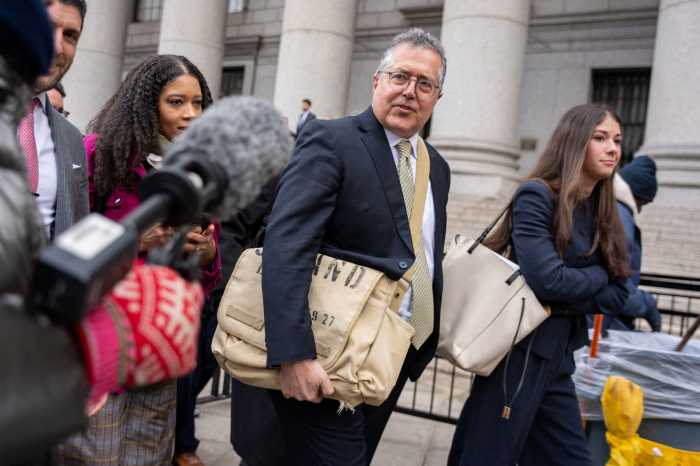
Jason Goldman, an attorney who represents the Alexanders in civil litigation, told amNewYork Law that lengthy questioning is both necessary and expected in trials like this one.
“You have to think about the significance of this trial, and the significance of only having one shot to question a witness. Once they’re off the stand, they’re gone,” Goldman said. “How could you be rushed? Every cross-examination could be the most important one.”
However, experts also emphasized that while making a point during cross is important, it can be even more important to know when to stop, as not to lose the jury. Greenberg said he found it surprising the defense had been crossing witnesses for so long.
“There’s all different styles of cross-examination,” Greenberg said. “There are people who think that cross-examination should be a series of nitpicky little questions that lead up to your main point. There are people who think that cross-examination should be ‘get in and get out,’ especially if you have a witness that could be very sympathetic to a jury or is very emotional.”
For witnesses testifying against the Alexanders, Greenberg said he’d think defense attorneys would want to make their point and move on to prevent questioning from feeling redundant or rude.
“How many questions can you actually ask about a sexual encounter before you look like you’re abusing somebody who probably is going to come across as sympathetic to the jurors?” Greenberg said. “You can push for a little bit, but it doesn’t take long for the jurors to get the point. And, if you go on too long, jurors get bored, and it loses its effectiveness.”
Goldman agreed, adding he’s found juries typically fixate on just a few major issues — and there can be an advantage to ending a cross-examination early if jurors are starting to tune out.
“You really physically have to keep half an eye on the jury to see what their engagement level is at,” Goldman said. “You never want to ask one question too many.”
Mistrial?
The defense has made multiple requests for a mistrial, citing the Alexanders appearing in a February release of the Epstein files possibly prejudicing the jury against the brothers and a juror who made up his mind midtrial (and was subsequently dismissed) as reasons why the case should be tossed.
Caproni has denied the requests, which experts said were likely made with the goal of bolstering the appellate record, more than anything else.
Mistrials are typically a goal of a defense attorney, legal experts told amNewYork Law, because it’s incredibly hard to try a case twice, especially one that involves dozens of witnesses, many of whom are traveling to New York from across the country, and who must give emotionally difficult testimony.
“Trying a case a second time never benefits the prosecution,” Greenberg said. “Witnesses never want to come back and do it a second time. And, it makes it easier to work out a deal.”
The way jurors have been dropping off — some for sickness, some for personal reasons, the one who was let go after he’d made up his mind during testimony — coupled with an estimated two weeks or more of testimony and arguments, the Alexanders’ team may get one by default, some experts told amNewYork Law.
With over two weeks of trial still ahead, there is one alternate juror left.
“They’re gonna run out of jurors,” said Steven Greenberg. “That’s the way it looks.”

Others aren’t so sure jurors dropping off the case will lead to a mistrial.
“I always get worried when you start running out of jurors,” Giuffra said. “But at this point, these people have stayed the course, and hopefully they want to see it through.”
Caproni seems to feel at least some anxiety over the loss of jurors, saying she was loath to lose another when dismissing a woman stuck in Miami after the blizzard Tuesday morning. The judge has urged jurors to do everything they can to remain available.
“Please stay safe and healthy and avoid getting sick,” Caproni told the jury. “We need you all.”
What the defense case will look like
After the government wraps up its case, the Alexanders’ defense teams will get a chance to bring forward their own witnesses and evidence.
But first, defense attorney Howard Strebnick, who represents Alon Alexander, will give his opening statement to the jury — he opted to reserve his remarks for the start of the defense case, while his counterparts representing Oren and Tal Alexander opened on the first day of trial.
Seth Zuckerman, who’s defended filmmakers in sexual assault cases, said that’s a tack he’s seeing more of in cases with multiple defendants.
“I really love that strategy, because he wasn’t going to say anything different from what the other two attorneys said, and now he gets a chance to make his opening statement at the conclusion of the prosecutor’s case,” Zuckerman said.
After Strebnick opens, defense attorneys are expected to call witnesses who will speak positively about the Alexanders’ character, along with evidence like text messages and emails between the brothers and alleged victims, as they seek to argue all of the sexual encounters were consensual.
Beyond that, experts agree defense attorneys will do everything they can to convince the jury the Alexanders were simply rude, not rapists.
“These brothers were womanizers,” Zuckerman said in predicting how defense attorneys may use the last days of the trial to sway the jury. “I think we’re going to see a lot of acknowledgement that they may not be great guys … They used crass language, but they didn’t drug anybody, and they didn’t rape anybody.”
The trial is expected to wrap up in mid-March.