

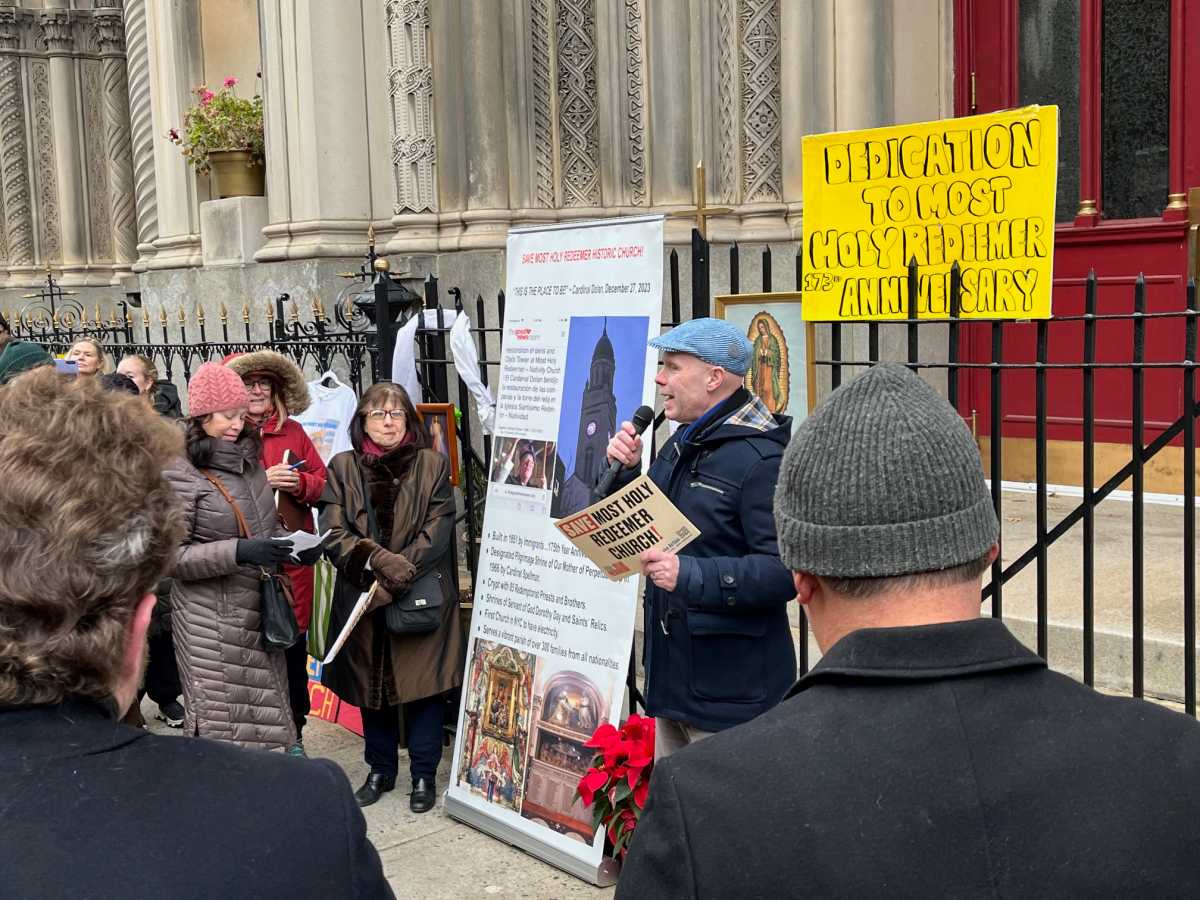
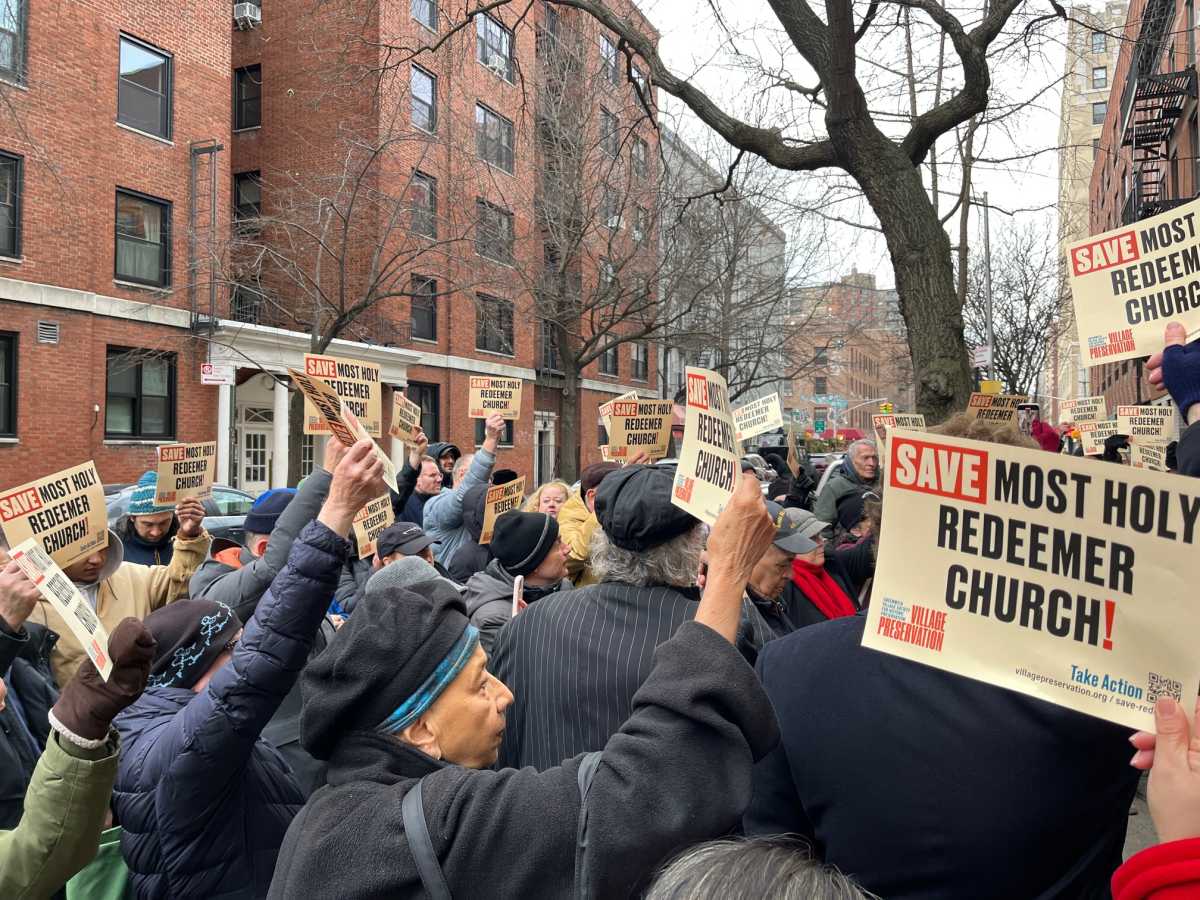
Around 100 parishioners, preservation advocates, and East Village residents rallied on Sunday to oppose the cessation of services and the potential sale of the Most Holy Redeemer Church.
Those seeking to preserve the building and continue religious uses held up a sea of signs, seeking to save the church that some described as one of the East Village’s “oldest and most prominent churches” as well as at one point one of the city’s tallest and largest at 250-feet tall, although it is 232-feet today.
They are also making a push to get the New York City Landmarks Preservation Commission to declare the 1851 structure, altered in 1913, a landmark, which would, except in very rare circumstances, prevent its demolition.
The Archdiocese of New York had previously stopped holding Masses and other services in the church, at 173 East 3rd St., and took steps to combine that church’s congregation with that of nearby St. Brigid’s.
This is one of at least two Catholic churches in Manhattan, including Our Lady of Guadalupe, located at 229-231 West 14th St., where an effort to obtain landmark status has begun to prevent the possible sale and demolition.
The Archdiocese of New York did not reply to calls and emails from amNewYork seeking information and, parishioners said they have not received responses to letters expressing concern.
“They’ve stopped services there, which is a clear indication from prior experiences in the neighborhood and elsewhere that they are moving toward ending use of the church for church purposes,” said Andrew Berman, executive director of the Greenwich Village Society for Historic Preservation also known as Village Preservation.
Parishioners, the East Village Community Coalition, the Lower East Side Preservation Initiative and Village Preservation are leading the effort to keep the church, arguing that consolidate the Most Holy Redeemer and St. Brigid parishes was merely an effort to sell one church, and allow for the construction of a new development in its place.
“Typically, they then sell off the property,” Berman continued. “I suppose by some miracle, the property could be sold to someone who will want to keep operating the church structure and keeps the building. In all likelihood, the entity that buys it would want to tear it down.”
Berman said hundreds of people, including a large number of parishioners, have been seeking to save the church from a possible sale.
“There is a very active congregation who doesn’t want to see this building destroyed and stop serving as a church,” Berman continued.
Executive Director of the East Village Community Coalition, Laura Sewell, said the Archdiocese has not replied to requests for information.
“The parishioners have received no response to individual certified letters or hand-delivered letters from the Committee to Save Most Holy Redeemer,” Sewell said.
The Parish of Most Holy Redeemer was founded in 1844 by German-speaking missionaries serving New York City’s German immigrant population, according to the church’s website.
The current church was designed by Munich architect Joseph Walch and construction was completed in October 1851.
A Catholic publication at the time called Most Holy Redeemer “the most beautiful and largest (church) in New York” which soon became known as “the German Cathedral of the Lower East Side.”
Most Holy Redeemer was consecrated in November 1852 by Archbishop of New York John Hughes and the Pontifical Mass was celebrated by Archbishop of Philadelphia John Neumann.
Archbishop Neumann, in 1977, was canonized by Pope Saint Paul VI as the first male citizen of the United States to be elevated to the status of a saint.
Most Holy Redeemer on Feb. 18, 1894, became one of the first churches, if not the first, to have electric lighting installed and became known as a church serving recent immigrants to New York City.
“During its first fifty years, the Church of the Most Holy Redeemer succeeded in being a spiritual refuge for the German population of New York’s Lower East Side,” according to the church’s website. “The parishioners of the church, many of whom still suffered from prejudice against immigrants, looked to the church as the center of their life.”
The Archdiocese has combined church congregations before, including Our Lady of Gaudalupe on West 14th St., which combined with nearby St. Bernard in 2003.
Village Preservation along with others submitted a request to the Landmarks Preservation Commission regarding landmark designation for our Lady of Guadalupe, supported by various elected officials, scholars, parishioners and New Yorkers.
The Landmarks Preservation Commission has said that, based on documentation, they believe that Our Lady of Guadalupe “may merit” consideration for landmarks preservation.
“That is not a commitment to do so,” Berman said. “We have many cases where they said that and failed to act.”