


BY ZACH WILLIAMS | Activists were both emboldened and validated, when criminal charges were filed on May 1 against the six Baltimore police officers involved the death of Freddie Gray — a black man who later died from injuries sustained while in custody.
Two days before the charges were announced, the NYPD moved quickly to answer challenges by those who took to the streets of Manhattan during an April 29 march in solidarity with their counterparts in Baltimore, where peaceful protests and looting alike overwhelmed law enforcement before the deployment of National Guard troops and the implementation of a curfew.
Demonstrations which began in Baltimore following Gray’s death on April 19 returned #BlackLivesMatter to the national spotlight, once again sparking debate about everything from racial profiling to the militarization of police departments to chronic unemployment and income inequality.
“Baltimore has definitely re-awakened the movement that was in the streets every day last year in response to the murders of Mike Brown and Eric Garner,” said Larry Holmes, a neighborhood resident and organizer with the Chelsea-based Peoples Power Assemblies.
“This could be a long hot summer,” he added.
The resurgent movement, however, must contend in New York City with a police department which displayed little patience on April 29 for protesters who did not demonstrate under their terms.
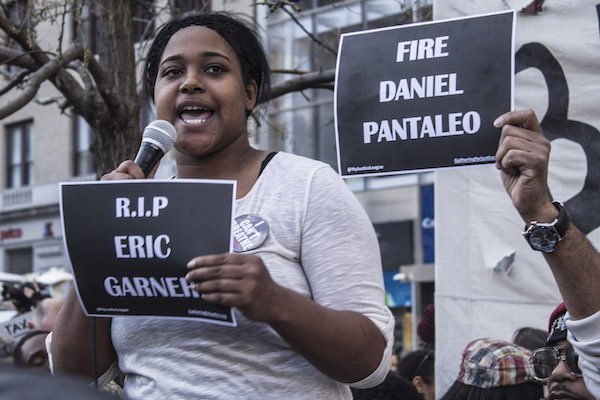
Police gave ample warning via loudspeaker and leaflets that anyone marching in the street would be subject to arrest. But activists were vocal in their intention to test them. Barely two weeks after a South Carolina officer gunned down Walter Scott after a traffic stop, family members of Eric Garner and Akai Gurley — two unarmed black men killed by NYPD officers last year — led the way in saying the status quo should change.
“The injustice that has been prominent against black and brown lives in urban communities must end. NYPD and all police departments worldwide have unjustified preconceived attitudes and opinions towards black and brown lives, and their work is unacceptable and they must be held accountable,” said Hertencia Petersen, Gurley’s aunt.
Many there also desired to challenge prominent media portrayals of looting and violence in Baltimore. Events there need to be considered in context, especially from the viewpoint of young people unsure as to how best to vent their anger, activists said.
“Certain parts of the media just portray our African-American brothers and sisters as criminals and thugs and n—rs, and just looting and messing up the community. Yes, (rioting is) wrong but that’s one of our ways of expressing how we feel,” said Harlem resident Taven Gibson, 23, on April 29.
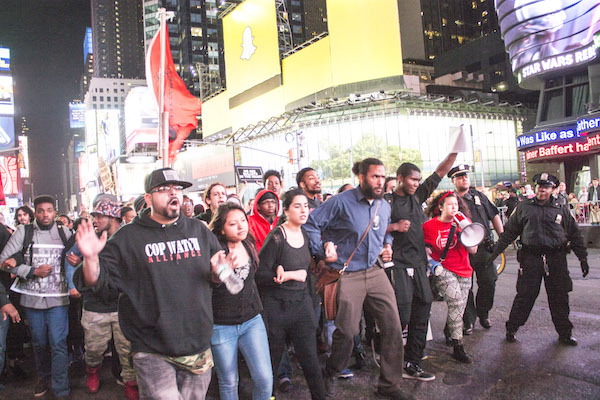
But their enthusiasm only took them a few hundred feet in a march from the square along W. 17th St. before police moved in, arresting perhaps a dozen people and leaving the crowd of about 1,000 people segmented. Bands of protesters were nonetheless willing to try again. One group of about 100 marched through Chelsea with a heavy police accompaniment before meeting with several hundred remaining protesters in Times Square. Scuffles broke out as the combined group sought to take the southbound lanes of Seventh Ave. but each time the police pushed them back.
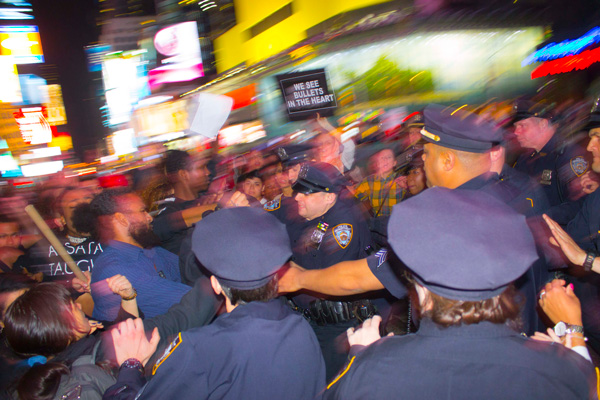
Attempts were also made during the night to block the Holland Tunnel and West Side Highway, common targets for civic disruption by #BlackLivesMatter actions late last year. In all, about 140 people were arrested on the night of April 29, including this reporter, whom police nabbed near the intersection of W. 43rd St. and Seventh Ave. while crossing the street as he photographed the scene.
At an April 30 press conference, Mayor Bill de Blasio defended the police response and dismissed as irrelevant his own 2013 arrest at a protest in support of a Brooklyn hospital.
“When the police give you an instruction, you follow the instruction. It’s not debatable,” he told reporters.
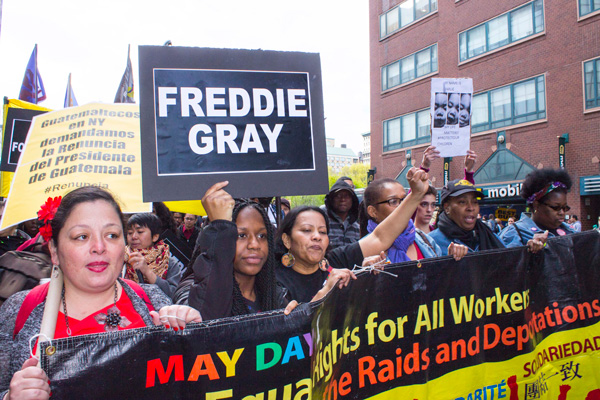
“May Day for Freddie Gray,” read signs at a demonstration the following day, where the annual holiday for labor and leftists served as the latest forum for #BlackLivesMatter activities — only this time in conjunction with a wide array of social, political and economic causes. The stalwart graying socialists mixed with anarchists and groups such as the CUNY Internationalist Club. Family members of Mexican college students kidnapped by corrupt police in cahoots with drug traffickers were just one set of speakers extolling the need for a society more tilted towards working class men and women.
“Most often, exploited workers are black and brown people. So what you have here is people for different causes all coming together for one central purpose, so I think this year, the theme incorporates all the different causes. But I think we are all here because black lives matter and that’s been the thread for the last several months,” said Elsa Waitha of Brooklyn.
This time they did not need to contend with police backlash while marching, as the event had secured a permit beforehand. A three-block-long procession began forming along E. 14th St. as they moved in-between an enormously long line of metal barricades set up for the occasion. Though such an arrangement was not as radical as two days before, tensions were also much lower between activists and the large police detachment, which chaperoned them to Foley Square downtown.
Their signs and slogans still demanded that the NYPD change its ways, including the perception (and reality to many) that enforcing the law in the city often means focusing on the activities of people of color. Just the day before, NYPD Commissioner Bill Bratton defended the “Broken Windows” style of policing through a 41-page report outlining its purported successes in lowering crime rates citywide.
Low-level lawlessness represented by the metaphor of a broken window invite more crime, states the report. Serious criminals, meanwhile, can often be caught when they commit crimes such as turnstile jumping, the report adds before acknowledging that changes could be made to improve police practices. Bratton said in an April 30 speech at the Police Academy in Queens that there is room for compromise with city council members who seek to decriminalize some petty offenses, according to media reports.
Some activists, though, are more focused on supporting a social revolt against the powers that be by people of color in collaboration with Caucasian allies who agree that police violence is just one manifestation of white privilege.
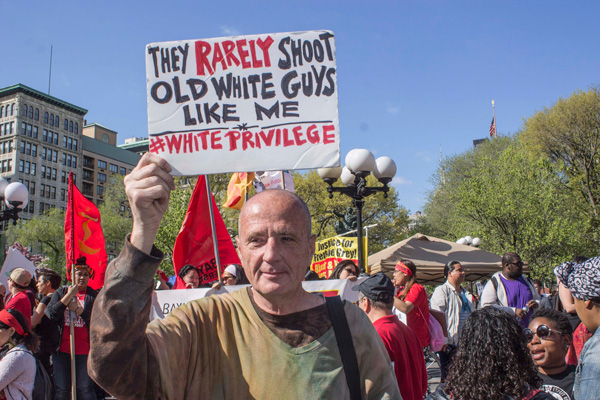
“They rarely shoot old white guys like me,” read the sign of East Village resident Steven Shryock at Union Square on May 1. He said in an interview he directs that message toward his racial counterparts.
“A lot of people like the sign, but a lot of people, especially white people my age, say I’m full of s—t because ‘there is no such thing as white privilege’ and that kind of stuff…right now there is so much denial,” he said.
The proclivity of police officers to notice the transgressions of people of color while ignoring those of whites was in full display in Baltimore, according to Imani Henry — who, along with Holmes and about 17 other activists from the Peoples Power Assemblies, ventured to that city on May 2. They visited the site in a poor area of the city where police arrested Gray and participated in one of the demonstrations occurring that day. But as the 10 p.m. curfew in the city persisted its final night, activists found yet more opportunities to compare police treatment of white people and people of color.
A photo went viral online of a black woman lying in pain on a sidewalk, supposedly after being caught by police after hours. White #BlackLivesMatter supporters, meanwhile, shared photos on social media of themselves walking the streets of Baltimore unscathed.