


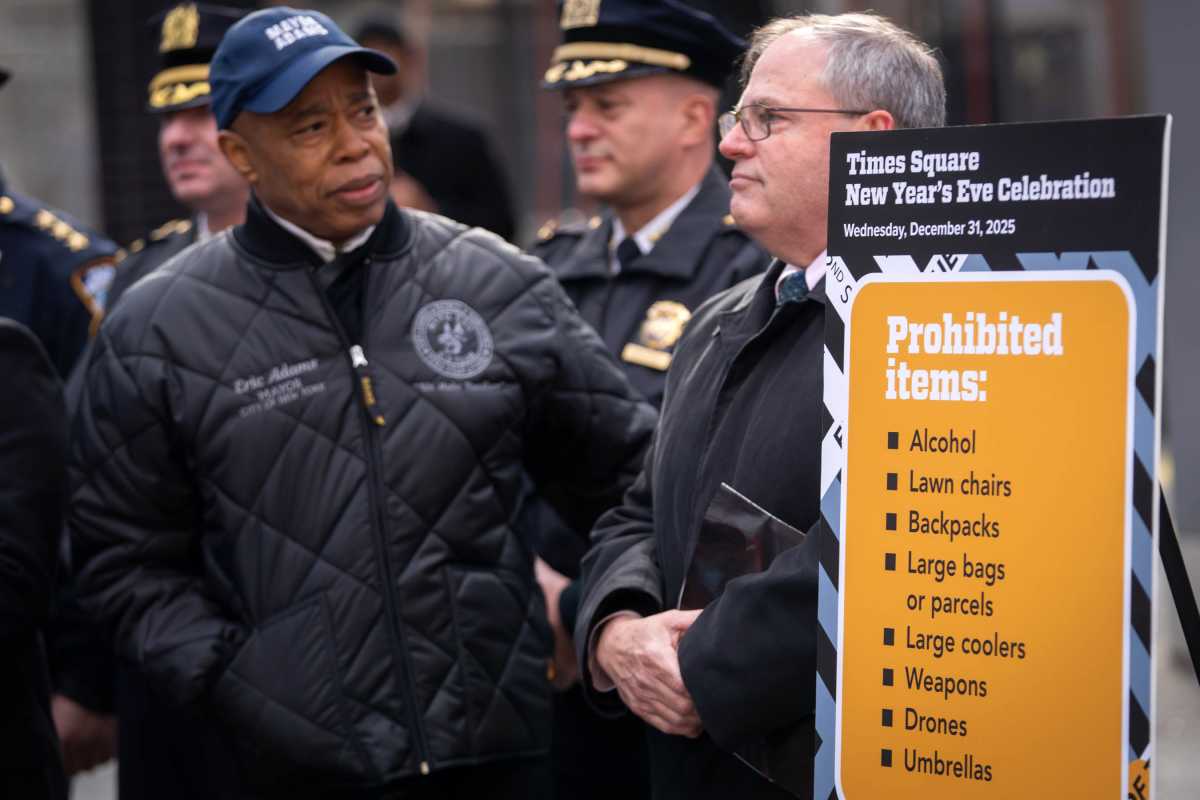
Outgoing Mayor Eric Adams turned the lights out on his four-year run at City Hall Wednesday afternoon by vetoing 19 bills passed earlier this month to protect workers, street vendors and immigrants, increase affordable housing in the city and reform the NYPD.
The last-minute vetoes occurred just hours before Adams’ four-year run as mayor ends; he gives way to incoming Mayor Zohran Mamdani at 12:01 a.m. Thursday.
A majority of those bills were pieces of significant, hard-fought legislation, including the Street Vendor Reform Package that was set to make over 21,000 additional vending licenses available and create a Division of Street Vendor Assistance to provide vendors with support and resources within the city’s Small Business Services Department.
In a statement, Adams said he was vetoing the bills because they ran “directly counter to [his] North Star of lifting up working-class New Yorkers,” as he believed they would “worsen” the affordable housing crisis, “undermine” small businesses “with an untested new licensing regime for street vendors” and “violate state laws governing our labor and law enforcement systems.”
It seems likely that the incoming City Council will override most of the outgoing mayor’s vetoes. All of the vetoed bills passed with a veto-proof majority, except Brooklyn Council Member Sandy Nurse’s Community Opportunity for Purchasing Act, or COPA, which squeaked by 31-10 after heated debate on the council floor.
Arguably the most controversial of the set, COPA would give local nonprofits first dibs on purchasing disenfranchised and low-income residential properties that have over five units. To override Adams’ veto, it will need 34 votes.
Both outgoing City Council Speaker Adrienne Adams and presumptive incoming City Council Speaker Julie Menin had choice words for the outgoing mayors’ actions, accusing him of prioritizing special interests and sidelining the legislative process.
“It is unsurprising that this mayor is ending his term by demonstrating, once again, that protecting and supporting working-class New Yorkers is not his priority,” Speaker Adams said in a statement. “His vetoes put special interests above greater affordability and opportunity for hardworking New Yorkers, and public safety…[and] continue his administration’s disregard for accountability, good government, and transparency that are necessary to improve public safety and ensure trust in city government.”
The outgoing speaker called the vetoed bills “sound policies” that the next council should defend. In her Wednesday evening reaction to the vetoes, Menin said that the council “will consider next steps” on the vetoes to ensure the body’s legislative priorities are upheld.
While last-minute, Adams’ vetoes were not necessarily surprises: the threat of them had loomed over the otherwise celebratory mood of the council’s last meeting of the year, where the notable legislation had been passed.
Other notable pieces of legislation Adams nixed in his final hours included a set of bills setting requirements for city-financed affordable housing, mandating at least 4% be for homeownership, at least 25% be two-bedrooms, at least 15% be three-bedrooms, 50% be affordable for very low-income households 30% be affordable for extremely low-income households.
He also shot down Queens Council Member Tiffany Cabán’s Safer Sanctuary Act, which would bar federal immigration authorities from having offices on land under the New York City Department of Correction’s jurisdiction and amend the city’s sanctuary laws to account for current federal immigration enforcement practices.
The first meeting of the council’s new legislative session will take place in early January.
Other high-profile bills Adams vetoed include those that would:
- Require co-op owners selling units to acknowledge a prospective buyer’s application within 15 days and inform the applicant of their decision within 45 days.
- Create a city land bank to acquire and manage vacant, abandoned, tax-delinquent, and foreclosed properties and allow the city to sell tax liens to it.
- Allow the city to issue street vending license applications until the licenses issued, not the applications issued, reaches the capped amount.
- Prohibit rideshare services like Uber and Lyft from deactivating drivers without reason.
- Require security guards working on city buildings be provided a minimum wage, paid vacation time and supplemental benefits that meet or exceed required compensation for private sector security guards.
- Require the NYPD get consent from a child’s parent, legal guardian, or attorney before collecting a DNA sample.
- Require the NYPD to provide the Civilian Complaint Review Board with officer body cam footage to investigate alleged police misconduct.
- Require the city to establish standards and procedures to determine conflicts of interest for city contracts over $100,000.