



Mayor Zohran Mamdani said Monday that his federal security clearance remains pending but is moving forward as expected, as his administration coordinates with law enforcement following the detention of Venezuelan President Nicolás Maduro in Brooklyn and his prosecution in Manhattan.
Mamdani was among several New York politicians who condemned the Trump administration’s unilateral decision to bomb Venezuela and apprehend Maduro and his wife, Cilia Florest, on a criminal indictment. Over the weekend, the new mayor described the operation as a “blatant pursuit of regime change,” calling it “an act of war and a violation of federal and international law.”
Maduro and Flores pleaded not guilty to narcotics trafficking and machine gun possession charges at an arraignment in Manhattan on Jan. 5, with Maduro telling a federal judge that he was “kidnapped” by U.S. military forces.
Mamdani said his greater concern at the moment is keeping the city and its large Venezuelan population safe. It is estimated that approximately 32,000 Venezuelans reside in the New York City metropolitan area.
Asked whether there had been any updates regarding the transportation plans of President Maduro between Brooklyn and Manhattan during federal court proceedings, Mamdani declined to provide specifics. Instead, he stressed ongoing coordination with law enforcement and a focus on minimizing disruption. The couple was transferred from the Metropolitan Detention Center in Brooklyn to Manhattan via helicopter on Monday morning.
Comparatively, during the 2018-19 federal trial of Mexican drug lord Joaquín “El Chapo” Guzmán in Brooklyn, authorities frequently closed the Brooklyn Bridge to transport him under heavy security.
“I continue to stay in constant communication with my police commissioner and the NYPD, and my job as the mayor of New York City is to ensure that any federal action has a limited impact on the day-to-day lives of New Yorkers,” Mamdani said.
At a news conference on Sunday, Mamdani stated that he did not yet have a security clearance, but that the process was ongoing, following remarks the day prior in which he had mentioned that senior members of his administration and his police commissioner had briefed him on the Trump administration’s decision to depose Maduro.
Asked Monday again about the status of his clearance, Mamdani said, “Everything is going according to a typical timeline,” and noted that the senior members of his administration who already hold federal security clearances from their prior positions are Police Commissioner Jessica Tisch and his chief counsel, Ramzi Kassem.
“I’m in the process of applying for that clearance, and I’m also thankful that there are senior members of my team that already have that clearance thanks to past positions that they’ve held. And so as a result of that, New Yorkers have nothing to fear about my ability to both represent our city and also to deliver for it,” Mamdani said.
In a 2014 oral history interview for Columbia University, Kassem recalled the bureaucratic slog of securing federal clearance while representing individuals detained in Guantánamo, an ordeal he said took nearly a year, far longer than usual, because of his travel history and dual nationality. Kassem, who would later serve as Senior Policy Advisor in President Joe Biden’s White House, emphasized that he did not treat the clearance process lightly, describing repeated, in-depth interviews with federal investigators and extensive follow-up questions about his background, associations, and loyalties.
“It was a very lengthy and intrusive process, but it’s what I expected and I’m happy to have paid that price,” he said. In the same interview, Kassem noted that while individuals have a legal right to apply for a security clearance, the ultimate decision rests entirely with the executive branch.
Courts, he said, do not intervene in clearance determinations, which are treated as an exclusive executive prerogative. Once the government has considered an application, it is under no obligation to grant clearance, and there is no judicial remedy if it declines to do so.
While the mayor of New York City is not a federal official, the position traditionally includes access to classified briefings on terrorism threats and other national security matters affecting the nation’s largest city. Following Mamdani’s election in November, a group of House Republican lawmakers attempted to intervene in the process, urging the Trump administration not to grant the new mayor a federal security clearance.
Mamdani’s pending clearance is not without precedent.
Former Mayor Bill de Blasio did not receive a federal security clearance until months into his first term, despite the position’s traditional access to classified briefings on terrorism threats and other national security matters affecting the city.
Former Mayor Eric Adams briefly lost some of his federal security clearance following his 2024 federal indictment.
According to a 2023 Congressional report by the Office of the Director of National Intelligence and the National Counterintelligence and Security Center, obtaining a federal security clearance can take several months. The report found that the average processing time for the fastest 90% of initial clearances was 125 days for secret-level and 172 days for top-secret, exceeding the government’s timeliness goals of 74 days and 114 days, respectively.
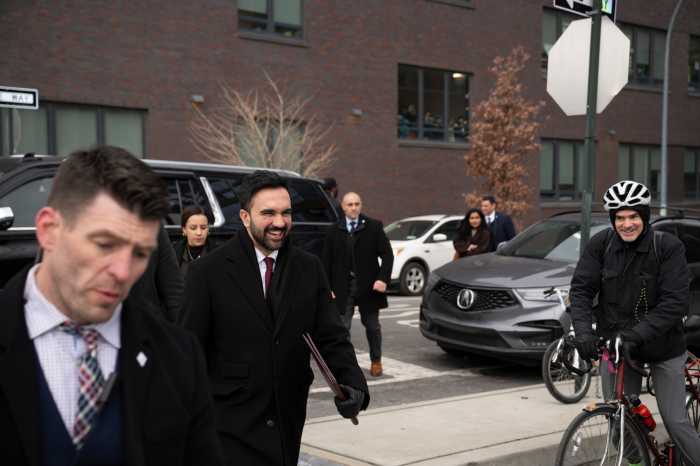
‘Commissioner Tisch not demoted’: Mamdani
Mayor Mamdani also sought to dispel online speculation that Police Commissioner Jessica Tisch had been demoted under a City Hall restructuring outlined in a day-one executive order, stating that the police commissioner continues to report directly to him.
“My police commissioner will continue to report directly to me,” Mamdani said at the same press briefing announcing two executive orders targeting junk fees and subscription traps. “The executive order is in terms of the question of coordination.
The executive order grants broad supervisory and coordinating authority to First Deputy Mayor Dean Fuilihan, including oversight of the NYPD and several other major agencies. Under the order, the first deputy mayor is tasked with coordinating agency operations, promoting collaboration among deputy mayors and ensuring consistency across city government.
Mamdani said the restructuring is intended to improve day-to-day coordination and management within City Hall, not to change reporting lines or diminish the authority of the city’s top cop. He compared the arrangement to that of the school’s chancellor, who also reports directly to the mayor while working within a coordinated management structure.
“This is about the daily minutiae of coordination, not about the question of reporting,” Mamdani said.
The executive order also authorizes the first deputy mayor to act on the mayor’s behalf in a wide range of fiscal, administrative and intergovernmental matters and to assume mayoral powers in the event the mayor is unable to perform his duties, consistent with the City Charter.