

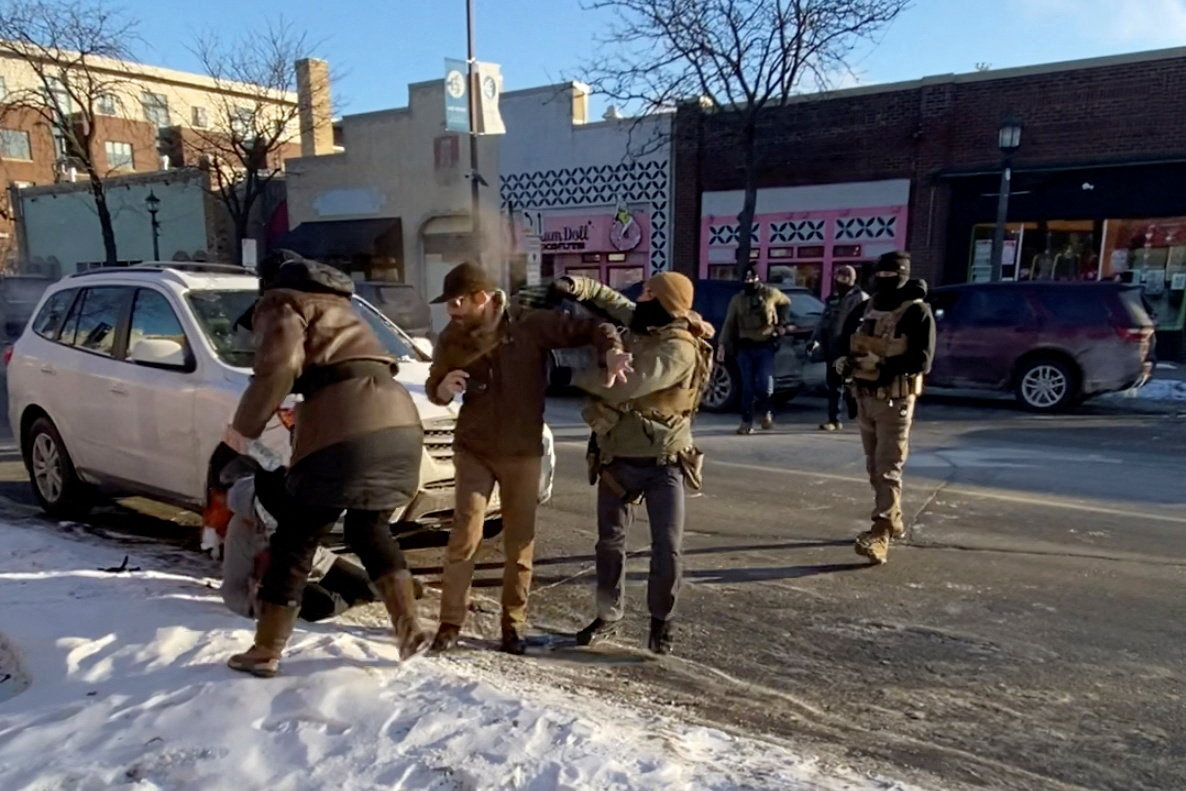
Rising from the ashes in Minneapolis is a smoldering question: who, if anyone, will investigate U.S. Homeland Security personnel allegedly responsible for the shooting deaths of Renee Good and Alex Pretti, along with other reported misconduct by federal immigration agents operating in the state?
Many critics argue that the U.S. Department of Justice has effectively disqualified itself. DOJ declined to pursue a civil rights investigation into Good’s death, and Deputy Attorney General Todd Blanche recently set conspicuously low expectations when he announced a federal inquiry into Pretti’s killing, warning the public not to expect “some massive civil rights investigation.”
Will state or local prosecutors step in? The Hennepin County Attorney’s Office is relatively small. The county attorney, Mary Moriarty, has been in open conflict with DOJ since last May, when DOJ announced it was investigating her policy of reducing racial disparities in plea bargaining. A former career public defender, Moriarty announced last August that she will not seek reelection. Free of political considerations now, she seemed to be the perfect candidate to lead the investigation.
Yet thus far, Moriarty’s response appears limited. According to press reports, Moriarty has asked the public to submit videos through an online portal, but little else has followed. Indeed, she was quoted in The New York Times last week saying, “We can’t stop what the federal government is doing.”
That is not entirely true.
If immigration agents committed crimes on Minnesota soil, they may be prosecuted under Minnesota law. The United States Supreme Court’s dual sovereignty doctrine permits state prosecutors to pursue their own investigations and charges — even where federal authorities decline to act. And beyond ordinary homicide statutes, Minnesota prosecutors possess a powerful and largely unmentioned tool: the Minnesota Racketeering and Corrupt Organizations Act.
Like its federal counterpart, Minnesota’s RICO statute was enacted to combat organized crime. But both state and federal RICO laws have outlived the mob wars of the 1970s. RICO has been used to take down street gangs, corrupt public officials, and, most recently, by Georgia prosecutors in 2023, when Fulton County charged Donald Trump and 18 others under that state’s RICO statute in connection with efforts to overturn the 2020 election.
Minnesota’s RICO statute permits prosecutors to treat a series of related crimes, committed by individuals associated with a common enterprise, as a single coordinated criminal operation. The law requires proof that a defendant: (1) was employed by or associated with an enterprise; (2) intentionally conducted or participated in the enterprise’s affairs; and (3) did so through a pattern of criminal activity.
If Homeland Security agents are employed by — or function as — an enterprise, and if they carried out their duties through a pattern of criminal acts, RICO can both punish both agents on the street and those in command positions.
There is a notable twist. Minnesota requires at least three qualifying criminal acts to establish a RICO pattern — more than federal law and most states, which require only two. Prosecutors cannot simply pile on offenses. Not every crime qualifies. The statute narrowly defines “predicate acts,” including murder, burglary, and threats of unlawful confinement.
Here, the deaths of Good and Pretti could supply two such predicates. A third may not be far-fetched. On January 20, the Associated Press reported that federal immigration agents forced their way into the home of a U.S. citizen in Minnesota at gunpoint, detained him without a warrant, and removed him from the premises. Could such warrantless home entries constitute burglary under Minnesota law — and thus a third RICO predicate?
If so, ICE agents could be treated as an “association in fact,” satisfying the enterprise requirement and opening the door to a sweeping state prosecution.
History suggests why this matters. The Pizza Connection case and the prosecution of John Gotti marked the beginning of the end of the Mafia’s grip on New York. In the 1980s, Queens Borough President Donald Manes and others were prosecuted under RICO for using a public entity — the New York City Parking Violations Bureau— to fix tickets and enrich insiders, bringing a corrupt political era to a close. RICO’s power lies in its reach.
Minnesota’s statute carries a potential 20-year sentence. Properly deployed, it is an effective tool that can halt brutality and corruption and have a deterrent effect that will undoubtedly cross state lines.
None of this would be easy. Federal authorities, some of whom could be targets, control much of the evidence. ICE agents will resist subpoenas. Claims of immunity will be fiercely litigated. Any state indictment would almost certainly trigger removal efforts to federal court, potentially placing the case before judges appointed by the very administration whose policies are under scrutiny.
Tough murder cases are ugly. People lie and witnesses can be intimidated, recant or even disappear. Prosecutors need to gather the available evidence and RICO may be an option, and a careful one. Serious consideration must be given to claims of justification that will undoubtedly be asserted by the “shooters” and other potential targets who should be given the opportunity to appear before a grand jury under waivers of immunity.
RICO may prove to be a “stretch” — and the kiss of death for a prosecutor is over-indicting a case or bringing a charge that passes legal muster but fails the jury’s “sniff” test. But the truth is RICO is a powerful option that should not be discounted or ignored. It’s not often employed in Minnesota but prosecutors should not go into battle with one arm tied behind their backs.
Douglas M. Nadjari, formerly a prosecutor in the Brooklyn District Attorney’s Homicide and Major Fraud’s Bureaus, is a partner at Ruskin Moscou Faltischek P.C. where he is a member of the firm’s health law, white collar crime and crisis management departments. He serves as co-chair of the Professional Discipline Committee of the New York State Bar Association’s Health Care Section and is an instructor at the Criminal Law Bootcamp at Tulane Law School.