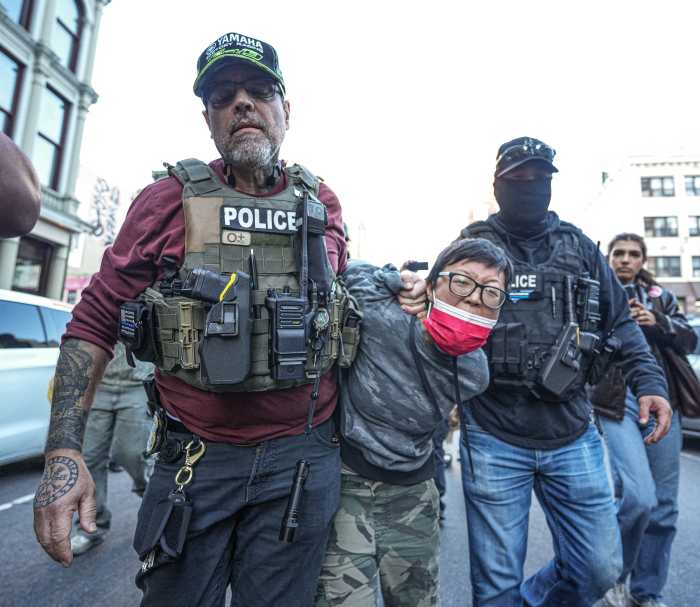



Federal immigration enforcement activities in Minneapolis ended tragically in January. Two U.S. citizens, Renee Good and Alex Pretti, were shot and killed in separate encounters weeks apart during operations involving Immigration and Customs Enforcement and the Border Patrol.
These deaths did not occur in a vacuum. They followed confusion in public spaces, blurred lines of authority and little timely information about which federal agencies were operating, under what directives or with what safeguards. For communities on the ground — and for officers themselves — the absence of transparency proved dangerous.
When the public cannot see how enforcement power is exercised, fear fills the space. Rumors outrun facts, parents keep children home, and witnesses hesitate to call the police. In neighborhoods marked by sustained enforcement, documented and undocumented residents alike withdraw from civic life, uncertain where authority begins and ends. Fear does not make cities safer; it makes them quieter — and more brittle.
The solution is not to abandon enforcement but to make it visible in ways that build public confidence.
New York City offers a model. Its Open Data Law (Local Law 11 of 2012) requires agencies to publish detailed datasets online in machine-readable form. Championed by Council Member Gale Brewer and signed by Mayor Michael Bloomberg, the law made New York the first major American city to mandate standardized data on a centralized public platform.
Policing statistics, inspection records, 311 complaints, school performance metrics and enforcement data are updated regularly and made publicly searchable. Residents can see where police stops occur, how long emergency response times take, how housing inspections are conducted and where public dollars flow.
But when immigration enforcement enters city streets, that visibility largely disappears. ICE publishes statistics on arrests, detentions and removals, but they are reported by fiscal year, meaning data labeled 2025 largely reflect conditions in 2024. Figures fluctuate until “locked” at year’s end and are released at least one quarter behind, with subsequent revisions superseding prior releases. The statistics are aggregated by large regional “areas of responsibility” — often spanning multiple states — rather than by neighborhood or municipality, and do not provide timely, localized information communities and policymakers can use to understand ongoing activity.
Federal reporting exists, but it is not structured as a standardized, real-time public platform comparable to New York City’s open data system. What is missing is standardized, publicly accessible information about where enforcement occurs, how long operations last, how many stops or detentions take place in a locality and whether force was used or non-targets were involved.
Congress should require the Department of Homeland Security to create a centralized, publicly searchable open data platform for immigration enforcement, modeled on the city’s Open Data Law. Accountability depends on contemporaneous details. Without these details, communities are left to imagine what they cannot see — and imagination rarely reassures. Fear isolates residents and shields misconduct from early scrutiny.
New York City agencies already publish operational data daily or weekly across multiple domains. Similar federal transparency would dispel confusion without compromising investigations. Basic information about immigration enforcement in public spaces — time, location, duration and type of encounter — can be anonymized and released with modest delay.
This is not a call to expose officers or endanger operations. Recent directives from the Department of Homeland Security have expanded body-worn camera programs and reinforced identification requirements during public-facing operations, and the Trust Through Transparency Act of 2025 would require their use in those encounters — an acknowledgment that documented authority protects civilians and officers alike. Cameras and identification deter misconduct and false accusations. But they must be paired with public insight into broader enforcement patterns.
Transparency protects civil rights and the rule of law. Publishing standardized data on arrests, detentions, transfers and use of force allows residents to assess whether enforcement aligns with stated priorities and to detect disparities across regions, demographics or protest activity — evidence journalists, lawmakers, officers and the courts can evaluate.
Journalists can report accurately, lawmakers can identify patterns before tensions escalate, officers can do their jobs with clarity instead of suspicion, and courts can evaluate enforcement against lawful, articulated objectives — protecting agencies when they adhere and helping victims seek recourse when they do not, grounding review in documented fact rather than after-the-fact assurances. Equal protection under the law requires evidence. If enforcement is lawful and proportional, data will show it; if it is not, transparency allows correction before tragedy multiplies.
The events in Minneapolis are not distant anomalies but warnings about what happens when power operates without visibility. Open data allows a democracy to watch power in real time — not only after the loss of liberty and life.
New York helped pioneer that principle, demonstrating that transparency is infrastructure, not ornament. The federal government should now adopt that same standard for immigration enforcement through a national open data framework that embeds accountability within the system itself.
Gale Brewer is a New York City Council member representing Manhattan’s 6th District. Michael Oliva is a New York based public policy and relations consultant.