


BY NORMAN BORDEN | Yes, “Steve McCurry: India” is a spectacular exhibition — but then again, Steve McCurry is a spectacular photographer. Best known for his iconic “Afghan Girl” image, which appeared on the cover of June 1985’s National Geographic, McCurry’s first exhibition at the Rubin Museum of Art (RMA) is an eye-opening retrospective of work from his more than 80 visits to the Indian subcontinent during the period of 1982–2014.
The show, which includes other iconic images as well as photographs never seen before by the public, coincides with the publication of McCurry’s new book, “India.” It’s also the museum’s first partnership with the International Center of Photography.
McCurry says that the publication of “Afghan Girl” changed his life — but in my opinion, some of the photographs in this show are just as memorable, including some from two of his previous books, “Monsoon” and “India by Rail.”
When McCurry visited India for the first time in 1978, he had only planned to stay about six weeks, but ended up wandering around the subcontinent for two years. He said he had no comprehension of India “until I stepped off the plane. I wasn’t prepared for the feeling of magnificence that it evoked. It felt both chaotic and connected.” McCurry has kept returning over the years to a country that retains the capacity to “delight, charm and horrify” him.
Many of the 37 photographs on view at the RMA show why. His memorable images of crowded, chaotic cities, primitive rural areas, ancient prayer ceremonies and huge religious festivals, and intimate portraits of ordinary people looking directly at his camera, capture India’s unique charms and beauty as well as its economic and cultural extremes that both fascinate and infuriate.
Explaining why he’s attracted to India, he says, “There is such an extreme range of class: rich and poor, old and new, sacred and secular…There are Hindus and Muslims, Sikhs and Jains, Christians and Buddhists all living amongst one another.”
Before his first trip to India, McCurry had always used black and white film. Realizing his India pictures should be in color, he brought along 300 rolls of Kodachrome.
“Color is integral to the story of the Buddhist monasteries, the Hindu temples, and the Festival of Holi,” says McCurry, who seems both pleased with and committed to his transition to color. “That’s the world we live in…color makes the picture more important,” he notes.
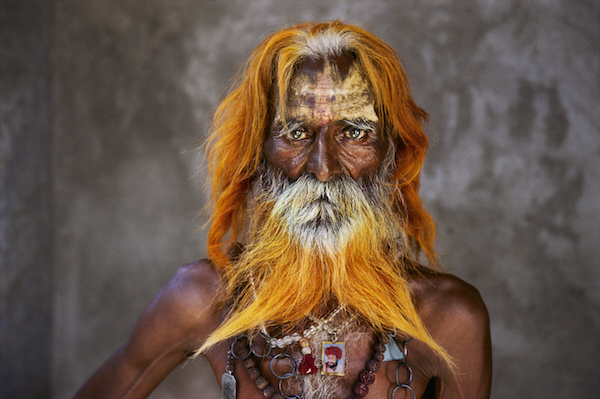
In 2010, Eastman Kodak recognized his superb use of color by asking him to shoot the very last roll (36 exposures) of Kodachrome they would ever manufacture. He chose to shoot about 24 images in India; the spectacular 40 x 60 inch print “Rabari Tribal Elder, Rajasthan, 2010,” with its subject’s intense stare and McCurry’s supersaturated color, is a testament to both the photographer’s talent and the film.
The importance of color in India is also beautifully illustrated by “Boy in Mid-flight, Jodhpur, Rajasthan, 2007,” one of my favorites in the show.
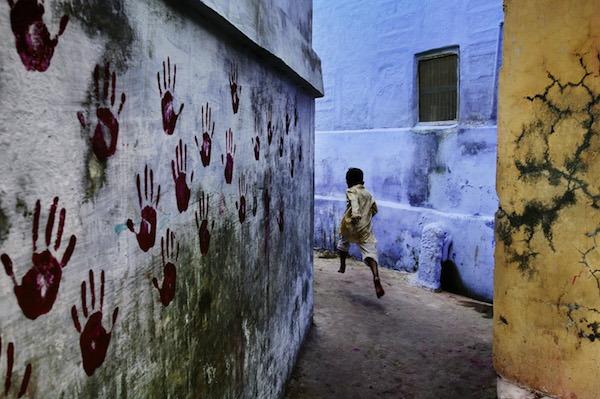
McCurry explains: “I’d been in Jodhpur many times, and I know the back streets well. There were always cows, people on bicycles, and workers in that narrow alley. I took a number of pictures, but I’m glad I waited for the moment the boy practically flew through the passageway.” In my view, I thought capturing the boy in mid-air at the end of the alley was fantastic, but framing it with the deep blue back wall, red painted hands and orange wall makes it a masterpiece. The picture’s impact is magnified by the large format print –– 40 x 60 inches.
This image supports the artist’s belief that a still photograph “is something which you can always go back to. You can put it on your wall and look at it again and again because it is that frozen moment. I think it tends to burn into your psyche. It becomes ingrained in your mind. A powerful picture becomes iconic of a place or a time or a situation.” Well, this is certainly one of them.
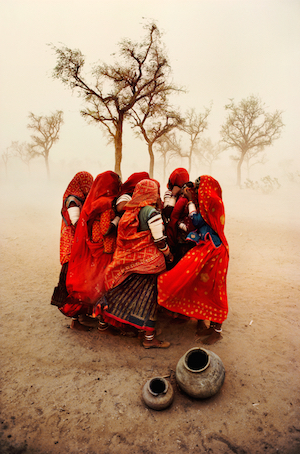
In 1983, McCurry returned to India to photograph a series for National Geographic about the monsoon, a season of heavy rainstorms that is synonymous with life, passion, and celebration. On view is “Dust Storm, Rajasthan, 1983,” an iconic image that also graces the cover of “India.” The picture has a mystical quality; the trees and cloud of dust contrast with the bright red saris the women are using to shield themselves from the dust clouds and wind. McCurry says, “I stopped and tried to make pictures, but they didn’t even notice me, they sang and prayed. Life and death seemed to hang in precarious balance.”
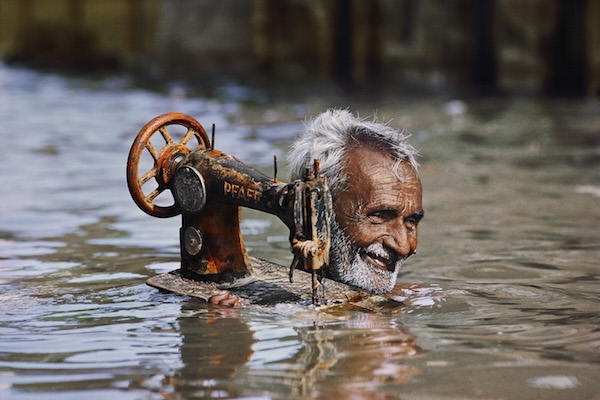
While shooting the “Monsoon” series, the photographer saw a tailor walking down the street carrying his sewing machine on his shoulder with water up to his neck. The machine was ruined — but when “Tailor Carries His Sewing Machine through Monsoon Waters, Porbandar, Gujarat, 1983” appeared on the cover of National Geographic, the manufacturer sent the tailor a new machine.
In his decades-long search for “unguarded moments, the essential soul peeking out, experience etched on a person’s face,” McCurry has given us an incomparable look at the India that is on the cusp between modernity and ancient tradition: the well-dressed customer waiting for his shoes at the cobbler’s shop; a mother and child at a car window; a father and daughter on Dal Lake; a man covered with green powder carried by a crowd during the Holi Festival; huge crowds gathering for the Kimbh Mela Festival; Buddhist monks debating.
Steve McCurry has seen it all. Now, through his eyes, you can too.
“Steve McCurry: India” is on view through Mon., Apr. 4, at the Rubin Museum of Art (150 W. 17th St., btw. Sixth & Seventh Aves.). Viewable with admission to the museum, Mon. 11 a.m.–5 p.m., Wed. 11 a.m.–9 p.m., Thurs. 11 a.m.–5 p.m., Fri. 10 a.m.–10 p.m., Sat. & Sun. 11 a.m.–6 p.m. Admission is $15, $10 for seniors/students, and free for children under 12 (or after 6 p.m. on Fri.). Visit rubinmuseum.org or call 212-620-5000 for more info. For artist info, visit stevemccurry.com.