


The outgoing New York City Council used its last meeting of the 2024-2025 session on Thursday to pass landmark legislation expanding permitting and agency support for street vendors, affordable housing policy and worker protection laws.
“When you think about issues that affect working-class New Yorkers, this is a day to be proud of,” said new Council Member Harvey Epstein. “We’re talking about worker protections, opportunities for more affordable housing…These are real ways to manage the affordability crisis, keep people in their homes…That’s what we should be proud of.”
Looming over the legislation, however, is the threat that outgoing Mayor Eric Adams may use his last few weeks in office to veto some or all of the bills — something that only the next incoming City Council will have the power to override.
Street Vendor Reform Package
The majority of the city’s roughly 23,000 street vendors are unpermitted and struggle to navigate the city agencies involved in their regulation. After years of pressure from vendors and advocates, the council passed a set of bills on Thursday designed to improve permit access and agency support for those selling food and goods on the streets every day.
Known as the Street Vendor Reform Package and made up of Intros. 431-2024, 408-2024, 1251-2024, the package will add more than 20,000 street vending permits to the system over the next five years, create a Division of Street Vendor Assistance within the Department of Small Business Services that would provide training, outreach and workshops on complying with local laws and regulations for newly permitted vendors and authorize the Department of Health and Mental Hygiene to issue more applications for supervisory licenses.
Bronx Council Member Pierina Ana Sanchez, who introduced multiple bills in the package, emphasized the importance of the bills to the street vending community.
Notably, there are just over 7,000 available permits for street vendors, and they and their advocates have reported issues with the way the Department of Sanitation has conducted enforcement against them.
“We’re at a pivotal moment for street vending reform. As the daughter and granddaughter of street vendors, I could not be more proud of how far we’ve come, and, honestly, shocked,” Sanchez said. “Countless lives are going to change after this.”
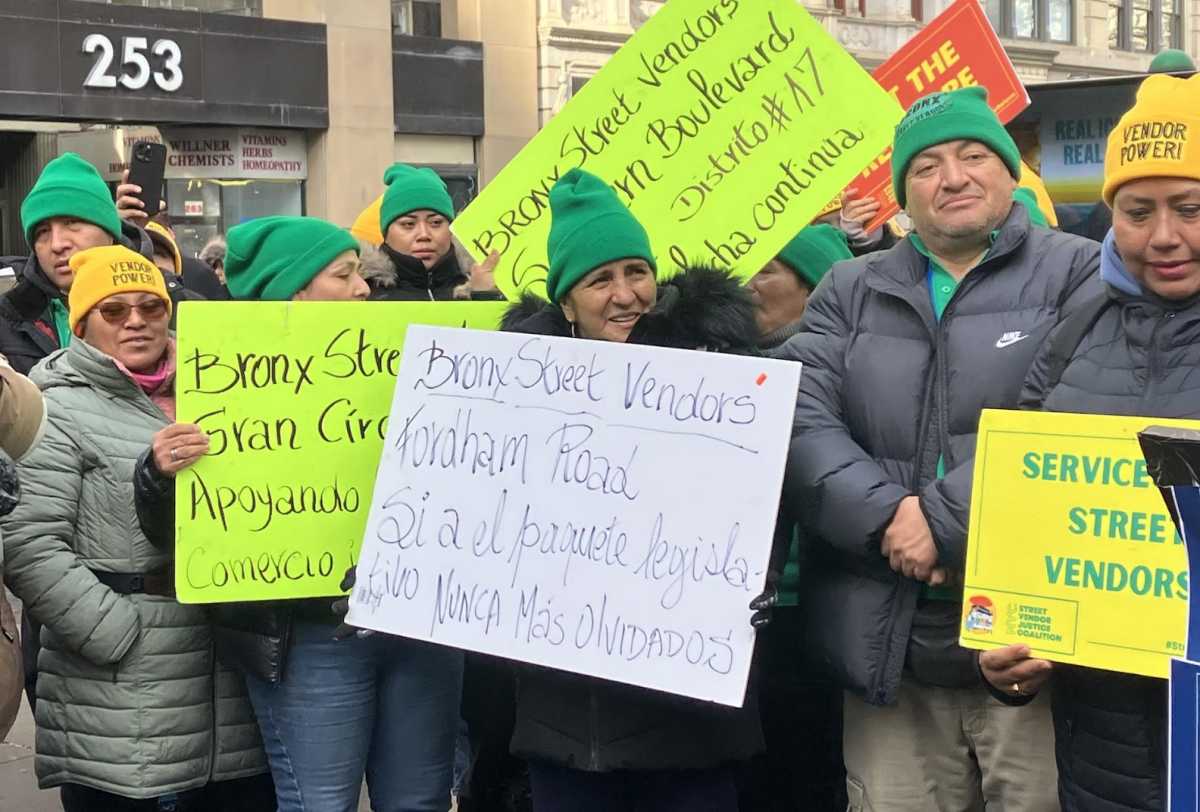
Before the council meeting began, vendors and advocates held a rally outside City Hall to push members to pass their legislation.
“It’s been a long road for us to be here,” said Lupe, a second-generation street vendor from East Harlem. “It’s a big celebration to pass this bill now…We need this.”
Lupe also spoke to the fears many advocates have that current Adams may veto the street vendor legislation before he leaves office.
“If the mayor hears this, don’t veto this law. You’re already leaving. So let us, who have been in the streets for more than 20 years, stay in the streets, but with a better process,” Lupe said. “I’ve been part of this part of the street vending system for over 27 years. My mom has been struggling to get a permit, to get a license for so many years….It’s time to see change now, and it’s time to be part of the change now.”
Vendors and advocates had another win earlier this year, when one of the package’s bills, now known as Local Law 122, passed in September, decriminalizing street vending offenses. Now, instead of facing criminal penalties for infractions, like vending without a license, vendors will face a civil one.
The fight for street vending reform isn’t over, however.
Advocates and vendors are still pushing for Intro. 947-2024, which would establish an Office of Street Vendor Enforcement in the city. Vendors say an office specifically dedicated to their businesses will help provide additional support to the tens of thousands of street vendors who form the city’s smallest businesses.
That bill will have to be reintroduced in the new year if it is to have the chance of becoming law.
Housing Policy
Qualified non-profits and community land trusts now have first dibs on purchasing disenfranchised and low-income residential properties when they go up for sale, under Intro 902-B, known as COPA, or the Community Opportunity to Purchase Act.
“This is a landmark piece of social housing legislation,” said Brooklyn Council Member Sandy Nurse, the bill’s sponsor. “It is protecting tenants and preserving permanently affordable homes.”
The bill received spirited debate during voting, with multiple members expressing their opposition, suggesting that it would take away the rights, choice and property of small and mid-size property owners and calling it “potentially illegal.”
“This is government overreach at the very best,” said Queens Council Member Vickie Paladino.
Nurse called those opposing it misinformed about the bill’s intentions and accused them of having “done nothing for homeowners or tenants.”
COPA only includes buildings that have over five units and an “extremely targeted set of properties,” in the Housing Preservation and Development’s Alternative Enforcement Program, said Nurse, which addresses distressed properties, like those with multiple building code violations or in varying states of disrepair. Nonprofits would have 25 days to submit a statement of interest upon receiving notice of a property being on the market.
“We are creating a small chance, just a tiny chance, that instead of property being sold to an investor around the world that we have a nonprofit we have a relationship with…purchase and improve the property,” Nurse said.
She emphasized that the bill had been pared down after extensive deliberations with council members and community stakeholders.
Though it’s also faced opposition from the real estate industry, Nurse and the bill’s advocates have said it provides local nonprofits the opportunity to purchase properties in their neighborhoods to ensure their ownership remains local and keep people in their homes.
“COPA will give a set of vetted, certified, qualified entities or preservation buyers the first chance to buy buildings with physical distress and expiring affordability restrictions,” Nurse said. “We’re going to be protecting tenants and preserving permanently affordable homes. With today’s passage, New York City will become the largest city in the country with an Opportunity to Purchase Program. It is a critical preservation tool to add to our toolbox.”
Less contested was Intro 1443, which passed without fanfare and requires 50% of newly constructed rental units financed by the city be designated as affordable for very low-income households, and at least 30% to be affordable for extremely low-income households, also sponsored by Nurse.
Very low-income households are those making less than 50% of the area median income, or AMI, and extremely low-income households are those making less than 30% of the AMI, adjusted for the size of the household.
The council also passed Intro 1433-2025, requiring 25% of all newly built affordable housing apartments financed by the city must be 2 bedrooms and 15% must be 3 bedrooms.
The bill’s sponsor, Bronx Council Member Eric Dinowitz, called it a win for affordable housing and for families, who he said are being pushed out the city due to a lack of family-sized apartments.
“People are struggling to find larger apartments,” Dinowitz said. “There are not enough two or three-bedroom apartments. And if there are, they’re certainly not affordable.”
“We’re losing families faster than any other demographic,” Dinowitz said. He added that families account for a significant portion of those in homeless shelters and blamed the city’s focus on studios and one-bedroom apartments for pushing families out.
“This is a pivotal moment for our city,” Dinowitz said. “We’re going to make [affordable housing] more of a reality for our families…and stop seeing the flow of families out of the city and start seeing the flow of families back into the city.”
When asked what he would do if Adams vetoed his legislation, Dinowitz said he didn’t see why the mayor would oppose “pro-family legislation,” and would “cross that bridge if it gets there,” if he did.
Though the bill is effective immediately, requirements won’t go into effect until July 2027, so that affordable housing projects currently underway can continue without hindrance.
Worker Protections
Construction Justice Act
Under the Construction Justice Act, or Intro 910, developers behind city-funded housing projects will be required to pay workers $40/hour in wages and benefits, at least of $25 of which must be in wages, to their workers, “engage in best efforts” to ensure that 30% of workers are city residents and provide a private right to action for aggravated workers.
Council Member Carmen De La Rosa, who sponsored the bill, emphasized its importance to the construction working community, frequently made up of immigrant workers, formerly incarcerated people and day laborers, people who she described as the city’s “most vulnerable.”
“It is important that those who are building our skyline are also able to live in it,” De La Rosa said. “That’s how we fix the housing crisis in this city…The Construction Justice Act is a win for all of us.”
Construction workers who gathered outside city hall prior to the vote emphasized the importance of the bill, speaking to low wages, some as low as $16/hour, that prevented them from properly supporting their families, and poor working conditions.
“This is a history-making bill,” De La Rosa said.
NYPD Reform
Finally, the NYPD must provide the Civilian Complaint Review Board with body camera footage for the purpose of investigating police misconduct under Intro 1451, sponsored by outgoing Council Speaker Adrienne Adams.
Adams said requiring police to provide the board with footage would “increase their ability to determine merits,” of allegations made against officers.