


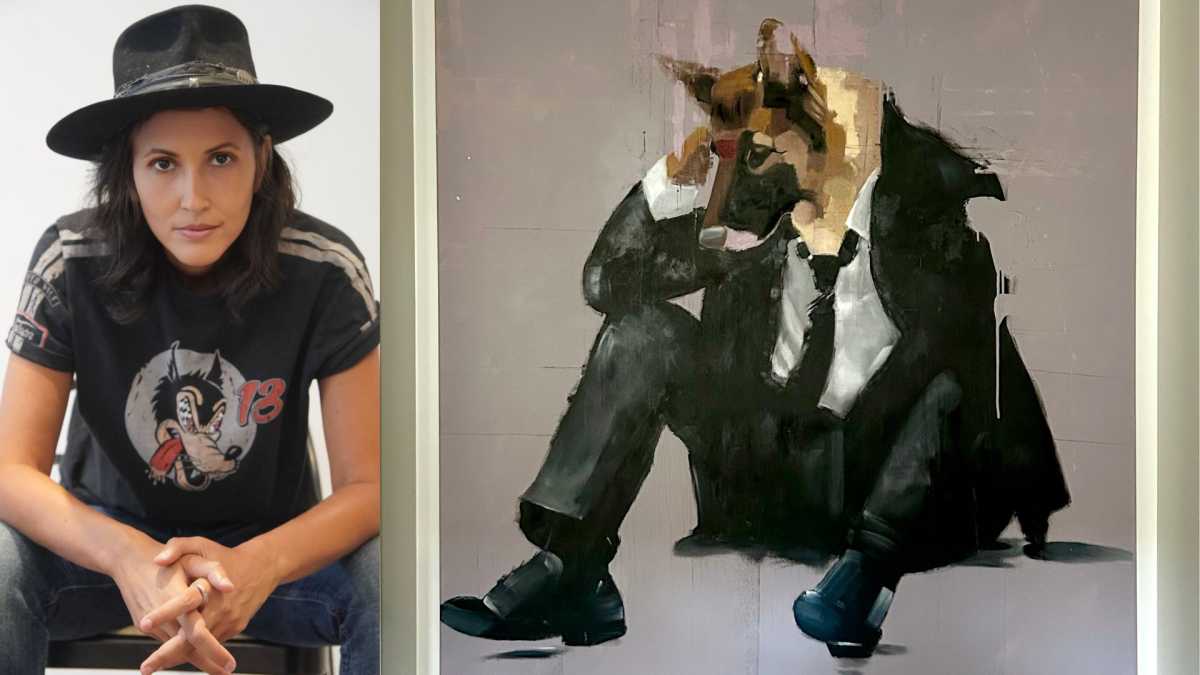
Artist Sandy Cohen stands as a testament to defiance rendered luminous — a creator forged in adversity who transforms pain into power, glamour into armor, and identity into sovereign presence.
Born in Israel and raised in New York City, Cohen revealed prodigious instinct early, moving through elite artistic training while still a child and later capturing the attention of Peter Max, who recognized in her work a rare emotional voltage: color that feels, line that insists, imagery that refuses passivity. International exhibitions and prestigious collectors soon followed, including royal collections in Morocco and Qatar, yet biography alone cannot explain her magnetism. Her work carries the authority of someone who has endured devastation and returned not diminished, but incandescent.
At the height of her early ascent, a catastrophic neurological reaction to antibiotics left Cohen severely disabled, bedridden, and dependent on a wheelchair. Nearly two decades dissolved into the brutal quiet of medical uncertainty, physical pain, and suspended purpose. Many careers would have evaporated into absence under such conditions. Cohen instead forged an interior arsenal. When she re-emerged in 2017, she returned sovereign, bringing with her a visual language sharpened by endurance and a psychological authority that cannot be fabricated.
Her work channels the electric inheritance of postwar Pop while refusing its emotional coolness. Echoes of Andy Warhol and Roy Lichtenstein surface in the strategic deployment of iconography and cultural shorthand, while the psychological voltage of Jean-Michel Basquiat and the existential intensity of Francis Bacon reverberate beneath the surface. One senses the chromatic euphoria of Peter Max, though Cohen wields glamour not as utopia but as armor. Her commanding female presence and unapologetic visual authority also resonate with the mythic self-fashioning of Frida Kahlo and the fearless chromatic feminism of Judy Chicago, while echoes of Tamara de Lempicka’s sleek Art Deco power portraiture surface in her fusion of glamour, geometry, and control. Fashion illustration, Byzantine icon painting, and the elongated authority of Mannerist portraiture flicker within her compositions, constructing figures that read less as subjects than as sovereign presence shaped by myth.
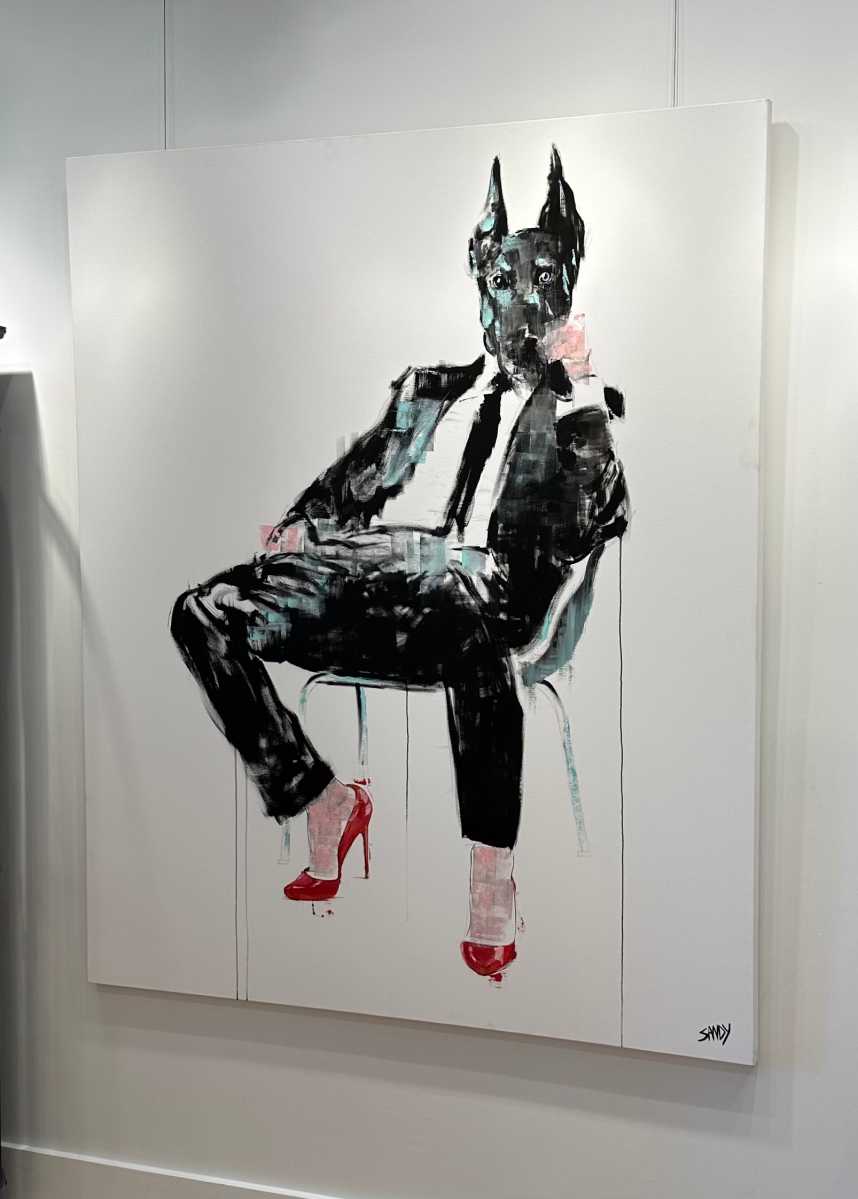
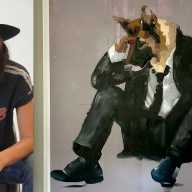
Her painting Balenciaga crystallizes this authority with arresting clarity. A sharply dressed figure reclines in composed ease, legs crossed with aristocratic indifference, clothed in a fractured black suit that vibrates at the edges as if authority itself exceeds containment. The head of a Doberman rises above the tailored form — sentinel, guardian, aristocrat of vigilance — its erect ears forming a crown-like silhouette. Red stilettos ignite the composition, puncturing monochrome restraint with surgical glamour and transforming elegance into weaponry rather than ornament. Masculine tailoring anchors the structure while flashes of pink at the wrist and ankle introduce softness beneath steel composure, allowing masculine and feminine energies to circulate like electrical current. The pose recalls the authority of Velázquez and Ingres portraiture, while the hybrid form evokes ancient deity iconography and heraldic myth, elevating the figure beyond individuality into archetype: protector, ruler, strategist. Against a stark white field that isolates the figure like a relic within a sanctified chamber, drips trailing from the limbs suggest motion beneath stillness and force beneath poise. Empire-building power radiates without visible strain, offering composure as the ultimate expression of control and ease as the final luxury.
Cohen’s biography reverberates through this visual command. A meteoric rise, devastating collapse, decades of immobility, and an improbable reemergence form the crucible from which this imagery rises. Her work refuses fragility, rejects apology, and replaces passive beauty with sovereign architecture. Where traditional pop flattened identity into consumable imagery, Cohen expands it into psychological infrastructure. Where glamour once signaled accessibility, she deploys it as perimeter defense. Where femininity has historically been framed as ornamental, she renders it structural.
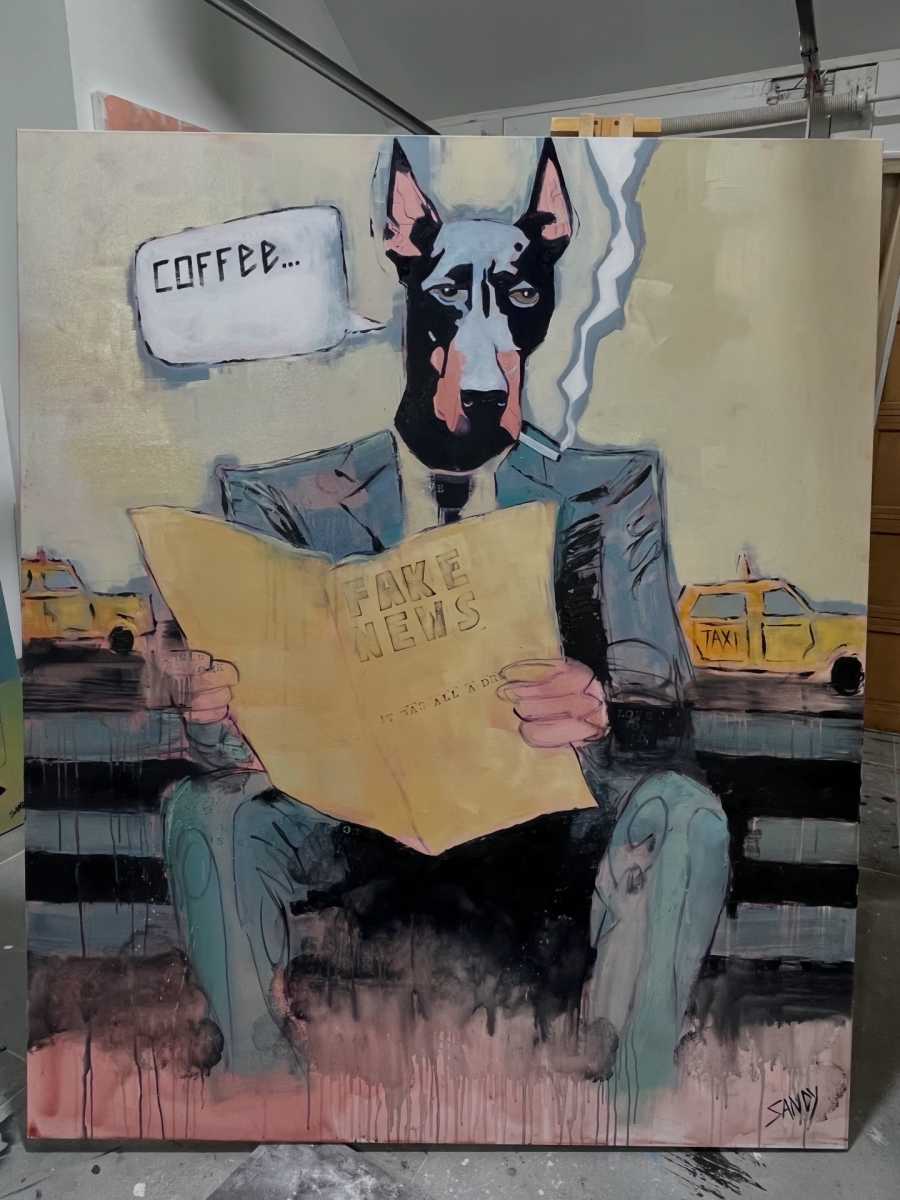
This vision reaches its fullest articulation in her forthcoming solo exhibition, I Shake My Sugar Daddy, Fill My Goodie Baggy, opening May 24 at Stella Flame Gallery in the Hamptons. Drawn from lyrics by her late sister Fame, the exhibition operates as both personal tribute and visual manifesto, transforming grief into enduring brilliance while interrogating the choreography of power, desire, and cultural consumption.
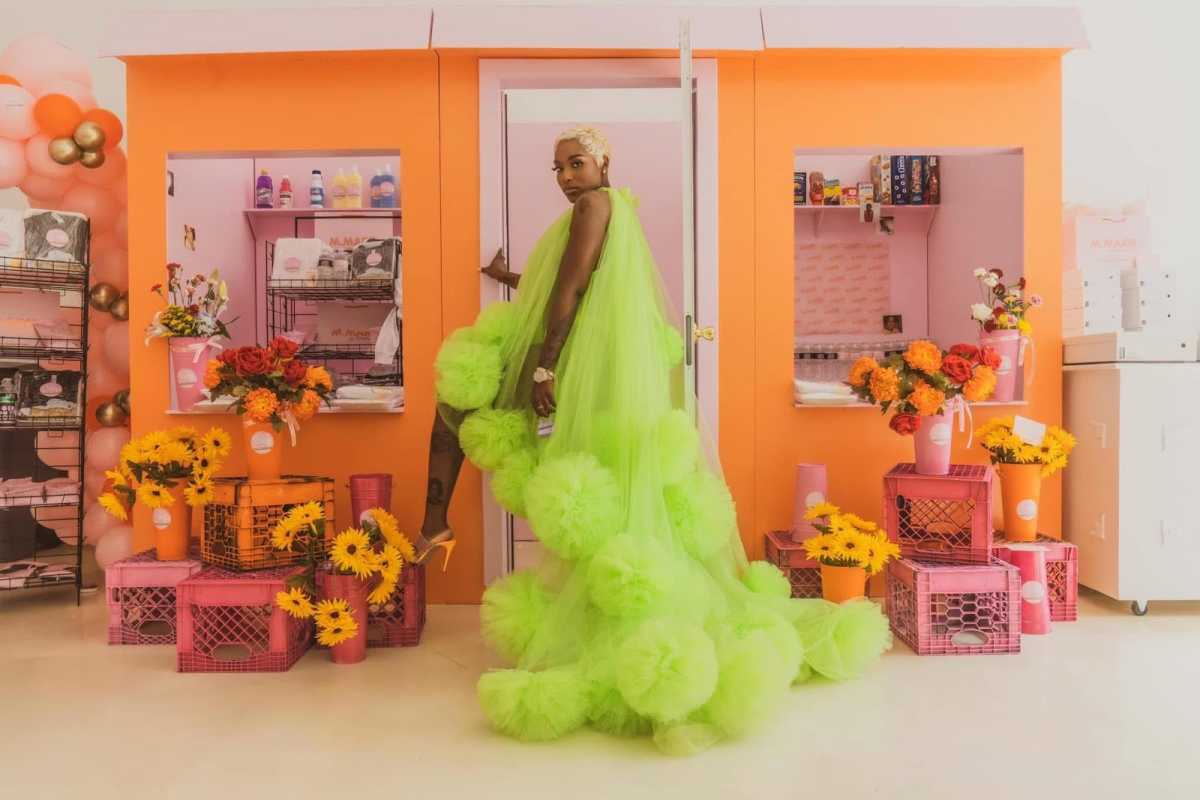
In tandem with the exhibition, Cohen expands her visual language into lived experience through FAME by Sandy Cohen Art, her artwear line created in memory of her sister and guiding muse. The collection translates personal loss into a lasting legacy and is now available through an international selection of distinguished retailers including Wild Side Sag Harbor, Human Steps, Sunbarth, La Scène des Artistes, and Chelsea Exclusive. Each piece functions as mobile iconography — bold, intimate, and unforgettable — extending Cohen’s aesthetic into the realm of movement, identity, and daily ritual.
Cohen’s work does not ask for permission, nor does it seek passive admiration. It asserts presence, reclaims narrative, and constructs a visual language in which resilience is inseparable from authority. What remains after encountering her work is not decoration, nor trend, nor momentary allure, but the unmistakable imprint of power exercised with precision, elegance, and unyielding will.