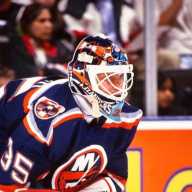


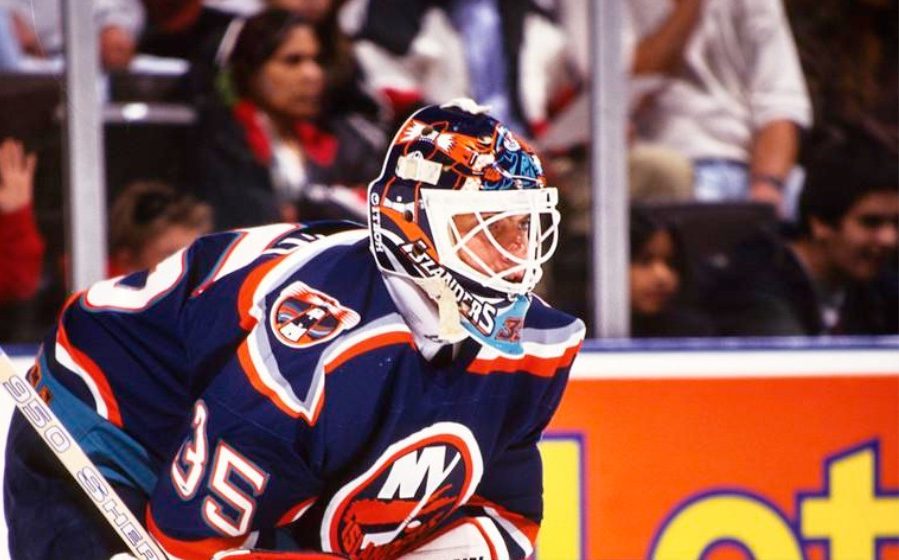
In 1995, the New York Islanders ditched their familiar blue and orange uniforms for the controversial Fisherman.
The Islanders had faltered after their four consecutive Stanley Cups in the early 1980s. Though the club had reached the Eastern Conference Final in 1993, it followed up by being swept, embarrassingly, by the crosstown New York Rangers in 1994.
In search of a rebrand to change the waning public perception of the club, the Islanders brought in Sean Michael Edwards Design, Inc. (SME), which had worked with the likes of the Florida Panthers and the NBA’s Toronto Raptors — both franchises began play in the 1990s with caricature-style logos.
“At that point, [the Islanders] viewed themselves as kind of a failed franchise that had not won a Stanley Cup in a decade and was coming down from this period of great success,” said Nick Hirshon, the author of We Want Fish Sticks, which chronicles the Islanders’ controversial rebranding, and a journalism professor at William Paterson University. “And now the Rangers just won the Stanley Cup in that market, the Devils were on the up, and up, so maybe the Islanders could not afford a brand new arena or new players, but they could make some money by unveiling a new jersey.”
Want to see the #Fisherman and the #Isles tonight? Wear one of these to the Coliseum and get tickets for just $25! pic.twitter.com/QY7yau3n1t
— New York Islanders (@NYIslanders) February 3, 2015
Across the NHL, a broader cultural shift was underway, as jerseys became more commonplace in the stands as fashion items. In the early 1990s, the league expanded into nontraditional hockey markets, each of which debuted uniforms that threw tradition out the window. The Panthers debuted the leaping cat; the San Jose Sharks introduced teal to the NHL’s color palette.
In 1995, the league introduced the third jersey program, and with it came a series of uniforms with sublimated base designs and cartoon-like logos. There was the “Burger King” in Los Angeles and “Wild Wing” in Anaheim.
On Long Island, the Fisherman — best described as an angry, orange version of the Gorton’s fisherman, holding a hockey stick — was cast.
Where hockey jerseys meet pop culture
Paul Lukas, the founder of Uni Watch — a blog about sports uniform designs — pointed to the proliferation of sublimation in the 1990s as a game-changer in uniform designs. Instead of stitching logos and patches onto a uniform, teams could have graphics printed into the fabric.
Sublimation, a printing process that permanently embeds dyes into fabric, allowed more “cartoonishness,” Lukas explained, in jersey designs. It also gave teams more freedom. The Islanders’ fisherman jersey featured wavy shoulder, tail, and sleeve stripes.
“I think it was also the beginning of a larger trend in uniforms, and the overall uniform world of the uniform being more of a superhero costume,” Lukas explained. “I would say the ethos of sports now, and of the visual aspect, the sports aesthetic is less athletes wearing uniforms than superheroes wearing costumes.”
When Hirshon, who wrote the book on the Islanders’ fisherman rebranding, started attending games at the aging Nassau Coliseum in Uniondale at the turn of the century, the Islanders were in last place in the NHL. He saw a lot of 1980s-era jerseys in the stands, but also, despite their bad reputation, a lot of fisherman jerseys.
The hockey jersey, Hirshon explained, had started to become a fashion statement in the late 1990s and early 2000s, when baggy clothes were trendy. Hockey jerseys began appearing in rap music videos, like Snoop Dogg’s “Gin and Juice” and Craig Mack’s “Flava In Ya Ear.”
“A lot of these were just fashionable,” Hirshon said. “So it wasn’t so much about performance on the ice. It was just, ‘The San Jose Sharks look like a cool jersey. I’ve not seen teal in a jersey,’ or ‘The cartoon shark chomping on the hockey stick is just a really neat image.’ And then you have the Mighty Ducks, which are the big one because they come into the league off of the success of the movie. And there were a lot of kids of my generation who may not have known much at all about hockey, but saw those movies, loved them, and then wanted to wear the jerseys without ever setting foot in California.”
1995-1996 Mighty Ducks of Anaheim “Wild Wing” alternate jersey pic.twitter.com/i36tU0GwV7
— Every NHL Jersey (@everynhljersey) August 8, 2023
The jersey economy
When Lukas was growing up in the 1970s, team uniforms were sacred. He couldn’t buy an official New York Rangers jersey anywhere.
“It had not occurred to the leagues and owners that people would spend hundreds of dollars,” Lukas said. “Nor did I think they wanted to democratize it. I think they saw jerseys and logos as their exclusive thing, what made them official and special, and they didn’t want just anybody wearing it, and they obviously didn’t see the tremendous sales opportunity there.
Lukas’ first Uni-Watch column was published in the Village Voice in May 1999. Over the past 26 years, he said, the general perception around sports jerseys has changed.
“When I started doing Uni-Watch, uniforms were athletic apparel that happened to be worn, or that happened to be sold at retail,” Lukas said. “Now I would say, uniforms are lifestyle apparel that happens to be worn by athletes.”
Hockey jerseys still weren’t widely available when Hirshon started going to games. At the Nassau Coliseum merchandise stands, he recalled, the Islanders had only two or three players’ jerseys available. There were a handful of stores scattered across Long Island that carried them, too. There was no NHL store.
By the mid-1990s, however, the new jersey designs had started to take over the game financially. The San Jose Sharks sold $150 million of merchandise in their first season, according to the University of California Press. When the Mighty Ducks of Anaheim broke into the NHL in 1993, they sold an estimated $300,000 worth of merchandise at their first game, according to a Washington Post article from that October. The next year, total sales of NHL merchandise exceeded $1 billion, according to the University of California Press article.
Hockey jerseys also held a level of prestige, Hirshon explained.
“The fact that you can afford a hockey jersey is a bit of a statement of financial capital,” he said. “I remember the first time I bought a jersey on the Nassau Coliseum concourse. That feeling in some way that I had arrived, that I had saved up my allowance enough that I could buy my own jersey.”
Eventually, Hirshon continued, hockey jerseys became more widely available, and the NHL relied less on jersey sales at arenas. Fans could get them through mail order or at shopping malls.
The modern-day jersey market
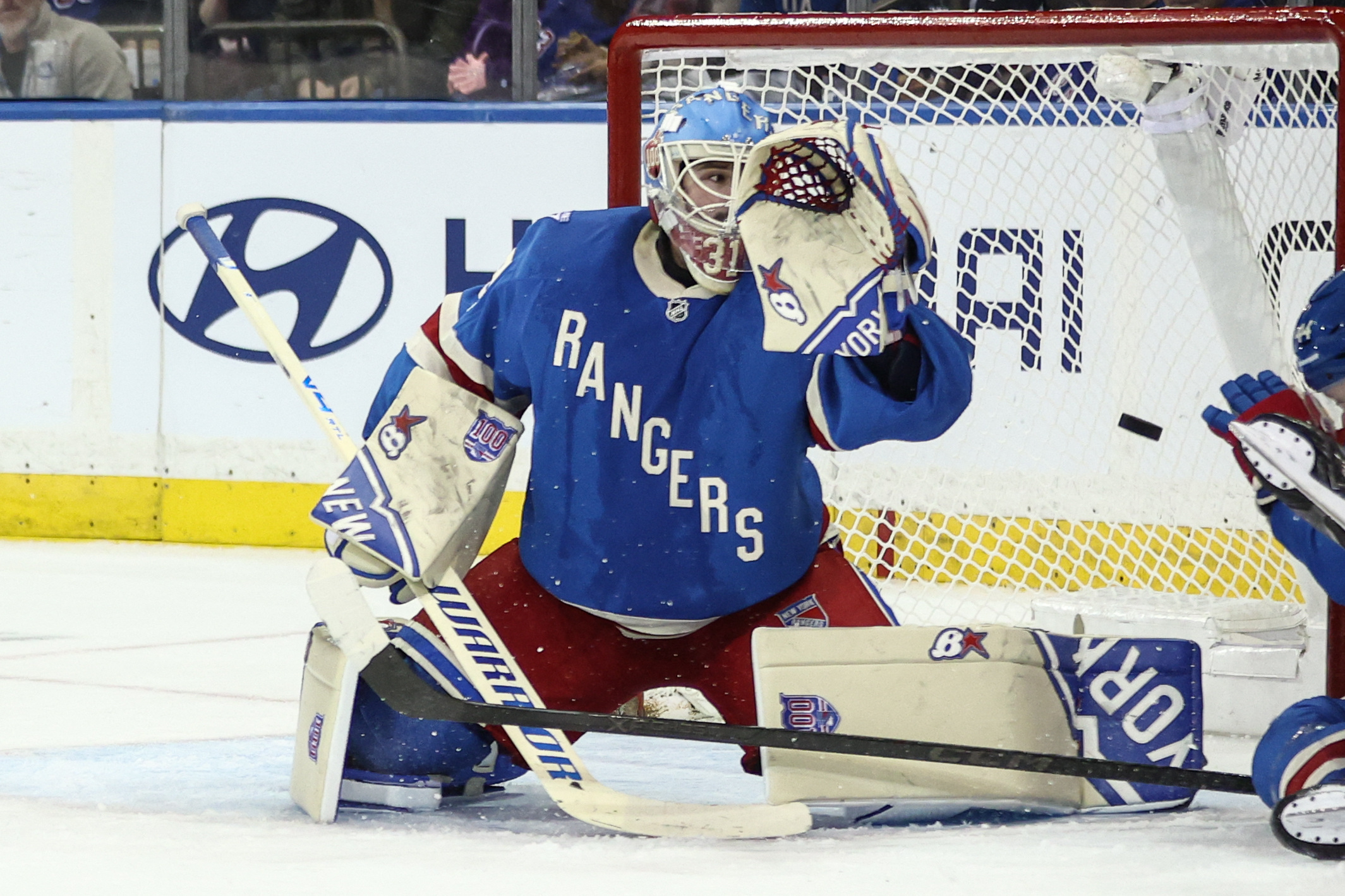
Buying hockey jerseys has never been easier.
Fans can order customized jerseys of any team, with any player pressed onto the back and delivered to their doorstep, though Fanatics has faced its fair share of criticism while monopolizing the market. The selection has widened, with more clubs introducing alternate uniforms — the Rangers, for example, have worn six different uniforms in the past three seasons, including an alternate set and a centennial throwback, and have played in the Winter Classic and Stadium Series outdoor games.
A blank Fanatics Premium NHL jersey — the standard jersey model for hockey fans — costs fans roughly $180 on Fanatics. Player name-and-number jerseys start at roughly $230.
The NHL’s shift in marketing tactics has changed how hockey fans view jerseys, according to Hirshon. Clubs are wearing more uniforms today than ever. Teams’ rosters are fluid and change constantly with free agent signings and trades. The accessibility of jerseys to fans worldwide has made them easier to acquire.
“There’s that dynamic of, ‘Do I really want to keep wearing a jersey of a guy who’s no longer on the team?” Hirshon said. “I need to update it, get the newest thing. They’re introducing all these different third jerseys, the Reverse Retros.
“It’s a lot of ‘Keeping Up with the Joneses.’ I want to get whatever the hottest new look is.”
Part of this, Hirshon said, is the effect of hockey trying to market itself in the U.S., where the sport has always played in the shadow of American football and basketball. If Connor McDavid, the best player in the NHL, walked down the street in New York City, few people would take notice. The same couldn’t be said for LeBron James or Patrick Mahomes.
But, as Lukas pointed out, these marketing tactics aren’t unique to hockey. The NHL has previously introduced leaguewide specialty jerseys like the inaugural third jersey program, the vintage jersey program in the mid-2000s, and, more recently, the two series of “Reverse Retro” jerseys in the 2021 and 2022-23 seasons. But each season, the NBA releases a new set of “City Edition” jerseys for all 30 teams. In recent years, Major League Baseball followed suit with its City Connect program.
“The churn is much faster,” Lukas said. “And that reflects that it’s very similar to the fashion world, the non-sports fashion, and because that’s what uniforms are now, they’ve become a branch of lifestyle branding and lifestyle apparel.”