



If City Center Encores! was originally founded as a kind of musical-theater séance — devoted to raising the dead, or at least the long-forgotten — then “High Spirits” is about as literal a mission statement as you could ask for.
The rarely revived 1964 musical opens with a séance and arrives at City Center like a theatrical ghost itself: long unseen, mostly forgotten, and faintly glowing with the promise of pleasures from another era. That alone makes “High Spirits” worth summoning. Whether the séance fully works is another matter.
With music, lyrics and book by Hugh Martin (“Meet Me in St. Louis”) and Timothy Gray, “High Spirits” adapts Noël Coward’s drawing-room farce “Blithe Spirit,” in which novelist Charles Condomine hosts a séance for research purposes only to find himself haunted — quite literally — by the ghost of his glamorous first wife, Elvira. The musical follows Coward’s plotting closely, padding it out with additional numbers and scenes for the eccentric medium Madame Arcati, now supplied with a café, a troupe of beatnik followers, and a broader, loonier finale.
Musically, the evening offers real pleasures. The score, largely unavailable on streaming platforms, turns out to be far more enjoyable than its obscurity suggests. Martin and Gray write tuneful, effervescent songs steeped in an early-1960s swing sensibility, and the large, lush orchestra reminds you exactly why Encores! exists.
HIGH SPIRITSPhoto by Joan Marcus
“High Spirits” may have faded from view precisely because of its fidelity to “Blithe Spirit,” which remains endlessly revivable: compact, economical, and dependent almost entirely on timing and verbal dexterity. “High Spirits” demands all of that precision, plus musical confidence, buoyancy, an ensemble, and even dance choreography.
That tension is felt acutely in this Encores! production. Directed by Jessica Stone, “High Spirits” arrives in an unusually bare presentation, even by Encores! standards. The cast relies heavily on scripts, and on the night I attended many still seemed to be feeling their way into the material, perhaps a function of Encores!’ famously brief rehearsal period early in a short run. The result is a tentativeness that drains the comedy of its sparkle and leaves some scenes oddly inert.
Steven Pasquale (“The Bridges of Madison County”), typically a sharp presence, appears stiff as Charles, struggling to generate the escalating panic and propulsion the role requires. Katrina Lenk (“The Band’s Visit”), as the spectral Elvira, brings undeniable glamour and teasing sensuality, but vocally she sounds ill at ease. As in “Company,” her voice seems better suited to contemporary material than to this bright score, and several of Elvira’s numbers land with effort rather than snap.
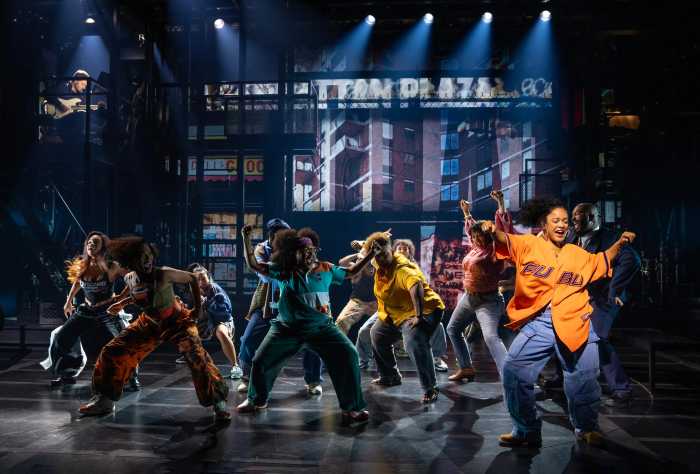
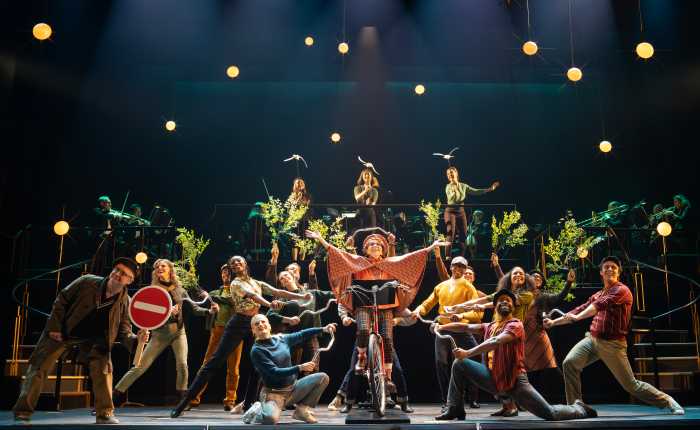
Andrea Martin fares better as Madame Arcati, though she too seems to loosen up only gradually. Her daffy instincts and comic authority eventually take hold, and by the second half she’s clearly having more fun — and so is the audience. Arcati’s expanded role, complete with bicycle antics and mystical acolytes, is the musical’s boldest departure from Coward. The beatnik ensemble, put to lively use in Ellenore Scott’s choreography, adds visual texture and period flavor, even when the surrounding scenes lag.
The evening’s most consistent delight comes from Philippa Soo (“Hamilton”) as Ruth, Charles’s anxious, tender second wife. Soo nails the early-1960s homemaker aesthetic and brings emotional clarity to Ruth’s predicament, grounding the farce in genuine insecurity and longing. That she and Pasquale are married in real life adds a subtle, if unintended, intimacy to their scenes together. Rachel Dratch makes the most of a small comic role as the Condomines’ oddball servant.
One baffling directorial decision is the introduction of Noël Coward himself as a narrator, stationed at the edge of the stage. Played by Campbell Scott, who also alternates in a minor supporting role, the device adds little insight and repeatedly pulls focus from the action. Coward’s voice already saturates the text, and literalizing him feels unnecessary.
Even so, “High Spirits” remains a useful reminder of what Encores! can do when it returns to its roots. Hearing this neglected score played live, at full scale, is a pleasure unlikely to be repeated anytime soon. But the production also illustrates why musicalizing Coward is such a delicate business: when the play itself is this revivable, the musical must justify its existence every step of the way. The séance may not fully succeed — but the spirits, at least, have been stirred.