


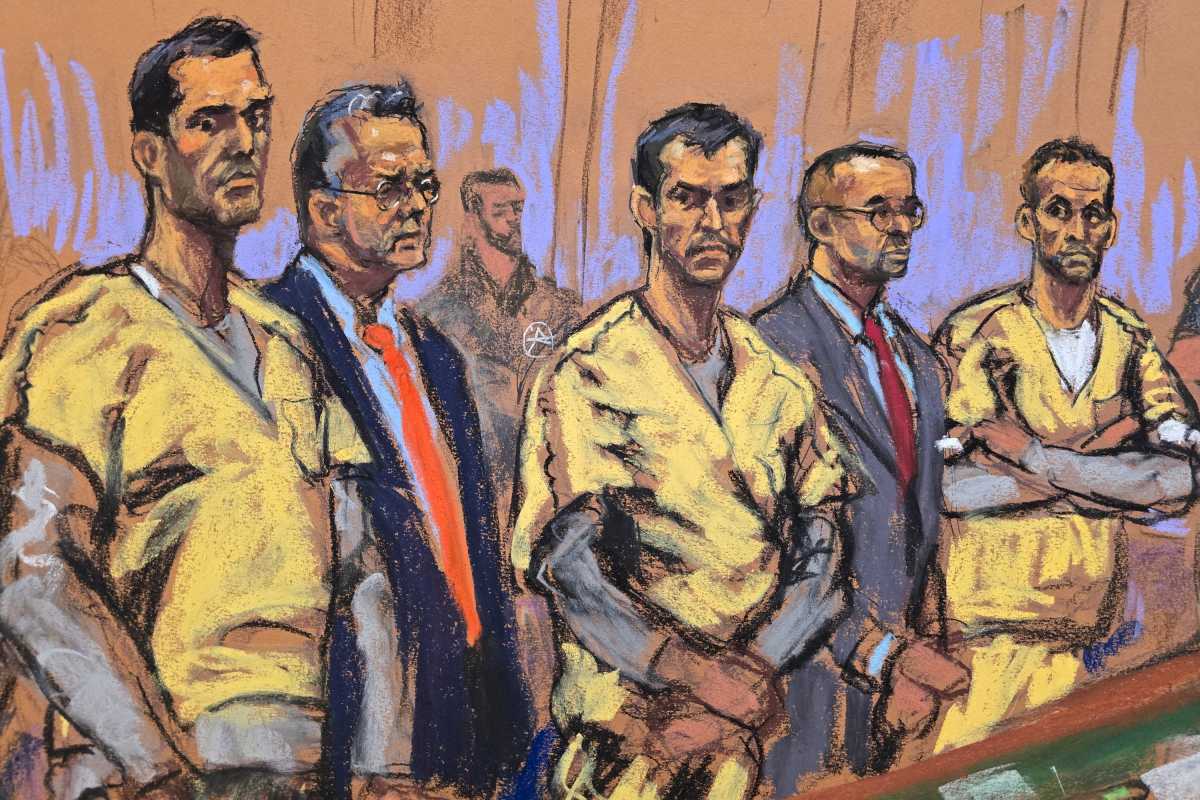
At their final public court appearance before trial, attorneys for twin brothers Alon and Oren Alexander, the luxury real estate brokers charged with sex trafficking and raping dozens of women over a decade, raised concerns over the validity of an additional charge prosecutors brought this week.
Prosecutors on Monday charged Alon and Oren Alexander with sexual abuse by physical incapacitation, alleging that the twins engaged in a sexual act with a woman on a January 2012 cruise while she was physically incapable of saying no. The new count concerns the same incident for which they’re already charged with aggravated sexual abuse by force, threat or intoxication. November charging papers allege the twins drugged or intoxicated the woman without her knowledge.
The Alexanders’ attorneys used the final conference before the brothers’ Jan. 26 trial to argue that the new charge should be dismissed because the indictment doesn’t state that the twins “knowingly” engaged in sex with the woman or that they “knew” she was physically incapacitated — a requirement, they argued, to charge someone with that crime.
“This is a fatal flaw requiring dismissal of the indictment,” reads a joint filing after the conference from the brothers’ attorneys at Agnifilo Intrater, Black Srebnick and Walden Macht Haran & Williams.
Furthermore, they argued, the fact that government prosecutors were charging the brothers with two different counts related to the same incident raised the question of whether the government really knew what happened that night, or if they were just charging anything they could think of and “hoping” one of the charges stuck.
“These two counts represent a classic hedge by the government: they now are charging what appears to be the exact same sexual encounter in two very different ways, allegedly violating two different statutes,” the court filing reads. “The government, after interviewing [the victim] multiple times, does not appear to know what happened in January 2012. Was an intoxicant used or not? Was force used or not?”
“These men’s lives depend on this,” said Zach Intrater, an attorney for Oren Alexander, in Tuesday’s court appearance. He criticized the government for tacking on additional serious charges so close to the trial.
“These are all serious charges,” Caproni replied.
The attorneys asked the judge to review what evidence the grand jury was given to determine if the new charge is valid.
In Wednesday night court filings, the government said there was “controversy” regarding whether it was necessary for them to prove a defendant knew what they were doing in order to convict them of this crime — the Second Circuit hasn’t yet taken up the issue — but regardless, they intend to prove that the brothers knew they were engaging in sexual activity with a woman who was unable to say no to their advances.
Still, prosecutors wrote, the word knowingly was “omitted” and should have been in the indictment. In light of that, they wrote, “the Government intends to expeditiously present a superseding indictment to the Grand Jury” that would include the word.
Whether the judge allows the prosecutors to make that correction will hinge on what evidence was presented to the grand jury, and whether it is sufficient to support the charge, said Anna Cominsky, director of New York Law School’s Criminal Defense Clinic.
“Maybe they are correct and that word needs to be added, but it would only be appropriate for it to be added if there’s evidence that was presented to the grand jury that supports that,” Cominsky said.
Regardless of whether the new charge sticks, Alon Alexander, Oren Alexander and their older brother, Tal Alexander, have already been indicted on 11 counts of conspiring to drug, sexually assault, rape and traffick dozens of women over the course of a decade, allegedly using their wealth and influence as luxury real estate agents in New York City and Miami to entice the women to travel, go on dates and attend parties with them.
The dispute over the new charge is just one of the points of contention between the parties less than two weeks before the trial, which prosecutors said they expect to stretch into late February or early March.
Late Monday evening, Caproni ruled Alon Alexander could not argue that his 2019 engagement to be married “constituted withdrawal from the sex trafficking conspiracy” and therefore he should be acquitted on certain charges.
Calling his engagement irrelevant to the case, the judge said Alon Alexander’s statements about his engagement could prove only that he intended to get married, not that he intended to remain monogamous during his engagement, or that he clearly communicated to his brothers that he intended to stop participating in the alleged sex trafficking conspiracy.
“It is an extraordinary (and unsupported) leap to infer from his pre-marital statements that ‘he also intended to stop assisting his brothers (with] their activities with women,’” Caproni wrote. “[Alon Alexander] saw an opportunity to reach for the prize and used his supplemental submissions to move for acquittal.”
The brothers’ attorneys and prosecutors have also spent weeks sniping back and forth at each other over whether the alleged victims would be allowed to use pseudonyms while testifying in court.
The defense’s stance has been that pseudonyms would be confusing for the jury and are not necessary to protect the women from retaliation or harassment, while prosecutors argued forcing the women to testify under their real names was an intimidation tactic and could result in them experiencing embarrassment, harassment or unwanted repercussions in their personal lives, particularly if they had uncommon, easily identifiable names.
Caproni has ruled witnesses can testify under varying degrees of pseudonyms based on the commonality of their names and how much other identifying information they’d be sharing during their testimony, such as their hometown or occupation. On Tuesday, she granted three additional victims, referred to as Victim 6, Victim 7 and Victim 20, permission to testify under full pseudonyms due to the rarity of their names and because most of them would need to refer to their job or hometown during their testimony.
The brothers’ attorneys objected to the three women using full pseudonyms, both verbally in the courtroom and in a filing after the proceeding ended. Caproni said her mind would not be changed.
“I only know one other woman with the name,” the judge said about one of the victims who will testify anonymously.
There have also been ongoing fights about what evidence should be permitted at trial, most recently over alleged victims’ social media posts, text messages and emails. Prosecutors argue the defense’s push to subpoena and submit that kind of evidence is irrelevant and serves only to knock the women’s credibility by making inappropriate suggestions about their character, while the Alexander brothers argue the photos and videos in question are necessary to establish a timeline of the alleged assaults.
As discussions over the details of that evidence are kept confidential for the women’s privacy, the full scope of evidence to be used will only become clear once the trial is underway.
Jury selection is set to start on Jan. 20.