

One year after New York City implemented congestion pricing, the program is no longer hypothetical. It is operational, generating revenue, shaping travel behavior, and producing real-world impacts for drivers, passengers, and transportation providers across the region.
Supporters point to early signs of success: fewer vehicles entering Manhattan’s core, modestly faster travel speeds, and increases in transit ridership. From an operational standpoint, congestion pricing has cleared several early hurdles and survived initial legal challenges.
But one year in is not the moment to declare success. It is time to ask more complex questions about affordability, consistency, and whether the program is truly aligned with its stated goals or is drifting toward something else.
An unsettled legal and political landscape
Legally, congestion pricing remains on uncertain ground. While courts have thus far allowed the program to proceed, litigation is ongoing. Challenges brought by neighboring states, municipalities, and industry groups continue to test issues of proportionality, exemptions, and economic impact. At the federal level, disputes over environmental approvals and administrative authority remain unresolved.
Congress, meanwhile, has not acted. Despite bipartisan bills that could pause, modify, or block congestion pricing altogether, legislative efforts have stalled. As a result, a program with national implications for transportation policy is operating in a state of political limbo, fully implemented, but not quite settled.
A growing policy contradiction
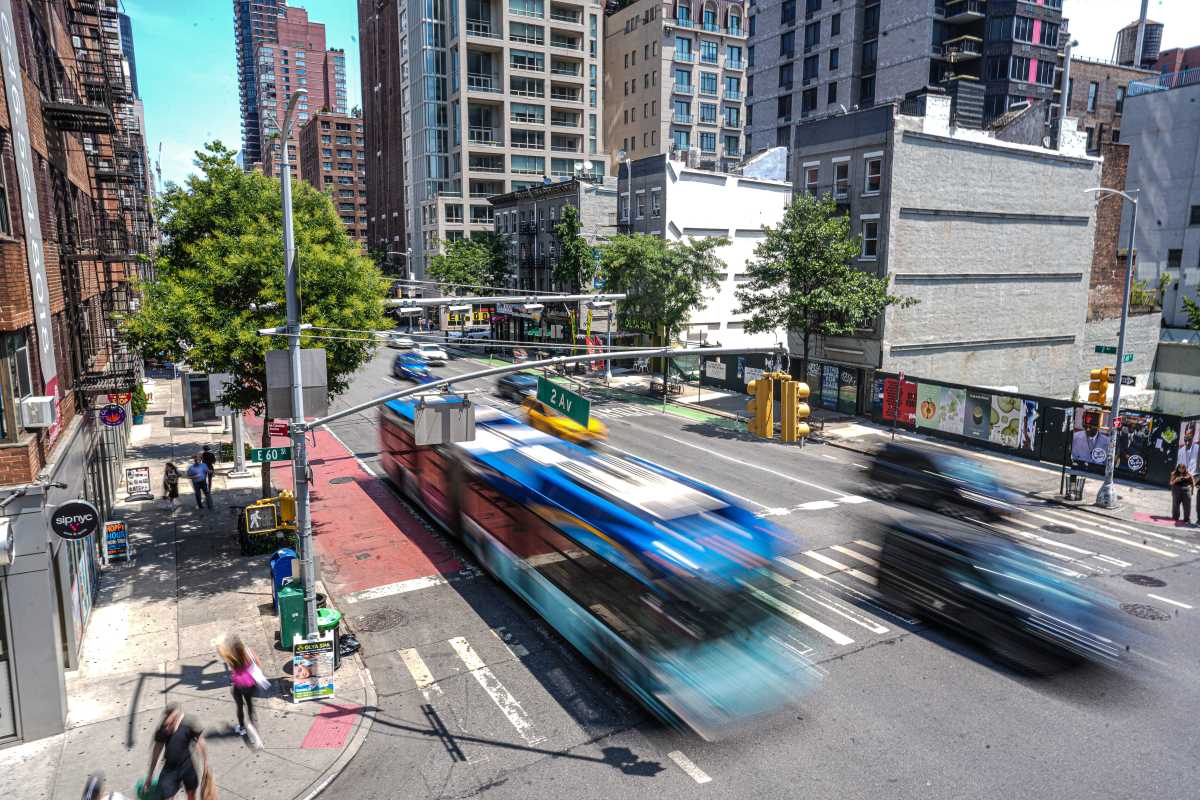
Perhaps the most striking issue one year in is the growing contradiction at the heart of New York’s transportation policy. On one hand, city leadership has championed fare-free bus pilots and broader affordability initiatives, implicitly acknowledging that cost is a barrier to mobility. On the other, congestion pricing layered on top of existing Metropolitan Transportation Authority surcharges and Port Authority fees has made taxis, for-hire vehicles (FHVs), and bus trips into Manhattan more expensive for passengers and drivers alike.
If the goal of congestion pricing is to encourage people to leave personal vehicles at home and shift toward shared, space-efficient modes, then increasing the cost of those very modes is counter-productive. Charging more to use taxis, FHVs, and buses undermines the policy objective and risks discouraging the behavior the program is meant to promote.
This tension is particularly acute for professional drivers, many of whom are already facing rising insurance costs, tighter regulatory requirements, and shrinking margins. For passengers, especially those who rely on taxis and FHVs for work or accessibility reasons, congestion pricing increasingly feels less like congestion management, and more like a new cost of living in New York City.
Who is paying and why it matters
There is no question that congestion pricing has been effective at generating revenue. Uber, Lyft, and taxis together generated roughly 27 percent of all congestion-pricing revenue in 2025 — about $150 million — on top of multiple existing MTA surcharges already borne by those riders. Aggregated, these rides contribute more than $525 million annually to the MTA, more than two and a half times the agency’s projected bus-fare revenue for 2026.
But revenue success alone does not answer the fundamental policy question: Is the burden being placed where it makes sense? These are not nominal fees borne by riders choosing taxis, FHVs, and buses, which are precisely the modes congestion pricing should support. If taxis, FHVs, and buses are no longer affordable, it will impact a significant funding stream for the MTA.
Taxis, FHVs, and buses are among the most space-efficient vehicles on Manhattan streets. If these modes are shouldering a disproportionate share of the financial load, courts and policymakers may increasingly question whether the program is functioning as a congestion-management tool, or evolving into a blunt revenue mechanism.
Time to rethink things, but not declare victory or success just yet
None of this is to say that congestion pricing has failed outright. It has reduced vehicle volumes and shown that pricing can influence behavior at the margins. These are real achievements. But one year in, its design is not fully aligned with its stated goals. Its burdens are increasingly falling on the riders and drivers who keep the city moving, and the policy contradictions are becoming harder to ignore.
Refinement is now essential. A durable congestion-pricing framework requires a serious reassessment of toll levels and exemptions based on actual congestion contribution, including full exemptions for buses, taxis, and FHVs that support shared mobility. It also calls for an evaluation and study which is independent of the MTA, including an analysis of environmental impacts, affordability effects, and true modal shift to determine whether the program is really working as intended for New Yorkers.
Absent that recalibration, congestion pricing risks losing public trust and legal durability, even as it continues to generate significant revenue. After one year, the question is no longer whether congestion pricing can work. The question is whether New York is willing to refine it so that it does.
The jury is still out.
Matthew Daus is the transportation technology chair for the University Transportation Research Center, Region 2 (NY/NJ) at the City University of New York