


A federal judge on Thursday kept alive claims that state health officials violated the due process rights of Rikers Island jail detainees who’ve been declared unfit to stand trial by keeping them in waiting, often for months, to begin court-ordered competency restoration services.
Detainees accuse the state Office of Mental Health of flouting court orders by refusing to accept them for treatment, leaving in limbo some 100 detainees on any given day.
The median wait time in 2024 was 81 days before transfer to OMH custody — but delays can run much longer, according to the August 2025 class action, with 130 people that year waiting longer than 100 days. In the past few years, 11 people have waited more than six months.
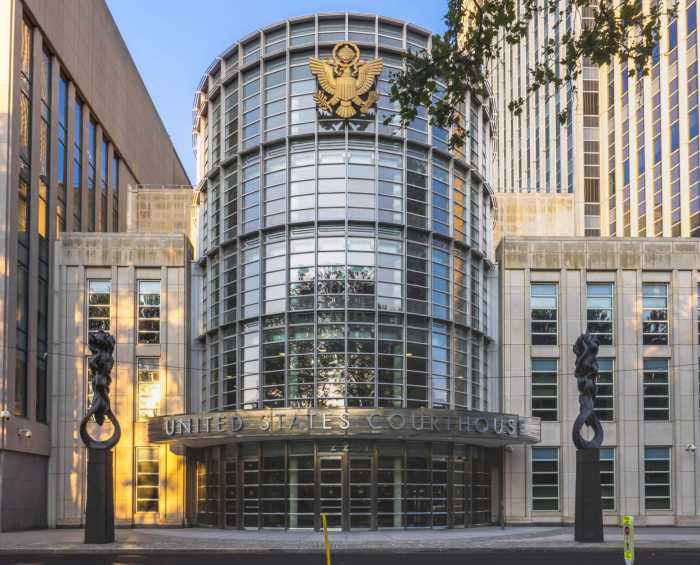
State and city agencies named in the complaint filed a motion to dismiss the lawsuit, but during an hour and a half-long hearing on Thursday U.S. District Judge Alvin Hellerstein of the Southern District of New York said the claims that the state denied the prisoners due process, at least, pass muster.
“You may be right in the end, but at this point I don’t see how I can dismiss the complaint,” Hellerstein told state attorneys, who argued that in past cases, judges have determined that lengthy holds in custody while competency restoration services are pending do not violate due process rights.
“I hold that there has been a well-pleaded complaint establishing due process claims,” Hellerstein said.
Arguing on behalf of the state, Caroline Wallitt, an assistant attorney general in the New York Attorney General’s Office, said the case “certainly raises a valid and serious issue,” but pointed to the state’s efforts to add beds to its facilities and to work with the Office of Court Administration to expedite proceedings.
Hellerstein however agreed with the detainee plaintiffs, who are represented by the Legal Aid Society and attorneys from Davis Polk & Wardwell, that the state should bring up those efforts in its defense; the argument doesn’t warrant dismissal.
Justin Mason, a spokesman for the state Office of Mental Health, echoed in a statement that the agency is working to manage an increased caseload.
“While OMH does not comment on pending litigation, our agency is continuing efforts to reduce a substantial and sustained uptick in 730 referrals from the state’s court system — a national trend that has been ongoing in New York since 2019 and continues today,” Mason said in a statement.
The agency added more than 100 inpatient psychiatric beds in recent years, Mason said, and expects to add another 25 beds this year. A new building for the Mid-Hudson Forensic Psychiatric Center is in the works, accounting for another 15 beds, and a project on Wards Island will tack on another 100 forensic beds — along with an additional 300 employees to improve the staff-to-patient ratio at forensic hospitals.
While the due process claims name only the Office of Mental Health and its commissioner, Ann Marie Sullivan, the suit also names the NYC Department of Health and Mental Hygiene, its commissioner Michelle Morse and the NYC Health and Hospitals Corporation, bringing claims under the Americans with Disabilities Act and Rehabilitation Act.
Legal Aid Society attorney Elena Landriscina argued that her clients face discrimination because they can’t partake in the criminal justice process while awaiting competency restoration treatment — barring access to government services, as compared to their counterparts who don’t have the same mental disabilities.
Landriscina found a comparison in the 2003 Henrietta D. v. Bloomberg decision, in which the U.S. Court of Appeals for the Second Circuit affirmed a holding in favor of HIV-positive New Yorkers who faced “unique physical barriers” to public benefits and services.
Hellerstein reserved ruling on those claims, but indicated he wasn’t readily convinced that discrimination could be pleaded, reasoning that mentally ill detainees simply need to go through additional procedures that take time before they can stand trial.
“It just takes time to do that. That’s not discrimination,” Hellerstein said.
Following the hearing Landriscina, the supervising attorney with the Special Litigation Unit at Legal Aid, said Hellerstein’s ruling underscores the responsibilities of the state.