
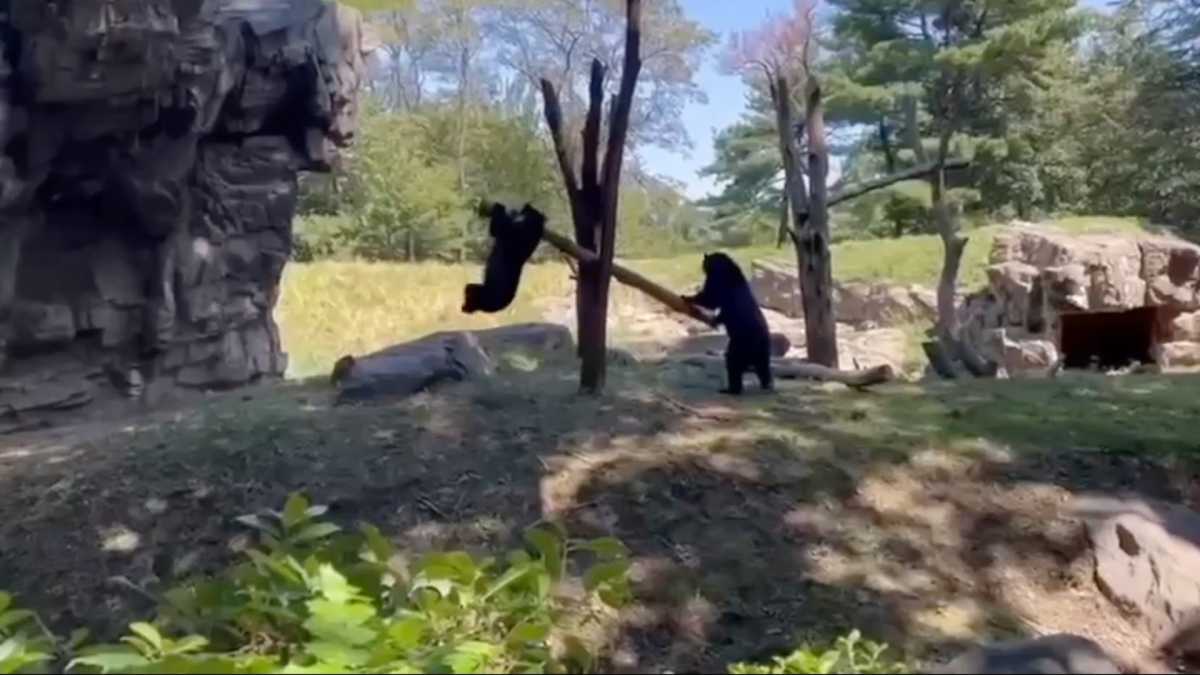
Two young bears at the Queens Zoo in Flushing Meadows Corona Park were caught living their best life when some humans spotted them playing a competitive game of seesaw — and it is all on video for New Yorkers and the rest of the world to enjoy.
The adorable scene shows two Andean bears playing with a large branch, each one taking turns pushing it up and down. Ursula McDermott, a zoo guest, captured the heart-warming moment as it unfolded.
The delightful video stars Coya, a female bear almost two years old, and her older male counterpart, Ransisku, a male who is nearly four years old. (Coya is on the right and Ransisku is on the left in the video.)
It is unclear which fluffy critter won the spirited match, but Mike Allen, director of zoo, commented that the bears’ playful moves are indicative of how they might act in the wild.
“As young bears, Coya and Ransisku are curious about everything in their environment,” Allen explained. “While this particular interaction with the branch is unique and fun to watch, it’s very much in line with their natural instinct to explore, climb, and test their surroundings. They’re learning about their habitat and each other every day.”
Andean bears: The only bear species native to South America (and you can see them in Queens!)
A smaller species of bear, Andeans are also known as spectacled bears for the distinctive white or cream-colored markings around their eyes. They are also the only bear species native to South America. Adults typically measure five to six feet long, with males reaching up to 340 pounds and females around 200 pounds. Highly arboreal, they rely on trees for nesting, foraging and resting.
In the wild, Andean bears inhabit the Tropical Andes across Bolivia, Colombia, Ecuador, Peru, and Venezuela. They are classified as vulnerable by the International Union for Conservation of Nature (IUCN). Fewer than 18,000 are estimated to remain, with populations threatened by deforestation and conflict related to cattle and corn production, according to conservationists.
The Queens Zoo is operated by the Wildlife Conservation Society (WCS), which conducts field conservation programs across the Andes to protect remaining bear populations. The zoo’s participation in the Association of Zoos and Aquariums Species Survival Program is a component of global conservation efforts.