


BY John Bayles
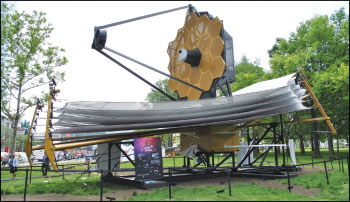
As a kick-off for the World Science Festival beginning this week in Battery Park, a full-scale model of the James Webb Space Telescope, successor to the Hubble, was unveiled at a special event on Tuesday.
“It’s a prime symbol of what the World Science Festival is all about,” said Brian Greene, co-founder of the festival, best selling author, and professor of Physics and Mathematics at Columbia University. “It’s about venturing into the unknown.”
Over 150 New York City students attended the event and in his opening remarks, Greene told the students the telescope represented what science was all about…“excitement, adventure, wonder and discovery.”
“It’s the most precise window yet into the cosmos,” said Greene. “It will provide answers to those deep questions.”
He asked the students one of those “deep questions” – did they believe there was life in outer space. And every student raised his or her hand in agreement. Afterward, Greene said he was surprised by that display, and that it made him feel optimistic about the future generation.
Also on hand was Nobel Laureate Dr. John C. Mather of NASA’s Goddard Space Flight Center. Mather is the senior project manager for the Webb telescope and told the students it would “literally re-write” their current science textbooks.
The Webb telescope is roughly the size of a tennis court. It is 80 feet long, 37 feet wide and 40 feet tall. It differs from the Hubble in numerous ways but most importantly in its ability to see infrared images. The Hubble, because it was warm, emitted its own infrared light and therefore was unable to detect infrared images clearly. The Webb however will be a cold telescope and Mather described the infrared technology it provides as a new opportunity.
“Everything we see [with the Webb] will be new,” he said.
With the Webb, Mather hopes to see the first stars after the Big Bang, the first black holes and how the our galaxy, the Milky Way, took it’s form.
“It wasn’t always a nice spiral,” he said.
He also hopes to use the telescope to study planets, particularly how stars interact with them and pass through their atmospheres. Studying that might lead to the aforementioned “deep question” about extra terrestrials. Should oxygen be found when a star passes through a planet’s atmosphere, one would be able to suppose that a life form, in turn, created the oxygen.
It’s also notable that the Webb is the first telescope not named after an astronomer. Instead, James C. Webb was a former NASA Administrator and was, in Mather’s eyes, a brilliant, dedicated civil servant.
The Webb will soar one million miles into space and be able to peer back 100 million years, before the beginning of time, before the Big Bang. It is expected to launch sometime in 2014.
The World Science Festival takes place in Battery Park from June 3rd to June 6th. For a complete listing of events and for more information visit
www.worldsciencefestival.com.