


 [/media-credit]
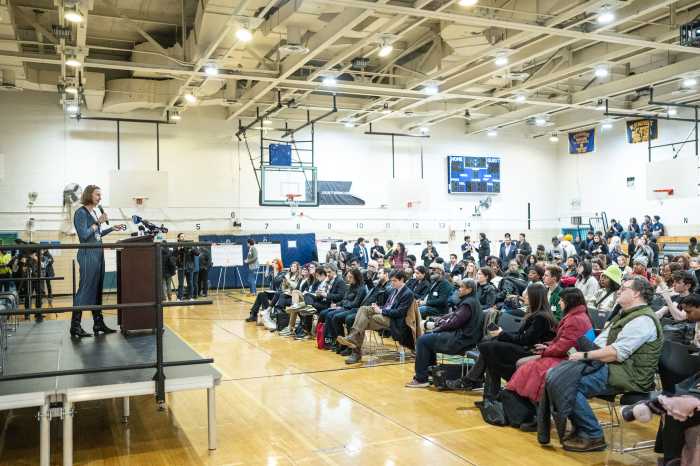
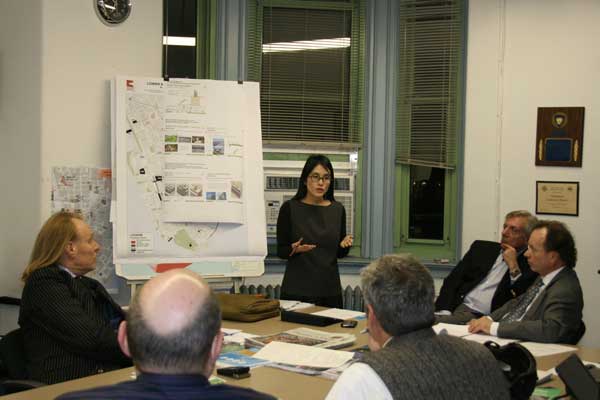
Grace Han, of the Department of City Planning’s Manhattan office, presented a series of amendments to the city’s zoning law that would lift certain restrictions to the construction and retrofitting of commercial and residential buildings in order to facilitate energy efficient designs. While C.B. 1 generally supported the plan, board members committed to preserving the historic characteristics of Tribeca buildings voiced concern that the allowances could result in unlawful aesthetic changes to landmarked buildings without additional design guidelines.
The proposal, subject to approval by the D.C.P. Commission as well as the City Council, would enable developers to more easily insulate buildings’ exteriors, add renewable generators such as solar panels and wind turbines, and otherwise make the buildings’ energy use more efficient.
Under the new rules, wind turbines, for example, would be permitted atop waterfront buildings and any others that are taller than 100 feet. The amended zoning would also encourage the creation of rooftop greenhouses by excluding the new structures from buildings’ floor area ratio and height limits, thereby maximizing profits for developers.
The changes are poised to save up to $800 million in energy expenses for property owners, businesses, and residents, according to the D.C.P.
“We hope developers will take the time to retrofit and make their buildings more energy efficient,” Han told the committee. “It’s about time that we look at renewable technology and ‘green’ development.”
Architect Corey Sharples, a member of C.B. 1’s Landmarks Committee, fears the plan might give developers a bit too much leeway when altering landmarked buildings.
“There’s a lot of pressure by the Mayor to go along with greening of the city,” said Sharples. “We’re concerned that, even with landmarks review, there would be pressure on the [city Landmarks Preservation] Commissioners to approve things that may not be in the best interest of historic buildings or the aesthetics of historic districts.”
Sharples also noted that Han failed to explain how the new regulations would dovetail with the city’s current buildings codes and was also concerned about the rules pertaining to future greenhouses.
“There’s a lot of money to be made from Manhattan rooftop parties,” said Sharples. “If you want to put up a greenhouse for kids, I’m all for it. But I don’t want to see 20-foot-high glass party spaces all over the city.”
George Calderaro, a member of the Historic District Council, a nonprofit advocate for the city’s historic neighborhoods, was equally hesitant about the proposal, even though he lives in Solaire, the country’s first Leadership in Energy and Environmental Design (L.E.E.D.)-Gold certified building.
“The proposals are very admirable, but in execution it could be disastrous,” said Calderaro. “The amendment must explicitly state that landmarks and buildings in historic districts are subject to review by the Landmarks Preservation Commission.”
In response, Han assured that all proposed changes to landmarked buildings will continue to undergo L.P.C. review, and that developers violating the rules would incur penalties.
“That won’t change,” Han said. “But the majority of our zoning doesn’t look at materials. The more guidelines there are, the more difficult they are to enforce.”
Jeff Galloway, chair of C.B. 1’s Planning and Community Infrastructure Committee, which hosted the meeting, defended the zoning changes. He contended that developers shouldn’t be penalized because of “green” features in their proposals.
“There’s absolutely no doubt that adding insulation will have a dramatically positive energy conservation effect,” said Galloway. “I don’t think you should hold this hostage to [new] design guidelines, which may or may not ever be approved for this city. It’s not obvious to me that adding a new set of guidelines actually will make things better.”
Nearly all C.B. 1 members present at the meeting, including Galloway, rejected the idea of wind turbines, asserting that the noise they create could disturb local residents and that they could be eyesores and possibly pose safety hazards to pedestrians.
“If you saw windmills everywhere, you’d feel like you were down at the East Side helicopter pad,” said Roger Byrom, co-chair of the landmarks committee.
“I find it impossible that you could put a turbine on a roof without problems,” said Galloway.
At the meeting’s end, both committees voted unanimously in favor of a resolution supporting the zoning amendment but urging the L.P.C. to evaluate renovations to landmarked buildings irrespective of the proposals’ “green” characteristics.