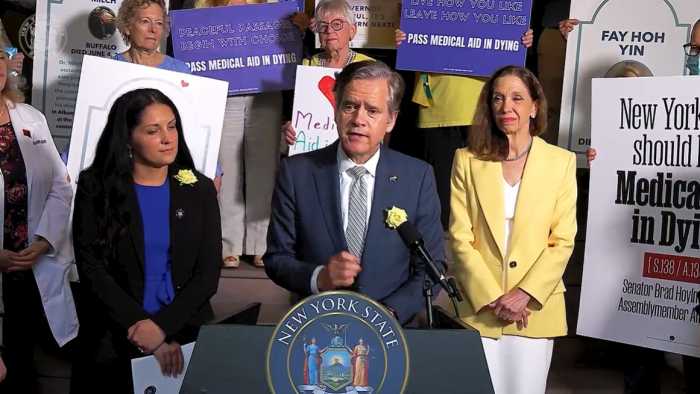



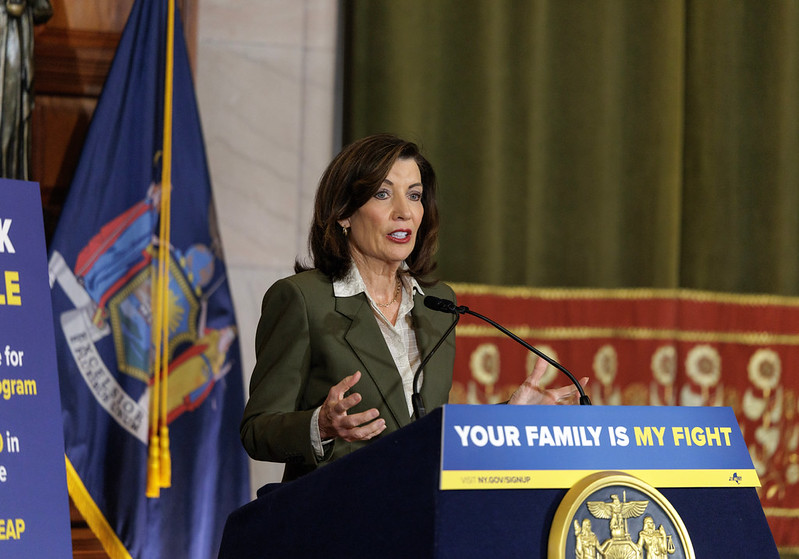
Gov. Kathy Hochul announced her support Wednesday for a revised version New York’s Medical Aid in Dying (MAID) bill, legislation that would give terminally ill patients in the state with six months or less to live the option to end their lives using a prescribed lethal cocktail of drugs.
The governor will not sign the version of the MAID bill that the state Legislature approved earlier this year. Rather, Hochul said, she would ink a revised version of the same legislation, agreed upon with the sponsors and legislative leaders, that will be introduced when the Assembly and state Senate reconvene in January.
Hochul made the announcement in an Albany Times-Union opinion piece on Wednesday, in which she called the bill a way to “speed up” the dying process for terminally ill New Yorkers who have been professionally diagnosed to have less than six months to live.
She said she will pass and sign the bill next month; the law will go into effect six months later.
The governor, whose mother died of ALS, said she spoke to New Yorkers throughout the state who are suffering from terminal illness to help her decide whether or not to approve MAID. She also heard from patients’ families.
“I heard from their children, who are watching a parent endure a slow, devastating decline,” she said. “I heard stories of a parent or spouse pleading for an end to the suffering and how difficult it was to reply, ‘We can’t in New York.'”
She said she spent time reflecting on religious viewpoints against the practice, opinions she said she both understands and respects.
“So after careful deliberation, I decided to support legalizing medical aid in dying in very specific circumstances and with significant protections included in the law to ensure it is not misused or broadly applied,” she wrote on Dec. 17.
Some of those safeguards in the law include allowing individual doctors and religiously affiliated health facilities to decline offering MAID.
Changes to the MAID bill
The bill’s sponsors, including Assembly Member Amy Paulin of Scarsdale and State Senator Brad Hoylman-Sigal of Manhattan, agreed to make additional amendments to the bill before the governor approves the legislation.
Confirmation from a medical doctor that the individual “truly had less than six months to live,” and from a psychologist or psychiatrist that the patient is capable of making the decision, will now be required, Hochul said.
She also requested a mandatory five-day waiting period to provide the patient the chance to change their mind, and both a written and recorded oral request to confirm free will is present.
Anyone who may benefit financially would be disqualified from being a witness or interpreter, Hochul said. Additionally, MAID in New York will only be available to residents of the state.
“I will ultimately sign once the Legislature returns to Albany and approves the amended language,” the governor said.
A ‘truly historic’ moment
Paulin said Hochul’s announcement will give many New Yorkers autonomy and dignity at the most vulnerable time in their lives.
She added that the issue is a personal one.
“My sister died a horrific death from ovarian cancer, and in her final days she was in pain so overwhelming that she begged for death,” the Assembly Member shared. “Her experience is, tragically, the story of so many others. Most people will never choose medical aid in dying, but they want the reassurance of having it as a compassionate safeguard that offers comfort even if it is never used.”

She thanked advocates and fellow politicians involved in the decade-long effort.
“With this law, New York will become the 12th state, plus Washington, DC, to embrace compassion at the end of life,” she said.
Hoylman-Sigal said in a media statement that the announcement is a “monumental victory” for New Yorkers with terminal illness.
“Since we first introduced this legislation nine years ago, I have consistently said this bill is not about ending life, it’s about shortening death,” he said. “I’m proud that New York is now the 13th state, along with Washington, DC, that will offer expanded end-of-life care so that terminally ill New Yorkers gain greater autonomy over how much pain and suffering they must endure.”
Robin of Manhattan, whose husband suffered and died from terminal cancer in 2018, said she can understand why patients would opt for MAID.
“I think there are certainly enough safety protocols in place that it’s not like a person can be influenced to make this choice,” she said. At least, it doesn’t sound like it.”
She added that the governor’s announcement in the Times-Union “read very sound and well thought out.”
Sam Mak, also from Manhattan, agreed with the bill.
“Allowing a dying person, and his or her family to decide on terminating one’s life is logical, and humane enough, I’d say,” Mak said.
Opponents to MAID react
Max Rodriguez, manager of government affairs at the Center for Disability Rights in Albany, said it is “disappointing” that the governor would sign the controversial bill. When looking at the legislation in other states, Rodriguez said many people choose MAID for the comfort of others—not for themselves. He explained that the fear of loss of autonomy such as “being a burden on friends, family and caregivers, a worry they’ll live a decrease in quality of life” have been reasons people chose physician-assisted suicide.
“The governor is opening Pandora’s box on suicide, creating a system in which some people receive suicide prevention while others are offered a fast track to death,” Rodriguez said. “In doing so, the state sends a clear signal that fears about illness, disability and becoming a burden are justified.”
With healthcare and similar services becoming increasingly difficult to access, the bill is even more concerning, he explained.
“At a time when access to healthcare and home and community-based services is increasingly restricted, New York has declared that the preferred response to illness and disability is death rather than care,” Rodriguez said.
In a joint statement with Timothy Cardinal Dolan, the Bishops of New York issued a statement saying they are “extraordinarily troubled” by Hochul’s announcement that she will sign the “egregious” bill.
“This new law signals our government’s abandonment of its most vulnerable citizens, telling people who are sick or disabled that suicide in their case is not only acceptable, but is encouraged by our elected leaders,” the statement read.
They also said the law will undermine anti-suicide and mental healthcare investments that the governor herself made throughout her tenure.
“How can any society have credibility to tell young people or people with depression that suicide is never the answer, while at the same time telling elderly and sick people that it is a compassionate choice to be celebrated?” the bishops questioned.
One man from Queens, who cared for two family members who were dying at the same time — his mother and aunt — said he does not support MAID, but understands it is a “very sensitive” subject.
“I was a caretaker for two family members who died recently from chronic diseases,” said the man, who declined to give his name. “Neither would have accepted this option.”