



Gov. Kathy Hochul has until the stroke of midnight on New Year’s Eve to sign or veto a bill that would literally mean life or death for many New Yorkers.
Earlier this year, the state Legislature passed the Medical Aid in Dying Act (MAID) — which would, if enacted, give terminally ill patients in the state with six months or less to live the option to end their lives using a prescribed lethal cocktail of drugs.
The legislation would legalize the practice known as “physician-assisted suicide.” The patient would receive the prescription from a pharmacy and self-administer the drugs.
MAID has proven controversial. While proponents say physician-assisted suicide delivers a dignified, merciful end to people dying of agonizing terminal illnesses, opponents argue that it sets the state on the course of adopting euthanasia through a program that, they say, offers inadequate safeguards to protect vulnerable patients and communities.
If Hochul vetoes the bill, proponents of MAID would need to reintroduce the bill in the next legislative session, beginning in January, if they choose to try and make it law again.
The governor’s office has not yet responded to amNewYork’s request for comment on the bill and whether Hochul is considering signing it.
Supporters of the MAID bill: It’s about ‘compassion’

amNewYork spoke with family members who believe patients should be granted the option of medical aid in dying as well as opponents of the heavy-hitting bill.
For Robin, a Manhattan resident, the issue is deeply personal. She spent two years watching her husband, Jonathan, fight metastasized prostate cancer. For much of that time, his life revolved around hospital visits for grueling rounds of chemotherapy and other treatments.
“It was hard,” she recalled about caring for him and watching the toll it took on his body. “The first year and seven months, that’s when I really started to see the deterioration.”
Jonathan grew increasingly frail and tired. One day, he fell out of bed and hit his head. The incident forced Robin to assume the responsibility for lifting and moving him. The couple eventually brought a hospital bed into their home, a painful but necessary step that helped Jonathan move a bit easier.
Meanwhile, doctors had confirmed there was “not much more” they could medically offer.
A compassionate social worker helped transition the couple to at-home hospice care. Robin described the process as “seamless.” A nurse began visiting their home, administering pain-relief medication that helped ease Jonathan’s suffering. He passed away peacefully, less than a week after entering hospice, in 2018.
Despite Jonathan’s determined will to live and initial resistance to accepting his diagnosis, his wife witnessed such profound suffering that she ultimately described his passing as a “blessing.”
“It was so bad at the end, it was a blessing,” she said. “But of course, I miss him terribly. We were married 32 years. But, there was no recovery.”
Robin told amNewYork she can see why a suffering person would choose MAID.
“I can certainly understand why people would want to choose that option. 100%,” she said. “I think there are certainly enough safety protocols in place that it’s not like a person can be influenced to make this choice. At least, it doesn’t sound like it.”
Some provisions in the bill currently include the patient being mentally competent; they would also have to make a request for the aid, both verbally and in writing. Doctors can also refer a patient to a mental health professional for evaluation.
“If the mental health professional determines that the patient lacks capacity to make an informed decision, the patient shall not be deemed a qualified individual and the attending physician shall not prescribe medication to the patient,” the bill’s language notes.
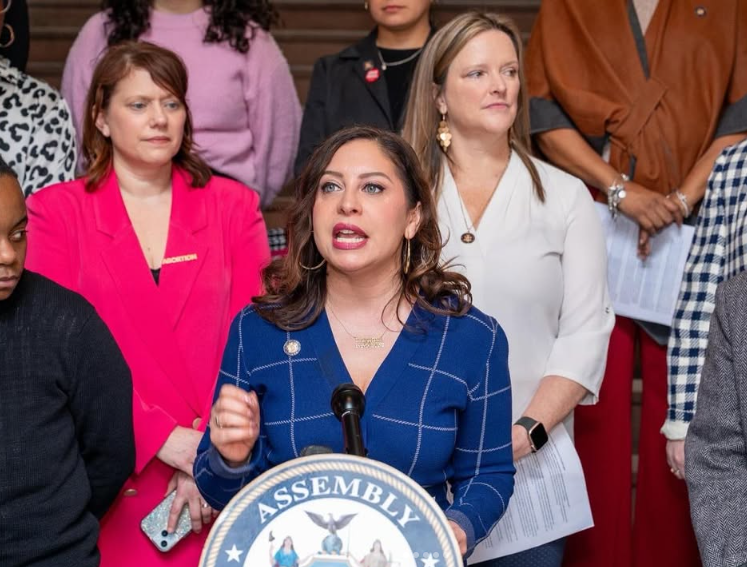
Assembly Member Amy Paulin of Scarsdale, a sponsor of the bill, said MAID is about “compassion.” It would give terminally ill New Yorkers the autonomy to “choose comfort and control at the most vulnerable moment” of their lives, she said.
Like Robin from Manhattan, the issue is a deeply personal one for Paulin. Her sister suffered and died from ovarian cancer, she shared with amNewYork.
“And in her final days she endured pain so severe that she begged for relief,” Paulin recounted. “Her experience is tragically shared by far too many families across our state. While most people may never choose medical aid in dying, knowing the option exists provides peace of mind when facing the unimaginable.”
If the bill is signed into law, New York would be the 12th state to allow MAID. It is legal in neighboring New Jersey.
“After more than a decade of advocacy, New York has the opportunity to join other states in offering a compassionate safeguard at the end of life,” Paulin said. “I urge its passage so that no New Yorker is forced to suffer without choice, dignity, or mercy.”
Outgoing Manhattan state Sen. Brad Hoylman-Sigal is another prime sponsor of the bill; in January, he will vacate his senate seat to take office as Manhattan’s next borough president.
Following the state senate passing of the bill on June 9, Hoylman-Sigal said that MAID is a “proven strategy” to “expand end-of-life options” and ease pain.
“MAID is a proven strategy to expand end-of-life options and reduce human suffering for patients with a terminal illness that is already in effect in eleven states and the District of Columbia, in addition to being supported by nearly 70% of New Yorkers,” he said.
Opponents of MAID say it is a ‘dangerous’bill
Kristen Curran, director of government relations at the New York State Catholic Conference, is concerned and critical of the MAID bill.
“This is an incredibly dangerous piece of legislation,” she told amNewYork. “The bill as written right now would be the most permissive assisted-suicide legislation in the country. Part of why this is so dangerous is because they are not going to stop here.”
She cited MAID in Canada, which has expanded its law to include patients who do not have a fatal or terminal condition as eligible for the procedure.
“Their legislation started out much like this legislation [in NYS], and they’ve done nothing but expand it, Curran explained, adding that it is a “huge threat” to vulnerable communities.
Max Rodriguez, manager of government affairs at the Center for Disability Rights in Albany, echoed Curran’s comments about the impact on disabled communities. His organization is against the legislation in all forms, even if Hochul were to add more safeguards to the bill.
“Amendments wouldn’t make any difference here as far as what the intent of the bill is,” he said. “Primarily, we are concerned about the kind of message this sends to society.”
When looking at the legislation in other state, Rodriguez said many people choose MAID for the comfort of others—not for themselves.
“Proponents have made it seem like pain is the reason why people opt for this, but when you look at the actual data, that’s not true,” he said. “In Oregon, the top five reasons people opt into assisted suicide is are actually all issues related to disability. The fear of loss of autonomy, feeling like a burden on friends, family and caregivers, a worry they’ll live a decrease in quality of life.”
When a person is terminally ill, they will likely become disabled, Rodriguez explained.
“You will eventually need care, help going to the bathroom, getting out of bed, getting dressed. As you are terminal, you become disabled. Really what we should be doing is providing increase in funding in programs to help people address those issues.”
Cardinal Timothy Dolan and the NYS Bishops issued a statement earlier this year with a similar message, calling for more help for New Yorkers, instead of a “state-sanctioned suicide” bill.
“At a time when New Yorkers are rightly concerned with issues such as affordability, crime, homelessness, federal cuts to Medicaid, behavioral health access, and their children’s education, it is unconscionable that lawmakers would consider now an appropriate time to legalize suicide for a segment of the population,” the statement read.