


The brutal cold snap gripping New York this winter has left utility customers feeling the burn of skyrocketing heating bills.
National Grid customers in NYC are outraged over skyrocketing heating bills, coinciding with the utility giant’s Monday announcement of “record usage” during the city’s ongoing cold snap.
The astronomical costs, several readers told amNewYork, are overwhelmingly driven not by increased consumption but by soaring delivery fees and other unclear charges listed on their monthly bills. Many customers said the extra charges far outweigh the actual cost of the natural gas they used.
The complaints coincide with National Grid reporting “record usage” during the city’s ongoing cold snap, as more New Yorkers are turning up the thermostat to stay warm while the mercury plunged far below the freezing point.
But some say their heating bills have gone up even as they resist the temptation to turn up the heat.
Rich Candia, a Staten Island homeowner who happens to enjoy minimal heat in his house, highlighted the disparity. He said the delivery service costs amounted to more than half of his most recent bill.
“My heat is completely off every single night, and I use it intermittently during the day, and my last two bills were over $300,” he explained. “I don’t like sleeping with the heat on. The delivery rate was 67% of the total bill. The delivery should not be 67% of the total bill.”
Candia explained that the heat in his house is typically set between 50 and 55 degrees for most of the day, despite the exorbitant costs.
“It’s preposterous,” he said.
Delivery charges draining New Yorkers’ bank accounts?
Candia and others who spoke to amNewYork said they started noticing higher delivery charges last winter. Linda Portnoy-Moleta, also of Staten Island, said she noticed higher delivery charges over the previous few months.
“Absolutely higher in the last few months, National Grid and Con Ed,” she said. “It’s outrageous how high these delivery charges are. It’s not fair, especially to us seniors on a fixed income.”
Charges listed as “delivery charges” on National Grid bills include:
- Basic service charges
- Over/last Therms
- Delivery Rate Adj.
- An array of surcharges and sales tax
But utility companies such as National Grid do not set their own rates unilaterally. New York’s Public Service Commission (PSC) is responsible for regulating the state’s electric, gas, steam, telecommunications, and water utilities, and overseeing the cable industry.
Members are appointed by the governor and confirmed by the state Senate. The PSC must approve any rate changes that utility companies propose.
amNewYork wrote about the most recent PSC approval of a National Grid rate hike for the NYC area, stemming from a three-year rate plan adopted in August 2024. That plan covered downstate New York, including New York City, Long Island, and the Rockaways, and provided phased rate increases through April 1, 2026 — including about 19.4% in Sept. 2024, 5.1% in April 2025, and 11.1% effective April 1, 2026.
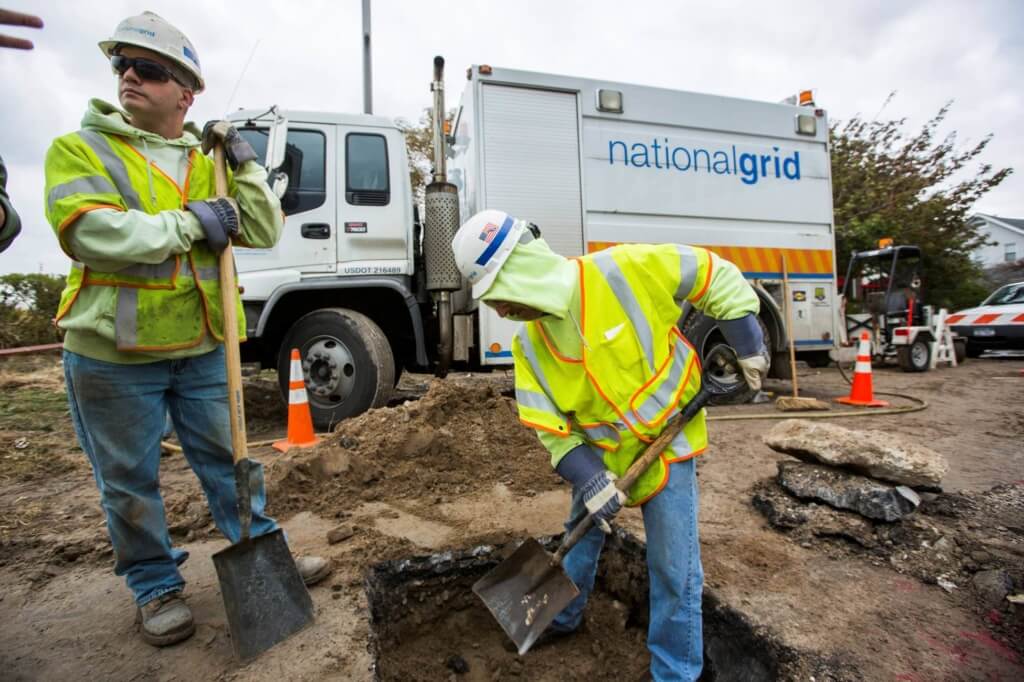
A National Grid spokesperson explained that the delivery fees on customers’ bills help pay for the company’s infrastructure, including maintenance, a union workforce and upkeep of the delivery network.
“The delivery rates are higher than the actual cost of the gas being used. That is a thing that often times strikes a customer,” the spokesperson said. “There are taxes and fees and surcharges in the delivery portion of the bill, along with the cost to run the business, including infrastructure upgrades, maintenance, wages for employees, etc.”
Meanwhile, the utility announced on Feb. 9 that it delivered “record levels” of natural gas across the state during the city’s ongoing cold snap.
In total, eight of the top 10 highest natural gas output days in National Grid’s history on Long Island have occurred between Jan. 23 to Feb. 7, surpassing a previous record that stood since Jan. 21, 2019. In that same period, NYC hit three of the top 10 days of natural gas output.
“Our outstanding workforce, and the natural gas system they operate, performed exceptionally well across New York under some of the coldest and most demanding conditions we’ve seen in decades,” Sally Librera, president of National Grid New York, said.
The company also said in its announcement that the higher bills are due to increased usage.
NYS Department of Public Service denies heavy delivery fees
James Denn, a spokesperson for the Department of Public Service, said the high gas bills are the result of “wholesale energy prices,” not delivery fees that the commission had already approved for National Grid.
“The PSC approved 2025 delivery rates for National Grid that were much more favorable to customers than the company’s original request, significantly reducing the initial rate year request,” he said. “Importantly, the PSC does not regulate or set wholesale energy prices, which is a leading driver of the increase in energy bills due to the current cold weather we are experiencing.”
When pressed on why the delivery rates are so high, he recommended customers file a complaint if they think their bills have an error.
Ronald G., of Queens, said he is frustrated with his heating bill.
“The actual gas I used in December was around $24,” he said. “My delivery services were almost $100. My neighbors are in the same boat. New York taxed both my gas supply and delivery services.”
A spokesperson for the NYS Senate Majority said the sticker shock customers are seeing are from the recent rate hikes. National Grid and PSC did not elaborate on the specific kinds of fees that would increase when they made the 2024 announcement.
Consumer advocates, like Joe Ranola, a NYC Realtor who runs an Instagram channel about housing and similar topics, said the problem with the high bills is not that delivery charges exist, but they have become “unavoidable, hard to understand and disconnected” from how much gas New Yorkers actually use.
“When a cost is fixed and regulated, people accept it. When it’s fixed, rising, and poorly explained, trust breaks down,” he said. “From a homeowner perspective, unpredictability is worse than high cost. You can budget for expensive. You can’t budget for confusing.”
View this post on Instagram
Despite the grim news, there is a potential silver lining for consumers, similar to the point Ranola made about transparency. Although the Senate is in charge of confirming PSC members, the legislative body recently announced a list of measures aimed at restructuring utility billing practices to make things better for New Yorkers.
The Senate Democratic Conference advanced legislation on Feb. 4 that would, among other things, require utilities to return excess revenue to ratepayers and mandate that utility providers notify ratepayers of a proposed rate hike via text, email, and/or their monthly utility bill.
One bill in the package, named S. 1329, would direct the Department of Public Service to limit monthly fixed service charges. If this were to become law, utility corporations would only be permitted to bill residential customers fixed charges for fixed operation and maintenance costs directly related to metering, billing, service connections, and the provision of customer service.
The package of bills also authorizes the PSC to consider non-economic damages when determining penalties for utilities.
NYS Sen. Kevin Parker, one of the sponsors of the package, said the legislation is about “restoring trust” and improving transparency in bills.
“It sets real guardrails on utility practices, strengthens transparency, and recognizes the day-to-day realities New Yorkers face when rates rise without warning or explanation,” he said. “At its core, this work is about affordability, accountability, and basic dignity making sure the essential services people rely on are governed with fairness and respect for those who pay the bills.”