


The City’s Department of Transportation has selected mobility company Tranzito to build and operate a citywide network of secure bike-parking stations, a project expected to include at least 500 units across all five boroughs aimed at boosting cycling by addressing concerns over bike theft.
The DOT announced Monday that the California-based company was the top-ranked bidder from a 2024 request for proposals and will enter contract negotiations for a five-year deal. The contract is scheduled to start May 1, 2026, meaning the first units are unlikely to appear until the second half of the year and will be overseen by the incoming mayoral administration.
Asked whether the mayoral transition complicates the contract, Tranzito CEO Gene Oh said he is confident it will not. “This program is even aligned with the new administration’s objectives,” he said, adding that his firm generally avoids political outreach. “We’re operators… we let the political wings kind of take care of itself.”
Tranzito has operated secure bike parking in the San Francisco Bay Area, Portland, and Minneapolis. While these cities have increased bike ridership through infrastructure investments, none have deployed a network at New York’s scale, he said. In the Bay Area, the company operates a few hundred locations; New York’s 500-unit network would be the largest in the country.
Oh described the project as focusing on two key groups: current riders who depend on bikes for work, including delivery workers, and new riders hesitant to invest in a bicycle without secure storage. “Providing secure bike parking is the first step to making cycling accessible to a much broader population,” he said.
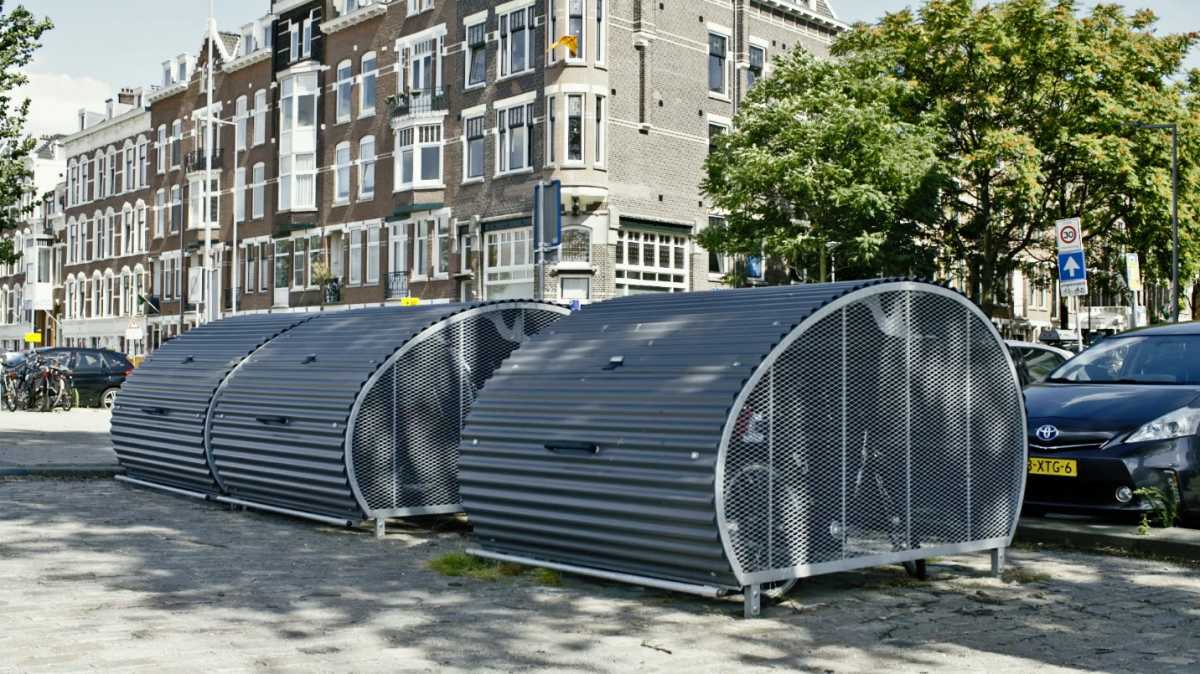
Most Tranzito units under consideration by the DOT are roughly the size of a compact car and can hold up to six bikes. While the DOT has not finalized pricing or access models, Tranzito has used smartphone-based entry with multi-factor identity verification in other cities. Oh said users without government ID could enroll through a manual onboarding process developed with local partners, including the Workers Justice Project.
“The idea is that all of these bike parking options can be accessed by smartphone with an app,” Oh said. Users will still lock their own bikes inside the stations. The company plans to layer in multifactor verification and security screening because “there’s other people’s private property that’s involved” inside each shared structure.
The cost of each unit to the city has not been finalized, though Oh noted that tariffs on imported materials, particularly from European suppliers in the Netherlands and Estonia, have increased current costs. The company also has U.S. manufacturing partners, with final assembly of each shed planned in Queens.
Oh said units in past installations have run “about $1,000 to $1,500” for basic non-smart versions with physical keys. App-enabled versions with Bluetooth access and remote support cost “anywhere from $2,000 to $3,000,” depending on component quality, though he declined to confirm any specific figures for New York.
E-bike charging is still under consideration. Oh said it would be “highly beneficial” for riders but requires more complex electrical work, which will also be decided by the DOT.
The DOT has also not indicated how much New Yorkers might have to pay to store their bikes. “From experience, Oh believes a “marginal user fee” is beneficial, arguing it improves both security and user responsibility. He said typical fees elsewhere run “$20 to $50 a year,” though New York would ultimately decide whether to charge annually or hourly.
The city plans at least 500 installations over five years, though the DOT has not finalized how many will appear in the first wave. Officials said secure storage is essential for the city’s growing ridership, now more than 600,000 daily trips, particularly for New Yorkers who cannot bring bikes into apartments or rely on heavy e-bikes.
“One thing I love about our city is how we are always innovating. We’re constantly deploying new tools to make New York smarter, safer, and more livable – and Secure Bike Parking is a perfect example,” said Deputy Mayor for Operations Jeffrey Roth. “These 500 new bike storage units will make biking safer and more convenient for thousands of New Yorkers, especially those without space to store a bike at home. Thank you to DOT for the hard work that got us here. I look forward to partnering with Tranzito as we bring this groundbreaking initiative to neighborhoods across the city.”
The announcement comes after several years of pilot programs from Brooklyn-based startup Oonee, which operates bike parking hubs outside Atlantic Terminal, Port Authority Bus Terminal, the Holland Tunnel, and Grand Central. The company also has contracts in Jersey City and Minneapolis. Oonee’s hubs are free to use and funded by advertising.
Speaking previously with amNewYork, Oonee CEO Shabazz Stuart said the RFP was “a dream come true” and hoped his company could be selected. After Monday’s announcement, Stuart posted on X, formerly Twitter, calling it the “hardest day of my life,” saying Oonee’s proposals were “not taken seriously.”
“We fought for nearly a decade to bring secure bike parking to NYC and ultimately were completely excluded from the @NYC_DOT process. To those who have believed in @ooneepod and our vision I am deeply sorry,” he wrote.