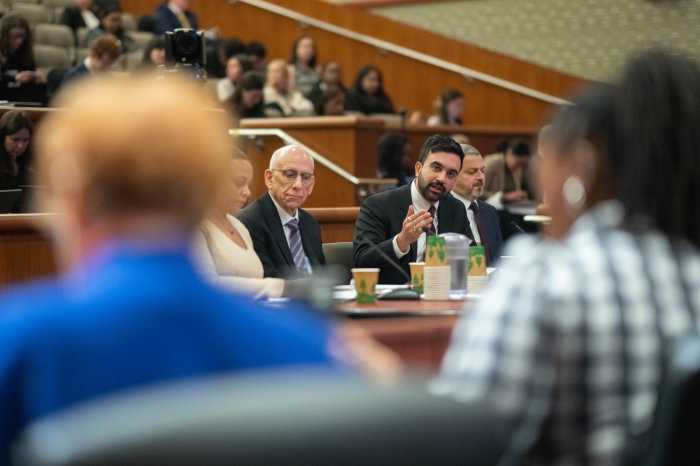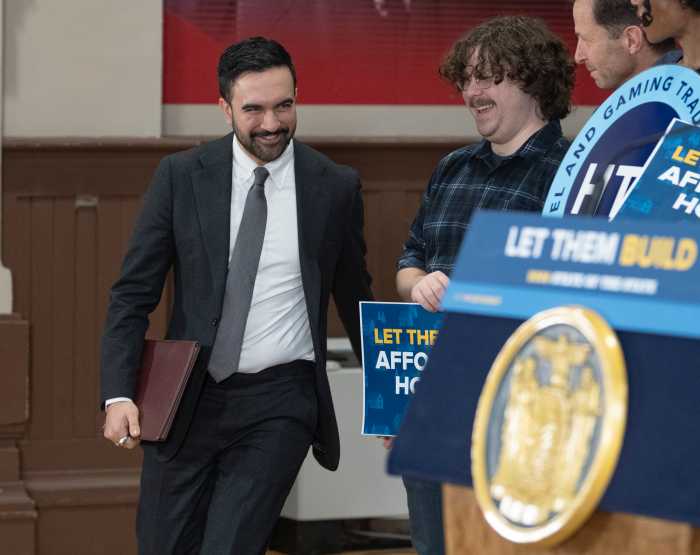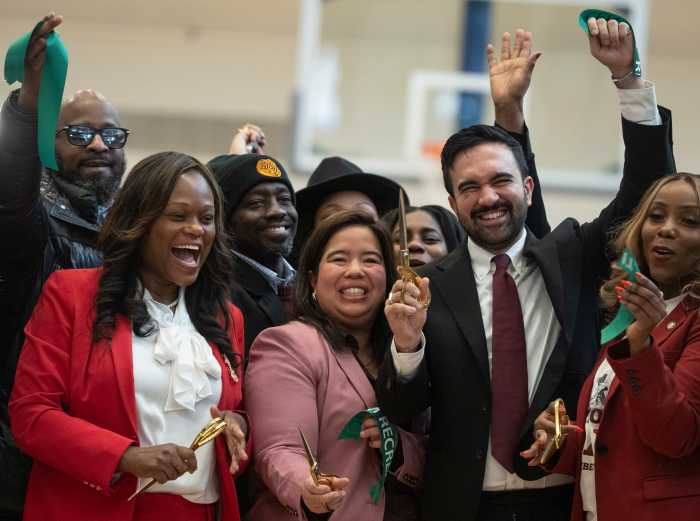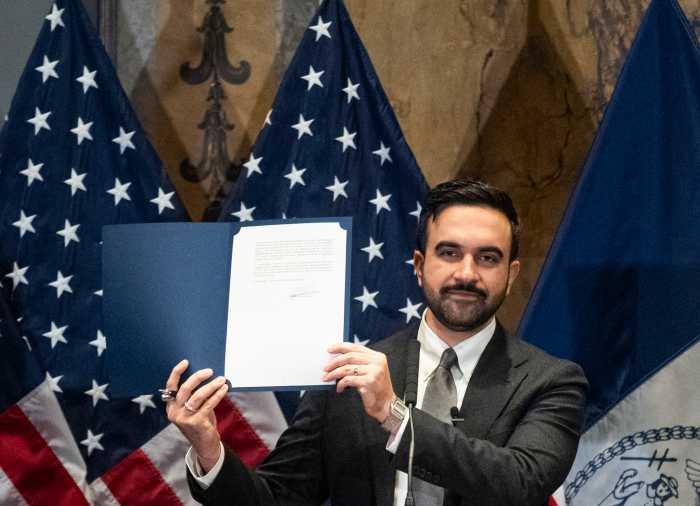



Thursday, Feb. 12, marks the 43rd day of Zohran Mamdani’s term as mayor. amNewYork is following Mamdani around his first 100 days in office as we closely track his progress on fulfilling campaign promises, appointing key leaders to government posts, and managing the city’s finances. Here’s a summary of what the mayor did.
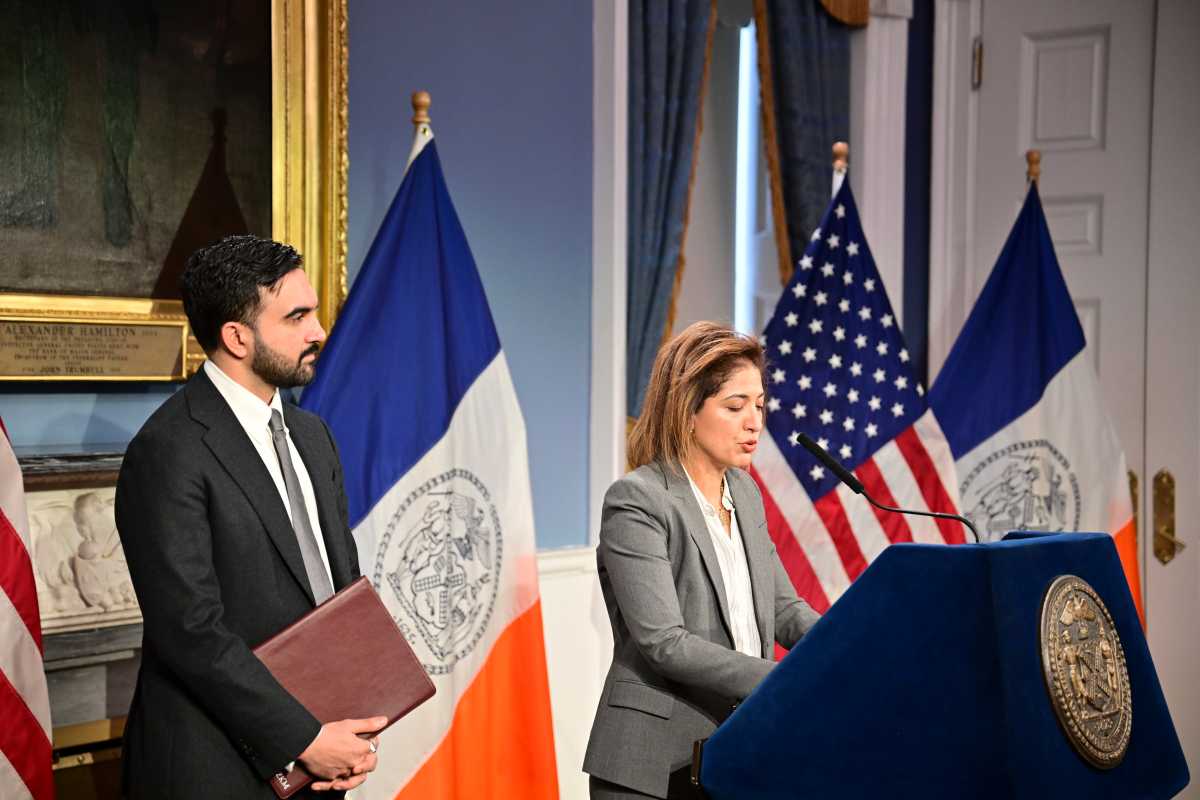
Mayor Zohran Mamdani on Thursday nominated former federal prosecutor Nadia Shihata to lead the city’s Department of Investigation, tapping a veteran of public corruption and organized crime cases to oversee the city’s independent watchdog agency.
Shihata spent more than a decade as a federal prosecutor in the U.S. Attorney’s Office for the Eastern District of New York, where she worked on major racketeering and public corruption cases, including serving as a lead prosecutor in the R&B singer R. Kelly’s racketeering and sexual misconduct trial, which resulted in a 30-year prison sentence in September 2021 after Kelly was convicted on all nine charges he faced.
Speaking at City Hall on Feb. 12, the mayor framed her nomination as a central piece of his administration’s push to restore trust in government and root out corruption across city agencies.
“There will be zero tolerance for self-enrichment or corruption in my City Hall,” Mamdani said. “But words are not enough. They must be backed up by action and accountability.”
If confirmed by the City Council, Shihata would lead the DOI, which probes corruption, fraud, waste, and abuse across city government and among those who do business with the city.
Shihata also served as chief of the organized crime and gang section and previously as deputy chief of the public integrity section, supervising investigations into misconduct by public officials.
Earlier in her career, she worked as an appeals counsel at the International Criminal Tribunal for the former Yugoslavia, and later clerked for a federal judge and worked in private practice at large law firms.
After leaving the U.S. attorney’s office in 2022, Shihata co-founded the women-owned boutique firm Shihata & Geddes LLP with fellow former prosecutor Elizabeth Geddes. The firm focused on criminal defense, civil rights cases, and internal investigations. Shihata departed the firm in September 2025, and the remaining partners later rebranded the practice as Corva Law.
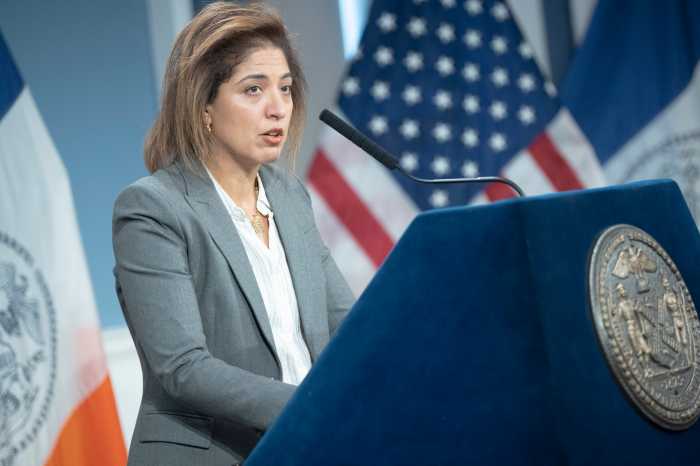
“I see the role of commissioner of the Department of Investigation as a continuation of that work,” Shihata said at the press conference. She said the agency’s mission includes not only rooting out corruption but also preventing it through oversight and policy recommendations. “DOI helps ensure that city government can tackle big challenges effectively and efficiently while operating with integrity, accountability, and fairness for all New Yorkers.”
Shihata, a naturalized citizen and Egyptian American, would be the first woman of color to lead the department, according to the mayor’s office. She described the opportunity to give back to a city that continues to welcome immigrants as profoundly meaningful, saying it “means more than I can fully express in words today.”
Her appointment follows the departure last month of former commissioner Jocelyn Strauber, who was appointed by then-Mayor Eric Adams in early 2022 to lead the DOI. Strauber oversaw the DOI inquiry that ultimately led to the mayor’s 2024 federal indictment; the charges were later permanently dismissed after President Donald Trump’s Justice Department moved to drop the case.
Mamdani described the new nomination as part of a broader effort to usher in “a new era of public excellence” at City Hall, saying many voters supported him because they wanted government that works for residents rather than insiders.
He also said the new administration would build on the work of Strauber, the previous DOI commissioner, whom he praised for investigating corruption at high levels of government.
In response to a reporter’s question, Shihata said she does not anticipate needing to recuse herself from any ongoing DOI investigations, noting she did not represent anyone under investigation by the agency during her time in private practice. If any conflicts arise, she said, she would follow proper recusal procedures.
If confirmed by the City Council, she said she plans to lead the agency “with independence, fairness and transparency.”
Housing: Mamdani’s CityFHEPS Pivot
At the same press conference on Thursday, Mayor Mamdani confirmed that his administration is pursuing a settlement in the ongoing CityFHEPS lawsuit, signaling a shift from his campaign pledge to fully expand the city’s rental voucher program for struggling tenants.
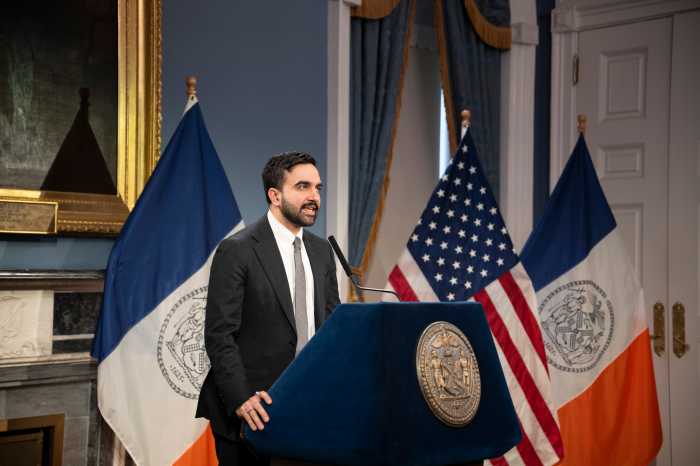
“Right now we’re pursuing a settlement in this case. That is a pursuit that looks to both prevent homelessness in our city, while also delivering a budget that is not just responsible but also sustainable,” Mamdani said, emphasizing that the negotiations are meant to balance affordability with fiscal responsibility as the city looks to balance the $7 billion budget deficit over the next two fiscal years.
On the campaign trail last year, Mamdani said he ended the Adams administration’s legal challenge to a City Council law greatly expanding eligibility for housing vouchers under a program known as CityFHEPS.
The mayor framed the City Fighting Homelessness and Eviction Prevention Supplement — known as CityFHEPS —program as one tool among many to address the city’s housing challenges, pointing to a broader, “all-of-government” approach. “We continue to take an all of government approach on this…putting together rental rip-off hearings across our city…ensuring tenants actually have recourse when they are facing undue burden from their landlords…we continue to take an all of government approach,” he said.
In a separate exchange with reporters Wednesday after testifying before Albany lawmakers on “Tin Cup Day”, Mamdani stressed the need to balance New Yorkers’ access to medium- and long-term housing with the realities of crafting a sustainable budget.
He described the prior Adams administration’s management of housing and assistance programs as mismanaged, noting that the city must now navigate both affordability and fiscal responsibility. When asked whether the settlement would expand program eligibility, he said, “I think right now, those conversations are ongoing,” indicating that details are still being negotiated.
Advocates have already expressed concern over the settlement approach. Christine Quinn, president and CEO of WIN, the city’s largest provider of housing and supportive services for homeless families, warned that delaying or narrowing CityFHEPS expansion could harm families in shelters and increase the city’s costs. Volunteers of America–Greater New York issued a similar warning, urging the administration to uphold the CityFHEPS expansion laws and emphasizing that stalling implementation could perpetuate cycles of homelessness and strain shelter services.
The Citizens Budget Commission (CBC) — a nonpartisan nonprofit that examines city and state public policy – released early last year, describing the housing voucher program as rapidly ballooning in cost and raising questions about its long‑term sustainability. Originally funded at about $25 million in 2019, the program’s budget has grown to roughly $1.1 billion in fiscal year 2025, more than 40 times its initial size, making it larger than most other U.S. cities’ federal housing voucher efforts.
The CBC analysis also states that while vouchers can be cheaper than shelter beds on a nightly basis, long‑term voucher costs, which average about $20,000 per household annually, accumulate quickly when families remain in the program.
WIN released its own report on Thursday, disputing the CBC’s claim that the program costs more overtime, saying that conclusion is “built on a fundamental misunderstanding of the cycle of homelessness.”
The report claims that when accounting for the extremely high rates of shelter return, WIN found that shelter actually costs 35% more, and moving families into permanent housing with CityFHEPS could save the City as much as $635 million in shelter costs over 5 years.
“Expanding CityFHEPS would help Mayor Mamdani solve New York City’s affordability crisis while helping to shrink NYC’s projected FY26-27 budget deficit,” Quinn said.
The CityFHEPS expansion dispute that Mayor Mamdani now oversees has its roots in a prolonged legal and political battle. In 2023, the City Council passed a package of laws to expand eligibility for the rental voucher program, removing shelter history requirements and raising income thresholds. Mayor Eric Adams vetoed the legislation, citing concerns about the program’s cost and questioning the Council’s authority to enact social services policy. The Council overrode the veto, making the laws effective.
Shortly after, the Legal Aid Society filed a lawsuit against the Adams administration for failing to implement the new laws, arguing that the city was legally obligated to carry out the Council’s reforms. The Adams administration countered that the Council had overstepped its authority, asserting that only the state legislature could mandate changes to social services programs.
In 2025, an appellate court sided with the Council and Legal Aid, directing the city to implement the expanded CityFHEPS laws. Adams continued to challenge aspects of the ruling, leaving the case unresolved when Mamdani took office, and he inherited the ongoing negotiations and legal proceedings that now frame his administration’s approach to CityFHEPS.
Immigration: Mamdani meets with Minneapolis mayor
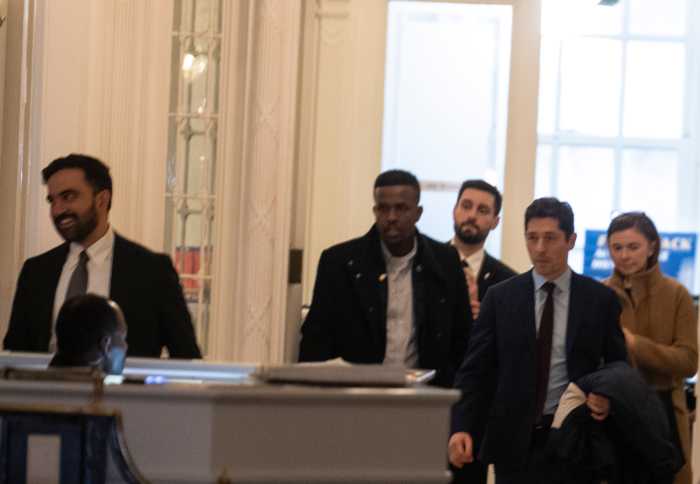
Mamdani, on Thursday afternoon, hosted a meeting with Minneapolis Mayor Jacob Frey at City Hall, in a conversation he said was aimed at sharing lessons between cities on protecting immigrant communities and responding to federal enforcement actions.
“I’m looking forward to having a conversation with Mayor Frey and also to building relationships with mayors across the country as we chart out how we can respond to the needs of the people that we represent, and what we can learn from other cities, also what we can share from the lessons of our own,” Mamdani said at the morning press briefing.
Frey, entering City Hall later in the day, told reporters that the focus is on preventing federal actions like Minneapolis’s Operation Metro Surge from being repeated elsewhere.
“What happened in Minneapolis does not happen other cities and states throughout the country. We want to make sure that our immigrant neighbors are protected, and mayors work together,” he said, calling the sweep “unconstitutional,” “anti-American,” and harmful to community trust.
In a video shared by Newsday reporter Matthew Chayes, the Minneapolis mayor highlighted local responses to the operation, including residents organizing to help neighbors and monitor daycares, while still cooperating with federal authorities on violent crime. He also emphasized that local non-cooperation with federal immigration enforcement, like in New York City, is essential to ensure public safety and access to city services.
After the meeting, Frey tweeted: “Today I had a meaningful conversation with @NYCMayor about the reality local governments are facing. When the federal government targets immigrant communities, it’s cities that feel it first — and cities that step up. We’re building a coalition of mayors ready to lead.”
The meeting comes amid the federal immigration enforcement surge in Minneapolis, known as Operation Metro Surge, which began in early December, when the Department of Homeland Security deployed thousands of Immigration and Customs Enforcement (ICE) and other federal agents to the Twin Cities with the stated goal of apprehending undocumented immigrants.
The operation drew widespread protests due to aggressive tactics and civil liberties concerns, and federal agents killed at least two U.S. citizens during enforcement actions, including Renée Good on Jan. 7 and Alex Pretti on Jan. 24, which significantly escalated public backlash and protests in NYC.
The Trump administration announced on Thursday that it is ending the ICE surge there following agreements with local authorities. Border Czar Tom Homan defended the Minneapolis operation, saying on X that the surge has been “concluded” with many targets removed, increased coordination with county jails, and a decrease in “unlawful agitator activity.” He framed the operation as a success for public safety, noting it would continue elsewhere to “deliver on the President’s goals to maintain border security and conduct mass deportations.”