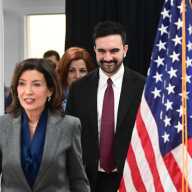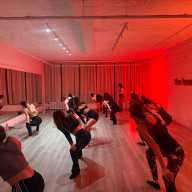



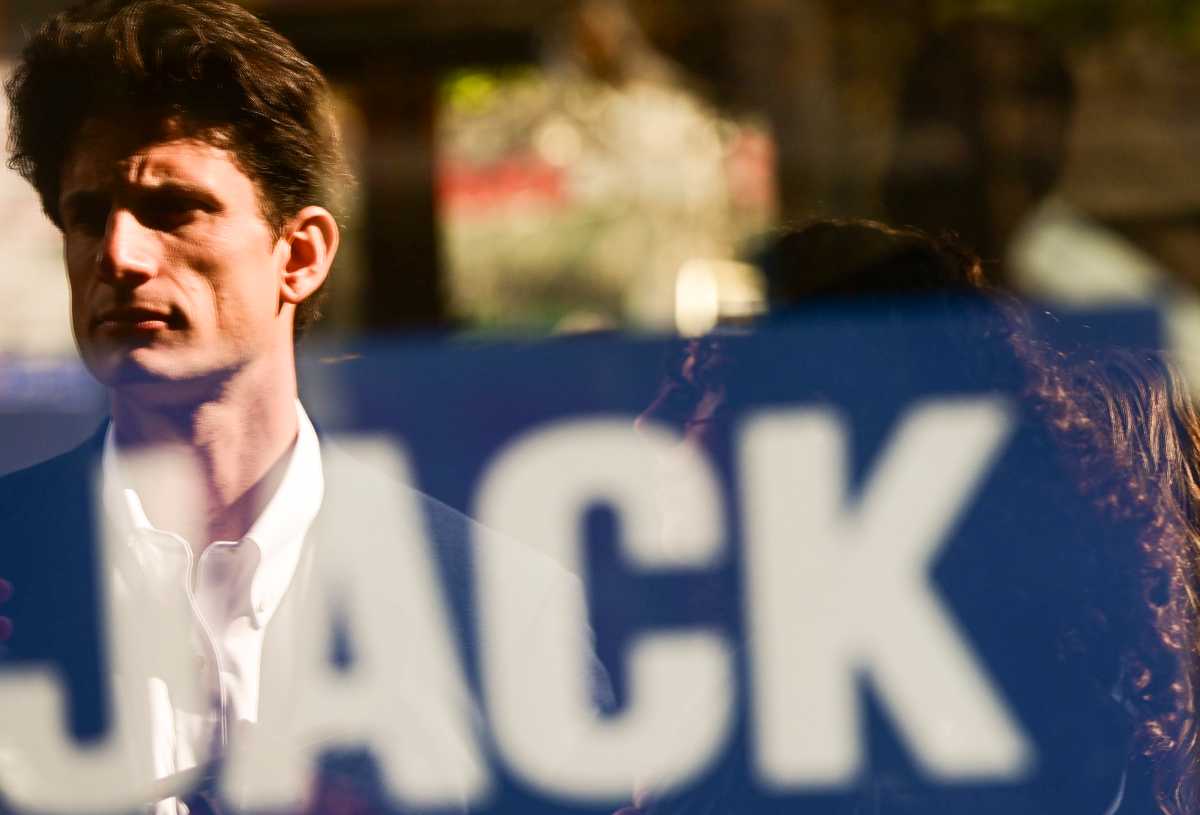
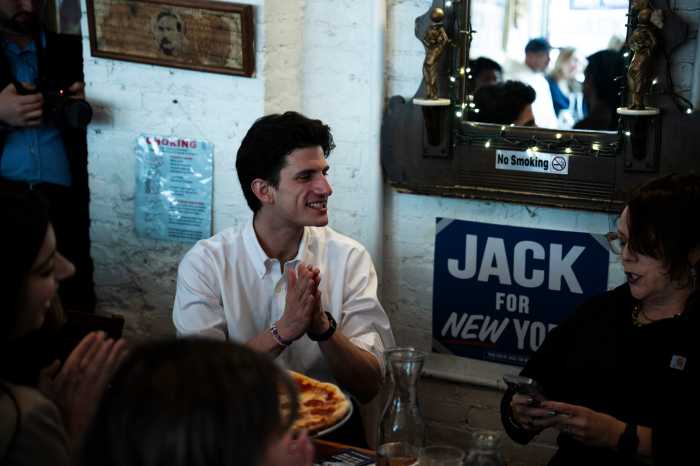
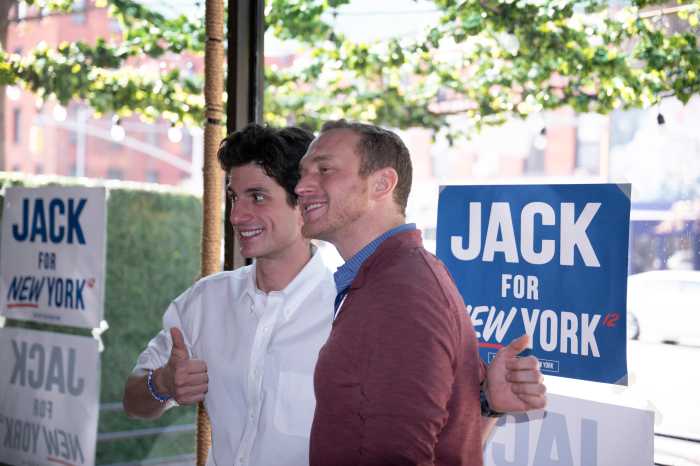
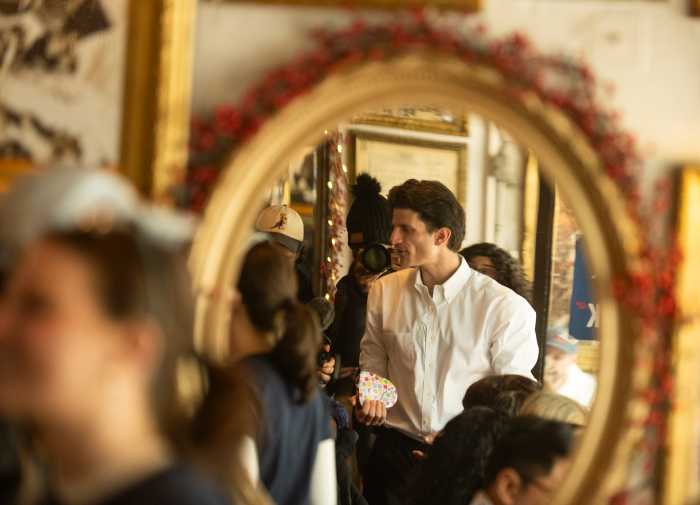
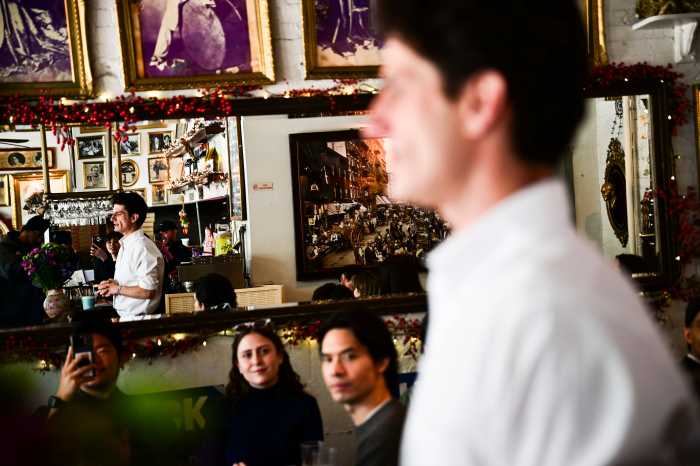
A few dozen people gathered for what Jack Schlossberg’s campaign called a Sunday afternoon “pizza party” — an informal meet-and-greet designed to recruit volunteers, answer questions, and connect with voters directly in the run-up to June’s Democratic primary.
Schlossberg, the son of Caroline Kennedy and the only grandson of President John F. Kennedy, entered the race with something few first-time congressional candidates possess: instant name recognition and the kind of media attention that can turn a down-ballot contest into a national curiosity.
But in the 12th Congressional District covering much of central Manhattan — a district known for a politically engaged electorate and a dense ecosystem of Democratic clubs, endorsements, and local political relationships — visibility alone rarely decides elections, pundits note.
After U.S. Rep. Jerry Nadler, the 78-year-old longtime representative of the district, announced he would not seek re-election, Schlossberg, 33, entered the race with a slew of competitors. He has tried to pair the celebrity of his last name with a policy-focused pitch and volunteer energy.
According to his campaign, Schlosberg has so far amassed close to 2,000 volunteers to get the word out.
“I’m the only candidate who’s really put forward concrete plans,” Schlossberg told amNewYork during an interview after the March 1 event. He pointed to proposals including a housing fairness plan, a proposal aimed at lowering the cost of food and clothing, and what he calls a “ricochet rule” designed to curb the flow of illegal guns into New York.
“I think the best way to differentiate yourself is on policy,” he opined.
Schlossberg has also described a renter-focused tax idea — allowing renters to deduct rent payments from their taxable income, similar in spirit to the way homeowners can deduct mortgage interest — as a way to address affordability in high-cost places like the stretch of Manhattan he is looking to represent.
Voters express curiosity in Schlossberg bid
At the pizza party in Chelsea, attendees mingled with campaign staff, spoke with Schlossberg as he made the rounds, and discussed issues ranging from housing costs to national politics. Some said they were drawn to the campaign’s generational message. Cody Vest, a Hell’s Kitchen resident who attended the event, said Schlossberg represented an opportunity for younger leadership in Congress.
“I would really also just like some fresh blood in Congress instead of these septuagenarians and octogenarians,” Vest said. “I want some young people in there.”
Others were curious but undecided. Brendan McGrath, a Chelsea resident who attended the gathering, said he had followed Schlossberg on social media for several years and appreciated his willingness to challenge the political establishment.
“He’s a really strong, bold voice… not afraid to shake things up,” McGrath said.
But he added that he has not yet decided how he will vote in the Democratic primary.
“I’m not sure who I’ll vote for ultimately,” he said. “Maybe I’ll decide when I walk in on election day.”
The mixed reactions sum up the challenge Schlossberg faces in translating attention into political support in one of the country’s most scrutinizing congressional districts.
An uphill battle for upstart candidate
Michael Lange, a political analyst who closely follows local races (and who moderated a recent candidate debate in the contest), described NY-12 as an electorate that tends to prioritize policy depth and government experience.
“This is a relatively older, very engaged, upper-class electorate… and extremely focused on substance,” Lange said.
That dynamic, Lange suggested, can make it difficult for candidates without extensive government experience to stand out — even if they enter with strong name recognition.
“I still don’t really know what his coherent message is,” Lange added of Schlosberg’s ‘Believe in Something Again’ campaign slogan.
The race to succeed Nadler has drawn several candidates, including Assemblymembers Alex Bores and Micah Lasher, both of whom represent the area and have longer histories in local and national Democratic politics. Nadler has publicly endorsed Lasher, his longtime former aide, to succeed him.
Eli Miller, who writes the local politics Substack Ghost Runner and recently launched a podcast dissecting the NY12 race, said the district’s institutional networks — including Democratic clubs, neighborhood organizations, and endorsements from elected officials — often play a decisive role in primary elections.
Lasher has consolidated significant support from Democratic elected officials and local political organizations across Manhattan. His endorsements include longtime City Comptroller Mark Levine, Manhattan Borough President Brad Hoylman-Sigal, Council Member Gale Brewer, and former city Comptroller Scott Stringer, among others. Several influential local Democratic clubs — including West Side Democrats, Village Independent Democrats, and the Eleanor Roosevelt Independent Democrats — have also backed his campaign.
Bores, meanwhile, has also secured a number of endorsements that reflect his ties to elected officials and Democratic activists in Manhattan.
Former Rep. Carolyn Maloney — who represented much of the Upper East Side in Congress for three decades before Nadler unseated her in 2022 when they were redistricted into the same area — has endorsed his campaign, positioning him as a prominent East Side contender in the race. He has also received backing from several fellow members of the New York State Assembly, as well as Democratic clubs, including the East Side Democrats, the Lexington Democratic Club, and the Four Freedoms Democratic Club.
“There’s just not that much room for an insurgent campaign,” Miller told amNewYork.
He argued that Schlossberg’s recognition is a real asset — it gets voters to pay attention — but that attention doesn’t automatically convert into support.
“Recognition and attention is a massive asset,” Miller said. “But I don’t see how people hear about him… and then conclude that this is the person they want to represent them in Congress.”
Schlossberg’s campaign also received a high-profile boost when former House Speaker Nancy Pelosi endorsed him.
But Miller questioned how much weight that kind of national endorsement carries in NY-12, absent tangible local organizing infrastructure.
He described Pelosi’s backing as a kind of “personal recommendation” and suggested that, in this particular district, endorsements matter most when they signal deeper political relationships — like the support of local officials, clubs, or established neighborhood networks — or when they bring volunteers and organizing muscle that can move votes.
Financial disclosures and climate policy
As voters in NY-12 weigh the candidates’ policy positions and backgrounds, Schlossberg’s financial disclosures provide a window into his personal holdings — including oil and gas royalty interests tied to energy production in Texas and Oklahoma.
According to a financial disclosure report filed with the House of Representatives, Schlossberg reports receiving income from a family trust connected to Arctic Royalty LP, which holds interests in several oil and gas operators in those states.
The filing lists multiple royalty streams from companies, including Hilcorp Energy, Ovintiv USA Inc., Contango Oil & Gas Management LLC, and Riley Permian Operating Co. Individual payments reported on the disclosure form generally range from $1,001 to $15,000.
The holdings stand in contrast to the emphasis Schlossberg has placed on climate policy during his campaign. He has called for strengthening federal environmental laws and expanding regulators’ ability to curb greenhouse gas emissions.
On his campaign website, Schlossberg has proposed updating the Clean Air Act and Clean Water Act to explicitly grant the Environmental Protection Agency authority to regulate greenhouse gases, while also supporting stronger enforcement powers and increased investment in climate adaptation and renewable energy infrastructure.
“Climate change requires immediate action,” Schlossberg says on the campaign site, pledging to protect air and water quality while supporting economic growth.
The disclosure does not indicate that Schlossberg plays any operational role in the energy holdings. The royalties are held through a family trust structure — a common arrangement in large multigenerational estates — and federal financial disclosure forms report income in broad ranges rather than exact amounts.
Scrutiny of fossil-fuel investments is not new for members of the Kennedy family seeking public office.
During his 2024 presidential campaign, current HHS Secretary Robert F. Kennedy Jr. — Schlossberg’s cousin, whom he has accused of hijacking the Kennedy legacy — faced similar questions after financial disclosures revealed income from the same oil and gas interests tied to the family.
Schlossberg reported no earned income during the filing period, with most of his assets held through trusts and investment accounts containing diversified securities and private funds. The filing lists four trusts connected to the candidate that hold a range of financial assets and real estate interests.
Among the holdings listed is an investment in Rory’s Place LLC, a restaurant in Ojai, California. The restaurant is operated by Rory and Maeve McAuliffe; McAuliffe is married to Schlossberg’s sister, Rose Kennedy Schlossberg. The disclosure lists the investment at a value between $1,001 and $15,000.
Federal disclosure forms list asset values in broad ranges rather than exact figures, and based on those ranges, Schlossberg’s disclosed assets appear to total roughly between $10 million and $30 million, though the exact value cannot be determined from the filing.
The disclosure also lists Schlossberg as a previous political correspondent for Vogue and a managing member of Squid Island LLC, a company that produces political commentary for social media.
A spokesperson for Schlossberg’s campaign said that the candidate filed his disclosure early because he believes voters should have transparency into candidates’ finances.
“Jack was one of the first to submit his disclosure because he believes voters should know exactly what is going on with the candidates,” the spokesperson said in a statement. “Jack invests in the market like millions of Americans, doesn’t mess around with companies like Palantir, and supports a congressional stock trading ban.”
The spokesperson also framed the issue as part of a broader debate about transparency in government.
“For the countless Americans invested in the market, one thing matters most: the corruption crisis,” the statement continued. “How is the President and his family allowed to rake in billions with no questions asked, no disclosures at all? That’s the real issue, and one of the main reasons Jack is in this fight. We need more transparency, not less.”
In addition to the energy interests, Schlossberg’s filing shows extensive assets held in brokerage accounts and trusts, including diversified stock and bond funds, private credit investments, and exchange-traded funds.
He also reports commercial real estate holdings in Chicago through Wolf Point Owners LLC, which maintains an ownership stake in the four-acre Wolf Point development site. The entity is part of Park Holdings Group LLC, an investment vehicle tied to the Kennedy family. The Chicago real estate assets are valued in the millions of dollars according to the ranges listed in the disclosure.
According to the latest filings with the Federal Election Commission, Schlossberg’s campaign committee has raised about $1.13 million since launching in November, up to Dec. 31, 2025. The campaign said the total includes more than 25,000 contributions, a figure that includes small-dollar donations under $200 that are not individually itemized in Federal Election Commission reports. More than 1,300 contributions exceeded $200 and were itemized in the filings, according to campaign finance records.
Early donors include Saturday Night Live producer Lorne Michaels, singer and actor Bette Midler, actor John Goodman, and musician Paul Simon, who each contributed about $3,300, according to campaign finance records. Schlossberg’s mother, Caroline Kennedy, gave $3,300 for the primary and $3,300 for the general election, while his father, designer and author Edwin Schlossberg, contributed $2,950 for the primary and $2,950 for the general election.
Foreign policy and Trump
Schlossberg has cast part of his campaign as a direct challenge to President Donald Trump, suggesting to amNewYork that the president and his allies view him as a political threat.
“I scare them, and I think that’s a real opportunity for NY12 to put itself on the map as the start of the movement that ends Trump,” he said.
But political observers like Lange say opposition to Trump is already a defining feature of politics in the district, and that simply positioning oneself as an anti-Trump candidate may not be enough to stand out.
“I do think Trump is obviously top of mind,” Lange said. “Basically, every conversation to some extent is framed around defending New York from Trump, standing up to Trump, countering Trump.” That dynamic, he said, reflects the district’s highly engaged electorate, where national politics often loom as large as local issues.
Still, Lange questioned whether Schlossberg’s framing of himself as a personal antagonist to Trump would resonate with voters.
“I don’t know if that’s going to land,” Lange said. “I don’t know if he’s demonstrated himself to be a communicator in a way that Trump would actually fear or respect.”
That district dynamic extends into debates over foreign policy, which have become a particularly sensitive issue in the race, especially questions surrounding Israel and the war in Gaza — an issue with particular salience in NY-12, which includes a large Jewish population alongside progressive voters who have been sharply critical of Israeli government policy, Lange noted.
At a recent debate moderated by Lange, Schlossberg initially appeared uncertain when responding to a question about the conflict, Lange said — a moment that illustrated how carefully candidates must navigate the issue in the district.
In a follow-up statement provided to amNewYork after the debate, Schlossberg clarified his position: “First, Benjamin Netanyahu and President Trump are both obstacles to peace. As long as those two are in power, I will look very carefully at any and all military aid being provided. The war in Iran leaves us all with more questions than answers. Forever wars are a real danger for us all.”
Schlossberg also addressed foreign policy at the pizza-party event itself, criticizing the Trump administration the morning after its strikes on Iran. Calling the action “lawless,” he warned that it could lead to “a more extremist, more hard-line government.”
That TV show and the ‘Kennedy moment’
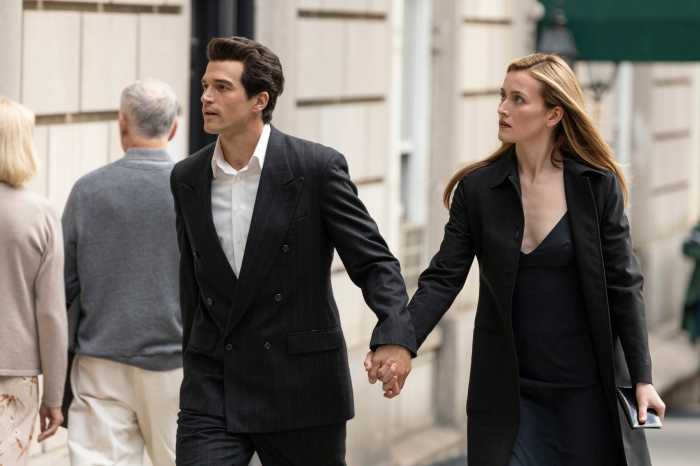
At the same time, Schlossberg’s candidacy is unfolding amid renewed cultural fascination with the Kennedy family. FX’s “Love Story: John F. Kennedy Jr. & Carolyn Bessette” premiered in February and has reignited public interest in the couple’s relationship and style, fueling a wave of online commentary and fashion nostalgia.
That nostalgia has spilled beyond social media and into real-world events. Men have been trying their best to recreate Kennedy Jr.’s signature look, a backward baseball cap paired with a shirt and tie, while women have been flocking to C.O. Bigelow, the historic West Village pharmacy, for $36 tortoiseshell headbands famously worn by Bessette-Kennedy. And good luck getting a reservation at their date-night spot, Panna II Garden Indian Restaurant.
The trend has even inspired JFK. Jr. look-alike – with two planned in Manhattan over the next week. One upcoming contest in Washington Square Park is being organized by Lahari Amirisetti, a FIT student behind a fashion-and-technology publication, who said the idea emerged as interest in the show surged online.
“We just wanted to create a community where the ’90s style can be really appreciated again,” said Amirisetti, describing the event as a way to connect people offline and channel the renewed interest into something communal and fun.
“He feels really parallel to his uncle,” she said, “There’s always pressure with being in the public eye, and I think Jack might feel the same way.” She added that while the show appealed to her on a surface level, it did make her want to learn more about the Kennedy clan and, in turn, Schlosberg.
The renewed fascination with the Kennedy family inevitably brings attention to Schlossberg, the latest member of the family to run for public office. Asked about the renewed attention around his aunt and uncle following the show’s release, Schlossberg said he sees the Kennedy legacy primarily through the lens of public service.
“My uncle John tried hard to educate people and engage them in politics,” he said, adding that he ultimately views his own campaign as separate from how the family is portrayed in pop culture. “I come from a family of public servants… but I’m my own person.”
Schlossberg has been sharply critical of the series since production began last summer, and repeatedly accused the show’s creators of exploiting his family’s history and distorting their lives. In recent interviews, he has intensified those criticisms, arguing that the series presents a fictionalized version of events and urging viewers to remember that the dramatization should not be mistaken for history.
The show’s release has also coincided with a difficult period for the Kennedy-Schlossberg family. Schlossberg’s sister, environmental journalist and author Tatiana Schlossberg, died in December at age 35 after battling acute myeloid leukemia. In a recent interview with CBS Sunday Morning, Jack Schlossberg said her final words to him referenced his campaign: “The last thing that she said to me was, ‘You better win.’”
Attention vs. organization
For political observers, the question now is whether the attention surrounding Jack Schlossberg — from his family name, media coverage, and a pop-culture moment he didn’t create — can translate into meaningful political support in a district where voters are known for close scrutiny.
In NY-12, analysts like Miller and Lange say, that requires more than visibility. It requires policy credibility, local relationships, and a campaign capable of reaching the kind of highly engaged voters who show up for forums, read endorsements closely, and expect candidates to explain not just what they support, but how they would govern.
Schlossberg’s campaign is betting that volunteer energy can help close that gap. In remarks to supporters at the pizza party, he argued that the race will ultimately be determined by field work.
“Politics is really about organizing everybody,” Schlossberg told the crowd. “Whoever wins is the most organized.”
And for several attendees of Sunday’s pizza party, Schlosberg has been successful at drawing them in with messaging and energy.
Lisa Marie, a 24-year-old who lives in the Village, said the campaign’s slogan — “Believe in something again” — resonated with her and pointed to what she described as Schlossberg’s ability to engage supporters directly, both online and at events. Jose, who lives in Turtle Bay, said he was drawn to what he described as Schlossberg’s sincerity and willingness to speak his mind, arguing that the campaign blends progressive ideas with a pragmatic approach.
Whether the attention surrounding Schlossberg ultimately translates into votes remains one of the central questions in the NY-12 primary.