

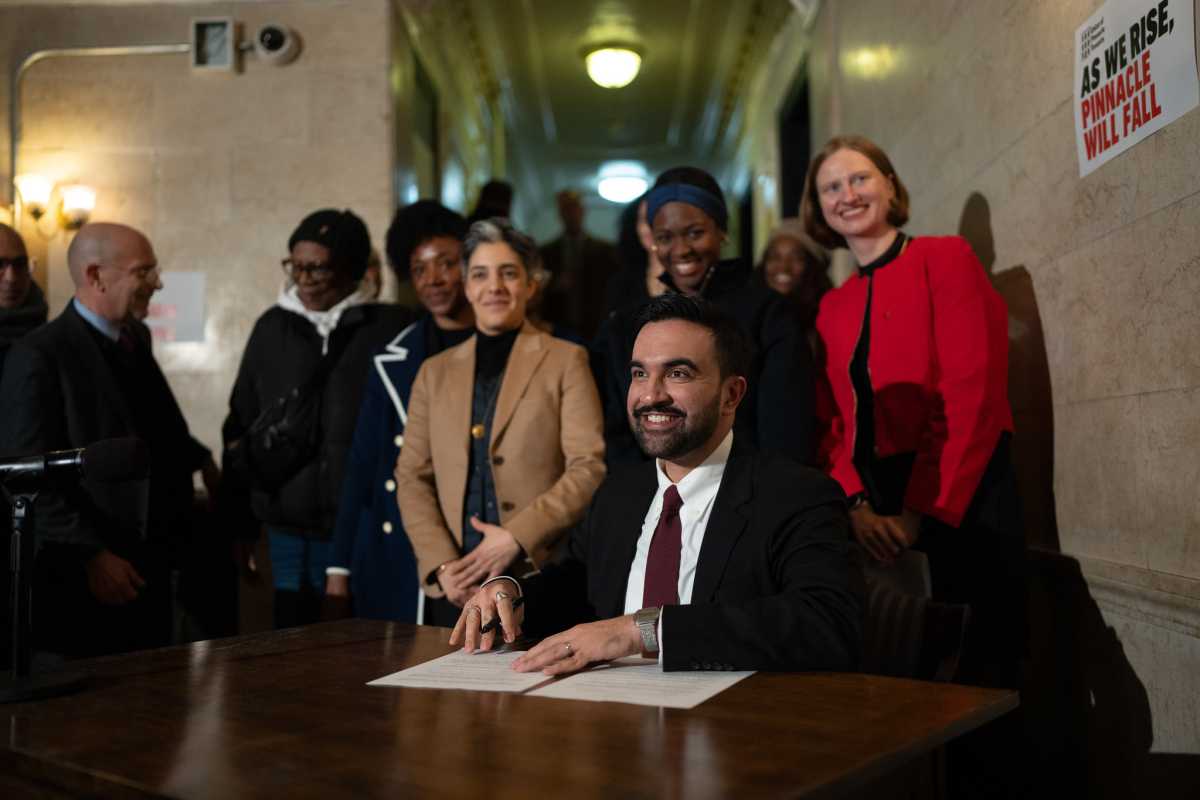
Mayor Zohran Mamdani came out swinging last week as he embarks on his pivotal first 100 days in office — taking executive action to advance his own agenda and attempting to undo the roadblocks his predecessor, Eric Adams, tried to throw in his way.
But in doing so, Mamdani — who had proclaimed on the steps of City Hall that he would strive to be an inclusive mayor for all New Yorkers — once again stirred grave concern among those skeptical of his ability to protect Jewish New Yorkers.
In his blanket repeal of all executive orders issued by former Mayor Adams between Sept. 26, 2024 (the date of Adams’ federal corruption indictment) and Dec. 31, 2025, Mamdani also torpedoed orders that sought to block city agencies and employees from divesting from Israel and have the NYPD review plans to keep protests away from houses of worship, including synagogues.
The blanket repeal also wiped out an Adams order that adopted the International Holocaust Remembrance Alliance’s definition of antisemitism as public policy for the city.
Mayor Mamdani indicated that his blanket repeal of Adams’ final set of orders was an effort to wipe the slate clean and restore trust among New Yorkers who had lost confidence in the mayor’s independence over the last 16 months. Mamdani also stressed he preserved a previous Adams order that established the Mayor’s Office to Combat Antisemitism, signaling (in his view) a continued commitment to fighting hate. Yet he also indicated that he would make changes to the program, without providing specific details.
So when it comes to the trust Jewish New Yorkers have in Mamdani’s ability to protect them, it felt like the mayor had taken one step forward and three steps back.
It made some skeptics wonder whether Mamdani is talking from both sides of his mouth when it comes to combating antisemitism, however and whenever it occurs.
Jewish New Yorkers are counting on the mayor to acknowledge that antisemitism is not something that can be merely condemned on paper; it must be fought proactively with every resource at the city’s disposal.
That means adopting the IHRA’s definition of antisemitism as part of public statements broadcasting zero tolerance for hatred.
That means directing the NYPD to take steps to protect synagogues and other houses of worship from protesters.
That means protecting New York’s interests in Israel, the only place in the world where more Jewish people live outside of the Big Apple.
Jewish New Yorkers need Mayor Mamdani to exercise his executive authority and boldly state his commitment to protect them — either by reaffirming the former mayor’s orders with his own signature or by issuing new orders with his own modifications.
We want to believe Mayor Mamdani’s statements that he will be a mayor for all New Yorkers.
But the worst fears of every Jewish New Yorker will be realized if, in the end, his words speak louder than his actions.