


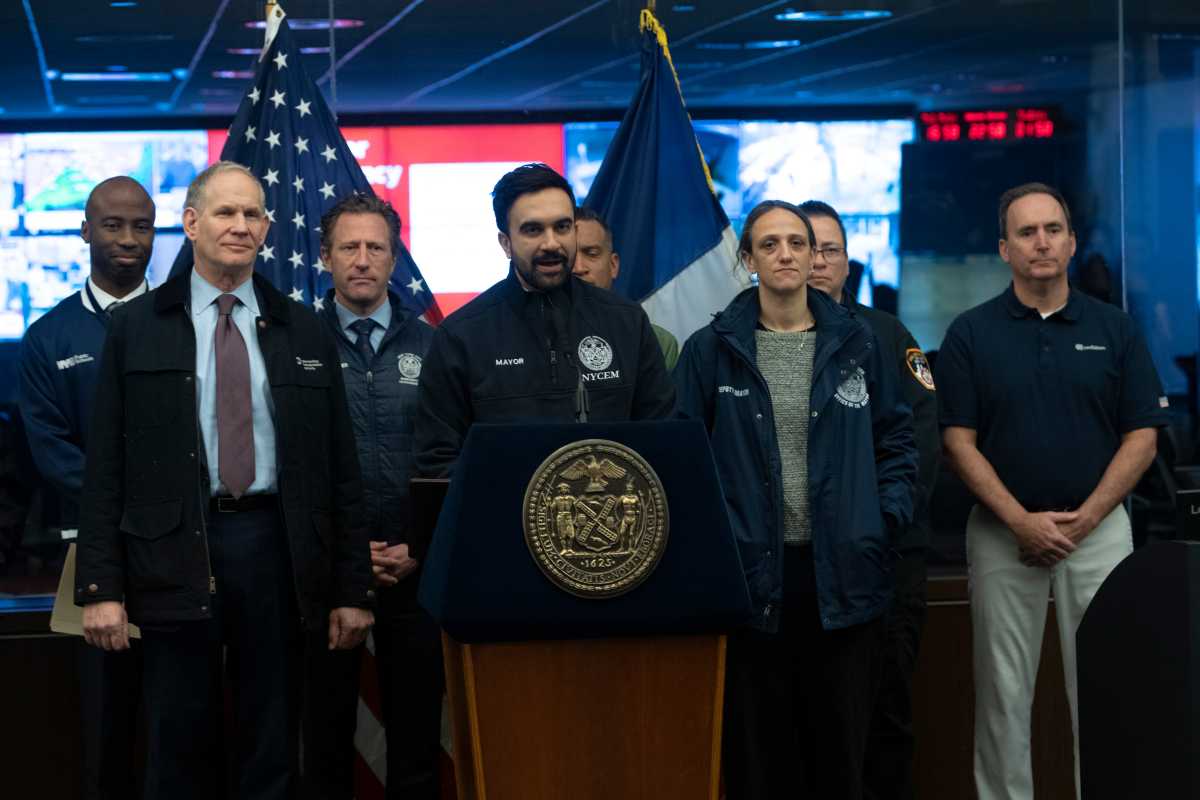
As a potentially historic winter storm approaches New York City this weekend, Mayor Zohran Mamdani said Friday that even if schools are closed to in-person instruction, classes will continue online.
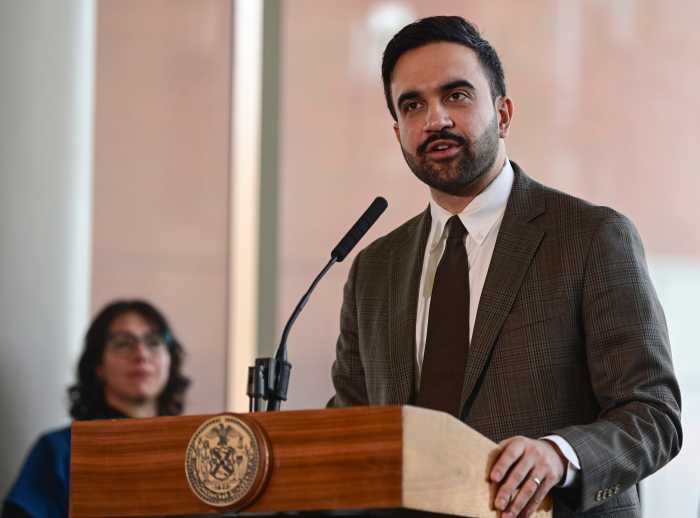
Speaking at a press briefing at the city’s Emergency Management Department on Jan. 23, Mamdani said public schools will either remain open or pivot to remote learning on Monday, with a final decision expected by noon on Sunday. A full closure without instruction, he said, is not under consideration.
“I have to apologize to the students that were hoping for a different answer,” Mamdani said. “A traditional snow day will not be the case.”
The news is likely to come as a disappointment to students across the five boroughs who were hoping for a long weekend, including at least one who went to unusual lengths to argue for a traditional shutdown. Mamdani said a student tracked down the city’s first lady’s email address to plead their case for a snow day.
“There was a student who found my wife’s email and made their case,” Mamdani said in an earlier interview with NY1. “They apparently made some good points.”
The mayor said the decision is driven by both safety concerns and state requirements mandating 180 instructional days per school year. With little flexibility left in the academic calendar, virtual learning has become the city’s default alternative during severe weather since the COVID-19 pandemic.
Mamdani said the addition of holidays to the school calendar by prior administrations has further limited the city’s ability to cancel instructional days outright.
“If it’s too much snow to safely call for students and educators to come to school,” he said, “that is precisely what pushes us to require remote learning.”
When asked whether traditional snow days are gone for good, Mamdani declined to declare them over entirely but said the options for Monday are limited.
“These are the two options,” he said. “In-person or remote.”
Forecasters are currently predicting between eight inches and more than a foot of snow, with snowfall expected to begin late Saturday night or early Sunday morning. The storm could also bring high winds, extreme cold, sleet, or freezing rain, conditions which could make travel hazardous well into Monday.
The city has issued a hazardous travel advisory for Sunday and Monday and urged residents to complete errands ahead of the storm. Mamdani said his biggest concern is that people may underestimate the severity of the weather and continue traveling unnecessarily, complicating snow removal and emergency response.
DOE says it’s ready this time
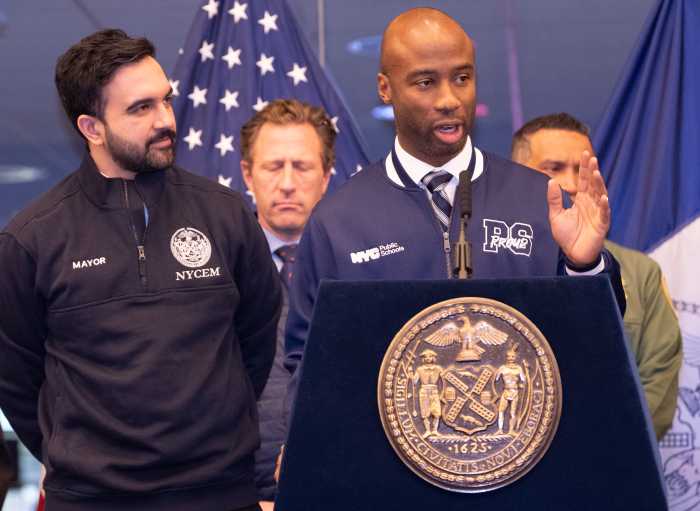
Schools Chancellor Kamar Samuels, in his first weeks on the job, said the Department of Education has been preparing for the possibility of a systemwide pivot to remote learning.
Samuels acknowledged concerns raised by reporters about the city’s last attempt to replace a snow day with virtual instruction in February 2024, when widespread technical failures prevented many students from logging in.
At the time, city officials acknowledged that the system had not been fully stress-tested and that key vendors were not included in preparedness drills, leading to confusion and public finger-pointing.
“That day will live in infamy for me,” Samuels said, who was a superintendent during that incident.
He said the city has since expanded system capacity and conducted repeated stress tests, including a large-scale simulation in December.
“We now have the capacity of having a million students logging in at the same time within 60 seconds,” Samuels said.
The DOE has also conducted simulations with students and staff and plans to stagger schedules if schools go remote to avoid system overload. Families have been encouraged to log in early on Sunday to ensure devices and connections are working.
Samuels said remote instruction will combine live lessons with asynchronous work, allowing students flexibility while ensuring instruction continues.
“No one is asking kids to be on a device for six hours and 20 minutes,” he said.