


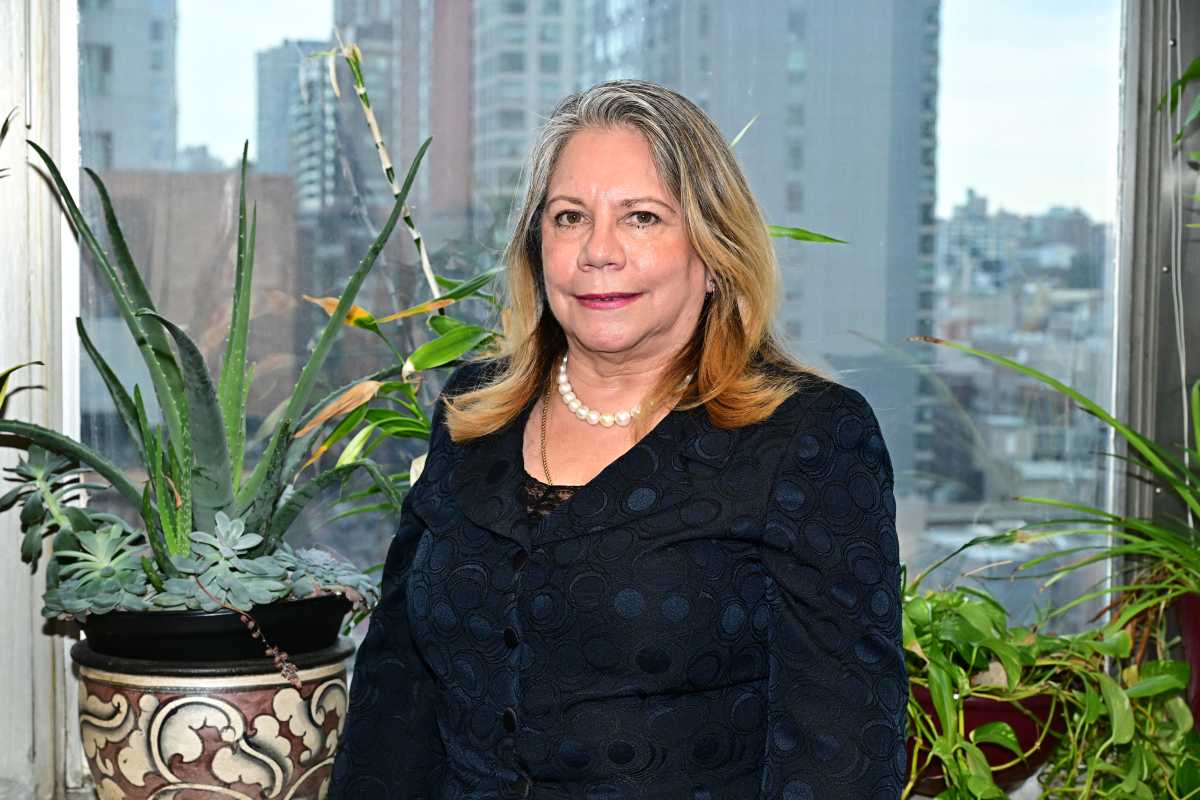
Brooklyn Civil Court Supervising Judge Carmen Pacheco’s future in law came to her as a college student — in a vision.
As she sat working on an assignment for a philosophy of law class with her Brooklyn College classmate and future New York County Civil Judge Betty Lugo, Pacheco began to draw a sketch of their future law firm in a high rise with a helipad on the roof and their names emblazoned in brass.
The firm’s name would have to be “Pacheco and Lugo,” for its acronym.
“We could be everybody’s PAL,” Pacheco told amNew York Law.
By 1992, the duo had founded the city’s first Latina-owned law firm on the 29th floor of the World Trade Center.
“Our names were etched on the wall in brass letters,” Pacheco said.
The firm balanced high-level corporate and banking work with pro bono service centered on serving outer borough communities like the one in Gowanus where Pacheco grew up.
Thirty years later, Pacheco and Lugo’s both made their way to the civil court bench — Pacheco in an administrative position leading the busiest court in the state, arguably the second busiest in the country.
When she was first elected to civil court in 2023, Pacheco became the first person of Peruvian descent to serve on the state judiciary. She did a stint overseeing Bronx criminal court before jumping back onto the civil side, where she was appointed as Supervising Judge of the Brooklyn Civil Court this past year, which oversees issues including housing, consumer contract disputes and small monetary claims.
Her goal in taking on the role of administrator is to ensure that every person who enters the court room feels heard and treated fairly, regardless of the size of their wallet.
“If I could have changed the perception on how Peter Public feels about this courthouse at least or how I left the criminal court in the Bronx, then that would be my measure of success,” Pacheco said.
She said that her 36 years of commercial legal practice gave her some fresh ideas about how to tweak court policy in little ways that would save big on time. But her managerial experience at her own law firm also has made her focused on making sure that litigants feel welcome and listened to in court.
“You have to see the needs of your people in your firm. And if you could do better, you try to do better dealing with the resources that we have, working with those resources,” Pacheco said.
Pacheco framed her move to the judiciary as a way to “give back” to the justice system; a continuation of the types of community cases that her law firm took on — some of which became their most high-profile litigation.
“I think the secret sauce to our success was that we went to the community and we provided a lot of free services. We equalized Wall Street and Main Street,” Pacheco said.
A landmark case of Pacheco’s in the mid 1990s involved representing around 1,800 families in a lawsuit against Cypress Hill Cemetery on the border of Brooklyn and Queens, which had built up a burial hill, on top of what was actually an illegal landfill made up of construction debris.
The cemetery dug the graves before it became publicly known that the soil at the surface of the mound rested on a layer of torn-down buildings. The families were horrified to learn that they had buried their loved ones on a base of demolition refuse.
“They had buried garbage in there. It was asbestos, tires, refrigeration — and these people were in there… We fought a big fight. And it wasn’t well received because we were bucking the system,” Pacheco said.
Pacheco founded the firm after working at a Wall Street law firm, while Lugo was working at the Nassau County DA’s office. Her experience in commercial law ended up supporting the fledgling firm in its early stages, taking on a host of work helping businesses and banks navigate the federal Small Business Administration.
It was during the pandemic that Pacheco and Lugo set their sights on the judiciary. In 2019, Lugo had mounted an unsuccessful bid for the open Queens district attorney seat. Then both law partners ran for civil court — Lugo in Manhattan and Pacheco in Brooklyn.
Pacheco did not win on her first run, but tried again a year later and succeeded. Despite her corporate background, she was first assigned to criminal court, which she said took courage because she had to learn an entirely new area of practice.
She applied her civil and math background to streamline the legal process for defendants. For example, she implemented a policy where defendants who were driving without a license could have cases dismissed if they paid their fines, preventing them from entering a cycle of felony convictions and credit troubles.
“I’m there looking at it from a different perspective,” Pacheco said.
As a supervising judge, Pacheco said she’s focused on “managing expectations” and treating the public as the “owners” of the court.
“You don’t want people feeling that they weren’t heard or displeased that the court system doesn’t work,” Pacheco said.
That principle hits at some of Pacheco’s foundational values. When she was in grade school, she served as school monitor and student government as a way to make sure that those “who were less popular” or bullied could participate in the social affairs of the school — a trait she credits to her parents’ teaching to treat others with dignity.
“I always felt that you really treat people in a way that they feel welcomed. Always,” Pacheco said.
One operational tweak she’s hoping to make to this end involves “time certain” scheduling in consumer debt parts to prevent litigants from waiting. She is also considering consolidating small claims parts to make more efficient use of judges and clerks.
She’s taken these goals from the monthly meetings that she holds with judges and court personnel, whom she relies on to keep the court functioning on a thin level of resources — not that she blames the court administration for what it’s allocated by the state, she added.
“You use what you can and you make it fit,” she said. “My chief clerk and I are able to make it happen.”