



Jenny Roberts claims the mantle of being the only New York law dean with a background as a clinical professor — a role that straddles the worlds of pedagogy and practice.
That status is reflective of her approach as the leader of Hofstra University’s Maurice A. Deane School of Law. Roberts has taken her interdisciplinary background to build on the school core areas of criminal, family and immigration law while spearheading forward-looking programs in technology and medical law that weave in with the university system’s institutional strengths.
“This is a school where we’re really focused on preparing lawyers for the world as it is and as it’s becoming,” Roberts told amNY Law.
For nearly 15 years prior to her becoming dean, Roberts taught at American University, where she co-led its criminal justice clinic. There, beyond the practical world of supervising students who are working real cases, she delved into scholarship, writing extensively about plea bargaining, misdemeanors and the collateral consequences of criminal conviction.
She said the two disciplines of scholarship and clinics go hand-in-hand. Clinical experience gave her a window into how to push forward legal scholarship. Her interest in research also led to her first brush with administration as the associate dean for scholarship and research.
Roberts said she has found all of these worlds coalescing as Hofstra Law’s dean. She found that by having a foot in so many different parts of legal education, “I could really bring all that together [with] a good understanding of all the different parts of what happens [in law school],” she said.
Though Roberts comes from a background in trial defense work, at Hofstra she’s found that its campus offers law students unique opportunities to collaborate with its science and technology programs.
There, Roberts has found plenty of opportunities for interdisciplinary programs that take advantage of Hofstra’s institutional offerings.
For instance, the law school has partnered with Hofstra’s business school and Cold Spring Harbor Laboratory, a Long Island institution famous for pioneering molecular biology and genetics and breakthroughs in cancer research on its Bioscience Business Innovation Program, that teams law students with business students and working scientists “to basically help the scientists develop their pitch and develop the business side of their idea.”
“You’re a law student and you’re in a room with the people who have these real world bioethics problems that you’re now getting to talk about in that setting,” Roberts said. “That’s pretty unique.”
The law school offers a Medical-Legal Partnership, which operates at four local clinics connecting students with patients with health-related legal needs. In 2025, the program provided legal assistance to 147 clients.
Roberts also described its Legal-Tech Fellow program, which partners with the university’s school of engineering to both study the legal ramifications of new technology and create new tools for the legal system. Students invented a “Claimbot,” that can guide the uninitiated through the New York State Small Claims Court system in dozens of languages as well as an AI app that determines eligibility for social security disability benefits.
Students are “hearing what the problem is, and they’re doing creative problem solving to think about, ‘Well, … What can law do to help solve this problem?” Roberts said.
These innovations don’t replace the fundamentals of law school, Roberts suggested. Ultimately she wants to ground all legal education at Hofstra in the basic trial advocacy skills, which have an application in many different specialized areas.
“If you learn how to interview clients in a way that’s truly client-centered where you’re listening so that you can hear the whole picture instead of leading someone into what they may think you want to hear, that’s a skill that makes for a good lawyer, however you’re going to practice,” she said.
Though her mother was a Legal Services lawyer in family law, Roberts didn’t think about the legal world as a path for herself early in life.
“I never intended to become a lawyer,” she said.
After graduating from Yale as an undergraduate, she came back to New York City where she grew up and worked for city Parks Department for a year before getting a job at Court TV, then a scrappy startup, and covered gavel-to-gavel trials. It was the experience of trial reporting that piqued her interest and drew her back to school to get her law degree from New York University, where she found herself thriving in an academic environment.
“I really appreciated being able to delve back into deep thinking and learning after being away from school for a while,” Roberts said.
After law school, she clerked in the Southern District of New York, then worked as a public defender at the Legal Aid Society, Criminal Defense Division in New York for about six years. But during that time the siren’s call of academia never ceased, so she became a law professor, teaching a criminal defense clinic and first-year criminal law.
Over her years of teaching, she found scholarly writing to be a compelling challenge that complemented her work as a clinical professor. She enjoyed dialoguing with other experts in the field, and looking at the trial system with a philosophical lens.
Her research brings scholarly attention trends that she noticed in her former practice. For instance, she has written extensively about the knock-on effects of being charged with a misdemeanor.
“When you leave the courthouse after a misdemeanor, you can leave with a world of problems that are unrelated to what happened in court that are related to your future employability, your future access to housing and education, immigration problems, occupational licensing issues,” Roberts said.
Though her research brought Roberts to her first administrative perch as an associate dean, her new role leading an entire campus is a major shift. She said she jumped at the opportunity to take a more encompassing role in part because she loves working with students.
“It’s an incredible opportunity to be able to set goals and think about the things that really matter and try to move the needle forward on those things,” Roberts said.
Her new responsibilities come with headaches — chief among them the cost of legal education and caps to government issued student loans for professional schools. The U.S. Department of Education has also taken aim at a federal Public Service Loan Forgiveness program that is a boon to many graduating law students.
Roberts said that she wants to help students avoid the high interest rates of private lenders or help those who might not have access to a private loan based on their credit. She’s already begun making changes to the way the school structures its scholarships to rely less on conditional scholarships that can dwindle after the first year if a student is not in the top 50% of their class.
The change, which will take effect in the fall, is aimed at more predictable financial support, in light of the new federal aid guidelines. As someone who spent part of her legal career studying and thinking about equity in the justice system, Roberts is applying a similar frame of reference to the hallways of Hofstra. She described her job as “talking to everyone and anyone inside and outside the building” about solutions to the practical challenges of law school.
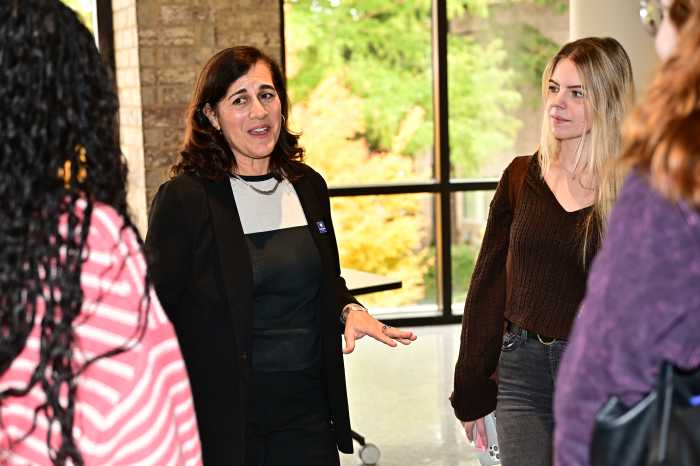
As amNY walked through the law school with Roberts, she sidled up comfortably to a group of students to ask them about what they had going on that day.
“This is why we do this. It’s for the students, that’s what drives everything,” she said. “That’s what gives me joy on a daily basis in the job.”