


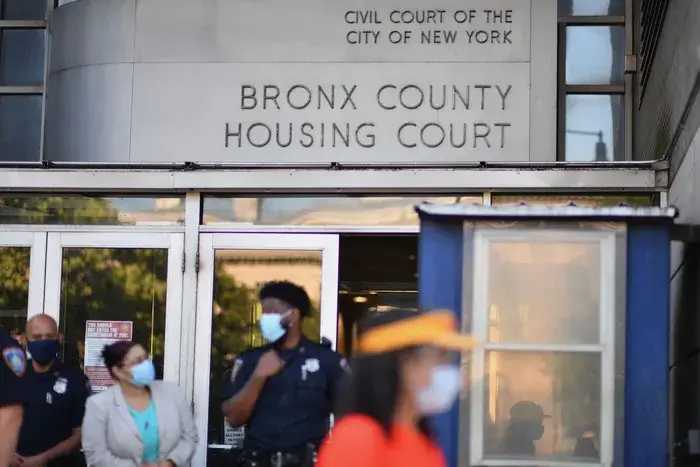
The city owes tens of millions of dollars to the legal nonprofits it relies on to fulfill its promise of free counsel to low-income and elderly New Yorkers facing eviction, landlord harassment and immigration issues.
And, if the city doesn’t pay them by next month, some of those nonprofits say their operations will be thrown into crisis and they’ll have to stop providing services to thousands who are counting on them.
“If we aren’t paid, it would create existential problems for our organization,” said Greg Klemm, the chief financial officer of Legal Services NYC, which provides tens of thousands of New Yorkers with counsel.
Klemm said the city owes his organization roughly $20 million for work attorneys have done over the past year and a half for city programs that provide the most vulnerable New Yorkers with free counsel as they fight to stay in their homes, through the citizenship or green card process or against landlord harassment and deportations.
The lag in payment has gone on for so long that it’s pushed Legal Services NYC to a breaking point, Klemm said, forcing it to max out its line of credit at $15 million to maintain its operations and pay staff, a practice that’s now racked up $370,000 in interest just this year — enough to fund the salaries of two and half full-time employees.
Klemm said the city hasn’t provided a timeline to releasing payments, forcing the group, which gets 45% of its income from city contracts, to drain its reserves.
“It’s putting us in a bind,” he continued. “If they do not pay us at all for December or January, we wouldn’t be able to meet payroll at the end of January.”
If bank accounts of multiple legal service providers dry up at once, Klemm said it would have a catastrophic ripple effect across the city’s courts.
“That is a substantial number of people that would not get services,” Klemm said. “I couldn’t imagine the devastating impact it would have on low-income New Yorkers taking legal action against landlords who are not making sufficient repairs. There would likely be an increased threat of deportation and family separation. It would be devastating.”
Legal Services NYC isn’t the only legal nonprofit the city’s left hanging. Legal Aid Society and New York Legal Assistance Group also reported late payments on city contracts, with Legal Aid saying it’s owed $16 million for work completed during FY 2025, which ended six months ago, and NYLAG reporting over $5.5 million in outstanding dues stretching as far back as Financial Year 2023.
Though the city provided Legal Aid with a 50% advance on its FY 2026 contract, the midway point has now passed, and the city hasn’t approved its FY26 budget or allowed it to submit invoices for payment for work on FY26 contracts, which began on July 1.
“The delay in payments severely impacts the Legal Aid Society’s cash flow and threatens our ability to make payroll for our staff and to pay vendors and subcontractors who are critical to service delivery,” a Legal Aid spokesperson told amNewYork Law. “LAS spends a significant amount of time just trying to get paid. [The city] has created unnecessarily complex processes and procedures that delay contract budget approval and invoice submission, this complexity not only delays a crucial payment process but also diverts limited staff time to attending to this rather than other crucial priorities.”
The New York Legal Assistance Group said that while it was “grateful” to the city for providing significant advances for its work, it was still experiencing delays and unapproved budgets that affect its financial stability and prevent it from providing vital services.
“As we move into the second half of this fiscal year, budgets remain unapproved, we remain unable to invoice, and no additional advances have been provided,” the group’s CEO, Lisa Rivera, wrote in an email. “The costs of doing this work exist in real time, addressing contract registration and payment delays is crucial, and expanding the use of advances when those delays cannot be mitigated is essential.”
The city’s Department of Social Services, which handles the nonprofits’ contract payments, told amNewYork Law that payment delays “can be caused by numerous factors,” and that it was “continuing to work through all outstanding budget items with our legal services providers.”
“Ensuring all appropriate payments are made in a timely manner is a top priority and both the city and agency have made significant strides to address payment delays,” a DSS spokesperson wrote in an emailed statement. “This includes appointing a chief nonprofit officer to improve coordination with our nonprofit partners, streamline operations, and resolve payment issues; working with providers to identify and address pain points in the contracting process; and reforming procedures to minimize delays in registering contracts to ensure providers are receiving payment for the work they do.”
The office did not respond to a direct question on when it planned to pay the money it owes the organizations.
Legal Services NYC said it has been in touch with the city’s contract managers, but hasn’t been able to establish any contact with upper leadership at DSS, despite trying for weeks.
“It is hard to tell whether it is stonewalling or incompetence, but there seems to be a general lack of willingness by them to move quicker,” Kelmm and his team told amNewYork Law in an email. He added that the organization was trying to get the city to release at least $2 million for one of their outstanding invoices this week, though it wasn’t clear if that would be successful.
The organization says it has grown to meet the city’s demands, hiring staff and ramping up its caseload, only to be left destabilized by quick growth it can’t sustain without the money it was promised to fund that growth from the city that asked for it.
“We have grown our organization to meet the city’s desperate need for eviction defense attorneys, and that means relying on the city’s promise to fulfill its end of our contracting bargain,” Klemm said. “Yet, year after year we find ourselves on the brink of collapse due to the city’s inability to pay legal service providers on time.”
If attorneys aren’t paid in January, Klemm fears staff quitting. He imagines it would take a significant period of time for the organization to bounce back, and would make it difficult to hire new staff if the group can’t pay its existing team.
The fact that late payments aren’t a new phenomenon for nonprofit legal services providers, Klemm said, is both confusing and frustrating, arguing that the city doesn’t treat other contractors this way.
“We estimate that we save the city over $350 million a year in averted shelter costs by keeping our clients in their homes, yet we have to continually beg to get paid for that work,” Klemm said. “It’s hard for me to speculate why it keeps happening, but it’s not okay.”
What he does know is that his organization needs the money the city promised it, quickly.
“The city has to make immediate payments on its nonprofit contracts,” Klemm said. “Time is running out.”