


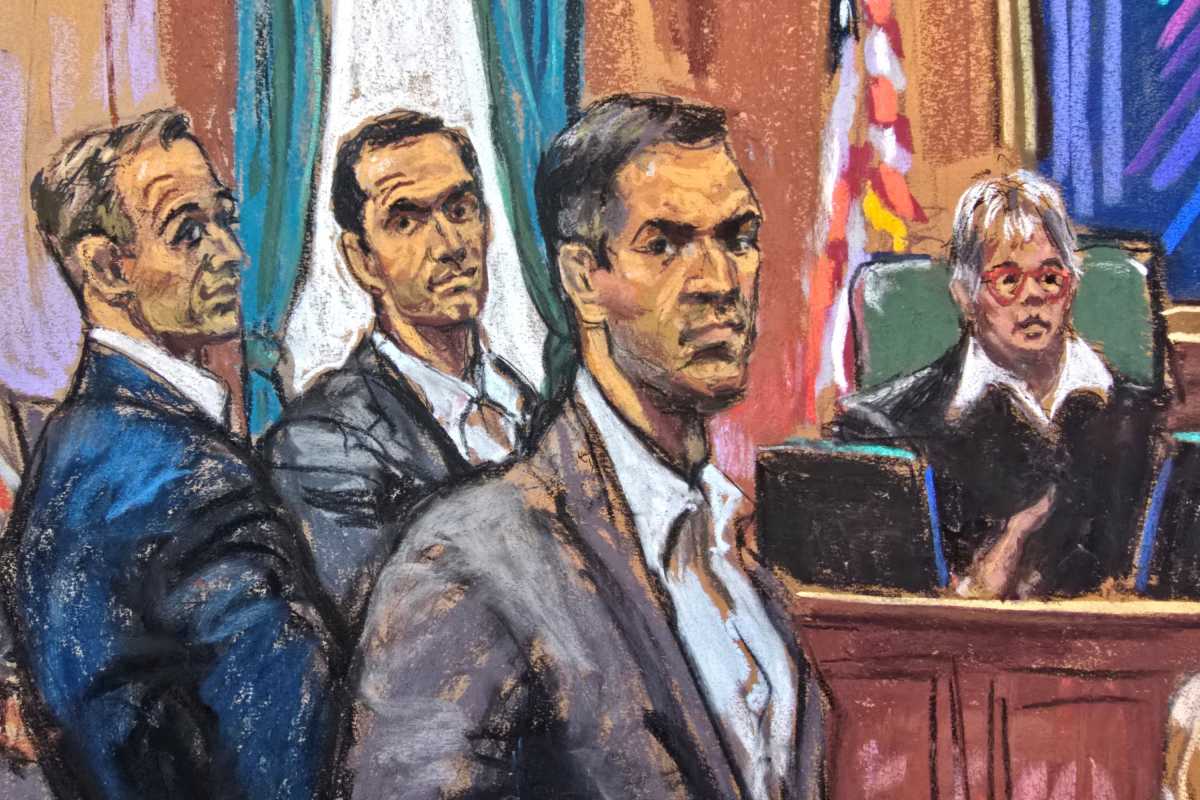
After rape accusations from over 60 women, six federal indictments and 12 counts of sex trafficking and sexual assault hanging over them, luxury real estate brokers and brothers Alon, Oren and Tal Alexander will head to trial in Manhattan’s federal court Monday.
It’s been a long road to opening statements. Since suits filed by Kate Whiteman and Rebecca Mandel garnered media attention in March 2024, twins Alon and Oren Alexander, 38, and their older brother, Tal Alexander, 39, have been on the receiving end of a steady stream of civil and criminal charging papers detailing dozens of nights where they allegedly drugged and raped women after using their wealth and influence to entice, coerce and trick them to meet, go to parties and take luxury, paid-for vacations for over a decade.
Accounts of the brothers’ sexual assaults and sex trafficking follow similar patterns: A Jane Doe in one suit says she was drugged and forced to have sex with Tal Alexander, where he forcibly ripped out her tampon and pushed her head down, forcing her mouth onto his penis, despite her saying no. Another suit, filed by Samantha Nicholson, alleges the Alexander brothers held her down and raped her in a hot tub in the Hamptons, then locked her in a bedroom in a New York City apartment and raped her again. Others say the brothers took them on fancy vacations, then drugged and raped them, while other women claim a brother tricked them into going to parties or vacations that ended in rape after creating the pretense he wanted to date her.
Prosecutors allege the brothers, all originally from a wealthy suburb of Miami Beach, have been working together to assault women since high school, and that their reputation for drugging and raping women was an open secret within the real estate industry.
However, the federal charges they’re facing only include alleged assaults stretching back to 2008, around when Oren and Tal Alexander started establishing themselves in the upper echelons of New York City’s real estate world. While Alon opted out of his brothers’ broker business, joining their parents’ security firm instead, he was certainly a part of the siblings’ sex trafficking conspiracy, prosecutors allege. All three have been held without bail at Brooklyn Metropolitan Detention Center for over a year, forced to trade their luxury high rises for jail cells.
Over two dozen of the brothers’ alleged victims are expected to testify at the roughly month-long trial — including at least one who was a minor at the time of the alleged assaults. All are expected to be aggressively questioned by the Alexanders’ top-tier defense team, which is led by husband-wife duo Marc and Karen Agnifilo, who boast a high-profile clientele that includes Sean “P. Diddy” Combs — who was also tried on sex trafficking charges —and Luigi Mangione, who is charged with gunning down UnitedHealthcare CEO Brian Thompson.
In the days leading up to the trial, U.S. District Judge Valerie Caproni of the Southern District of New York ruled that Alon Alexander couldn’t use his marital engagement to prove he wasn’t a part of the sex trafficking conspiracy, and issued decisions that set limits for what social media and text communications attorneys could show to the jury and finalized which witnesses could testify under pseudonyms.
Criminal law professors, sex trafficking experts and attorneys who have worked on both sides of sexual assault cases told amNew York Law that the defense team’s strategy will likely argue the Alexanders’ alleged sexual encounters were either consensual or didn’t happen at all and that the sex trafficking charges against the brothers are too broad, severe and inaccurate for their actions. They will also maneuver to undermine the credibility of the women testifying against them, the observers said.
Whether the defense’s arguments prevail, those legal experts told amNewYork Law, will primarily rest on how the jury is instructed to understand the sex trafficking and commercial sex statutes and the prosecution’s ability to keep the credibility of their witnesses intact.
What are sex trafficking charges?
Despite popularly held beliefs, sex trafficking doesn’t have to involve the movement of a person across state lines, or, anywhere at all — sex trafficking can happen even if two people stay in the same apartment, said Shea Rhodes, a Villanova Law School professor and national expert on sex trafficking statutes. The crime is defined as acting to recruit, entice, harbor, transport, provide, obtain, maintain, patronize, or solicit a person — who benefits by receiving anything of value, including things like paid-for trips, fancy dinners or accommodations — for sex through fraud, force or coercion.
Prosecutors on the case will move through each piece of the statute, tying specific allegations witnesses will make on the stand against the brothers to each legally required element of the crime, Rhodes said.
“You only need to prove one of the acts. Did they entice their victims? Well, that’s pretty clear, looking at the women they gave trips to and other things that have value,” Rhodes said. And, harboring, for example, can include staying at paid-for travel accommodations while being assaulted, Rhodes added, something the brothers are charged with doing in court filings.
The thing of value that victims receive does not have to be money, and doesn’t have to be given in direct exchange for sex, legal experts said. Thus, a defendant would need not explicitly tell a woman he’d take her on a trip if she had sex with him during it to be convicted of a crime. Prosecutors would simply have to show the brother did both of those things and that they were connected in some way.
“Then, we’d move on to proving the means, which are force, fraud and coercion,” Rhodes said.
While force can be easily understood as a classic show of physical power against a victim, an abuser could also wield fraud to coerece them: the abuser could convince a victim that he wants to start a relationship with her or to convince her to travel with him, take her to a party or to his apartment, where he then rapes her — something prosecutors refer to as “Romeo pimping,” Rhodes said.
Some women claim the Alexander brothers have done just that: they’d gone on a few dates with one of the Alexanders — some even had consensual sex — then met up with the brother for another date or agreed to a trip, only to be sexually assaulted.
One accuser claims Alon Alexander, who she’d gone on a few dates with and thought was interested in pursuing a relationship with her, sent her fake photos of a barbecue being held at a Miami home to entice her to come over. When she arrived, she says, she was the only one there. She reports Alon and his twin, Oren, and their cousin locked her in a bedroom and took turns raping her, despite her consistent pleas for them to stop.
Two of the sex trafficking charges against the Alexanders involve minor victims. On those counts, the government won’t have to prove any force, fraud or coercion took place, Rhodes said, because children can’t consent to being bought or sold for sex.

While Rhodes said witness testimony is legally enough evidence to convict somebody, she’s certain the prosecution will be bringing a great deal of documentary evidence, like travel receipts, photographs and text messages that back up what the women on the stand are saying.
Though Rhodes said the alleged actions in the Alexanders’ case are “exactly” what the sex trafficking statute was designed for, she expects the defense team will continue their pre-trial argument that sex trafficking charges are inaccurate to the allegations against the Alexanders, which have found little success with the case’s judge, in front of the jury.
The brothers’ defense team will likely argue that whatever actions the Alexanders may have taken were not criminal ones, said Steven Greenberg, a criminal defense attorney who worked on R. Kelly’s sex trafficking case in the Eastern District of New York.
“Federal statutes are so all-encompassing they can criminalize almost anything,” Greenberg said. “From the defense perspective, you’ll [argue] that what might have happened…Was it technically wrong? Possibly. But is it something to convict somebody for?”
“You have to do it very carefully,” Greenberg continued. “But you want the jury to say, ‘Look, maybe I would not have behaved this way, but I wouldn’t have behaved this way on either side. Do I want these people to go to jail for going out to nightclubs and hooking up with somebody?”
One way he’d make the argument sex trafficking isn’t an accurate charge, he said, would be to suggest the nights in question were natural, consensual products of the environment the brothers and their alleged victims were in, and the only reason the women are accusing the Alexanders of rape is because they either regretted their actions or that they are trying to shake them down for a payoff.
“We’re talking about the New York and Miami dating scene, which … is not calling someone up and going to a candlelit dinner,” Greenberg said. “People are in an environment which is designed for adrenaline; they are going there because they want to hook up with somebody. They’re willingly taking drugs at these places, and afterwards, they’re saying ‘I didn’t mean to do that,’ but at the moment, on both sides, people are making these decisions to do it.”
Other sex crime defenders said the Alexanders’ defense team would make the argument that sex trafficking should be used in more severe cases, where people are being moved around, taken to brothels or experiencing extreme amounts of violence — not allegations like this, which they’d call “simple date rape.”
This expected back and forth over what should fall within a statute the public typically misunderstands illustrates why jury instructions — the directions crafted by attorneys on both sides of the case and the judge on how jurors should consider the evidence they hear against criminal statutes — will be so important to the case.
“With federal jury instructions, you can tell a story,” Greenberg said. The defense is likely to push to include explicit definitions of legal consent and continue their pre-trial work of trying to push out additional explanatory sentences about the charges, arguing they’d allow the prosecution to instruct the jury to agree with their arguments.
The questions of consent, emotion and witness credibility
Thomas Giuffra, who represented women in civil sexual assault and trafficking suits against Combs and Harvey Weinstein, said in the 30 years he’s represented women in similar cases, the defense’s argument is either one of two things: it was consensual, or it never happened.
Greenberg, Giuffra and Rhodes all said the defense would work to represent the women as complaining for attention or filing suit because they simply regretted their actions after waking up the next morning.
“You want to point out that they were perfectly fine with what occurred, or at least appeared to be perfectly fine, and they seemed to be people who were willing participants,” Greenberg said. “I think society’s attitudes have changed in the last five to ten years. We’re now going back and looking at things that maybe weren’t okay, but aren’t necessarily illegal.”
Greenberg said an argument likely to be used by the defense to rebut the prosecution’s claims that the women were too intoxicated to consent to sex will be that the women remembering and conveying details of their alleged sexual encounters is evidence enough to show they were sober enough to consent to them.
“That’s how you do it,” Greenberg said. “You point to the detail in their testimony, and you say, ‘If they remember these details, you know they were alert enough to know what was coming.’”
New York Law School professor Rebecca Roiphe said the prosecution’s best strategy will be to get ahead of the defense’s attempts to impeach witnesses’ credibility. Through argument and expert testimony, prosecutors can make it clear to the jury that posting on social media and speaking with your alleged rapist don’t negate any claims of criminal activity before the defense tries to raise these arguments.
“I wouldn’t want to say it’s a weakness, but it’s a known fault line in their case,” Roiphe said. “They need to make sure they’ve shored it up before the defense has a chance to create a different narrative in the minds of the jurors…so that the jury does not immediately see those things and think, ‘Oh, my God, the case has been blown up.’”
Giuffra said prosecutors will likely present studies showing victims of assault don’t always behave rationally and only a very small percentage of women report rape to police immediately.
“It takes a long time for people to process rape and… women don’t want to be labeled as a rape victim…so they try to put normalcy into something that’s abnormal,” Giuffra said. “You’ll see these emails where they have contact afterwards, and the defense will say, ‘Well, if he raped her, why would she have these conversations with them that seem normal afterwards?’ The reason is self-protection.”
However, Nicole Blank, the sole female attorney who defended R. Kelly at trial, said the years between the alleged assaults and the women coming forward would provide an opportunity for the defense to create questions in the jury’s minds about the women’s credibility.
“The Alexander case involves a lot of delayed reporting, and with delayed reporting comes a lot of legitimate trial questions for the defense,” said Blank. “In other words, they’re going to dissect the timeline, because we have multiple individuals claiming things happened at multiple different times…They’re going to want to find out when the allegations were solidified, how these allegations changed over time, and what influenced them as time went on.”
Blank said the defense will likely try pointing to therapy the women may have sought out or media they may have watched to argue those things altered their recollection. They’ll also likely try to claim the accusers all spoke with each other and each other’s attorneys to launch a coordinated attack on the Alexanders.
That’s going to be difficult for the Alexanders to do in court, as attorney-client communications are confidential. However, the brothers have publicly claimed that the attorney representing some of the brothers’ first accusers, Evan Torgan, has worked with women taking the stand to conspire against the Alexanders. Caproni has indicated she won’t allow the defense to make this argument in full, but the question of exactly how much the defense can ask the alleged victims about their communication with each other’s attorneys has been left open.
“What on earth besides rape would motivate so many women to put themselves in the national spotlight like this?” Rhodes said. “Nothing.”
When juries hear so many people saying the same thing, it tends to persuade them, Rhodes and other experts said.
The fact that there are so many victims, defendants and charges simply makes the trial incredibly complicated for everyone — the jury, the defendants and the prosecution, Blank said. One reason for this is that the jury can’t allow testimony from one woman providing evidence to convict the brothers on one charge to spill over and act as evidence for another charge in a different situation.
“The focus has got to be the fact that there are different defendants with different levels of contact with each of the individuals,” Blank said. “It is very difficult when you have multiple defendants and multiple accusers to make sure that the evidence that applies to one defendant isn’t applied to the other one.”
But, in her opinion, the complexity gives the defendants an advantage.
“When three individuals are sitting as codefendants, there’s probably a reason that they have decided to keep them together,” Blank said. “Once a witness is on the stand, the [defense] is going to have three bites at the apple with that witness: the attorney for the first brother, second brother and third brother.”
Bennett Gershman, a professor at Elisabeth Haub School of Law at Pace University, said he thinks the difficulty of separating out all the different testimonies will actually work in favor of the prosecution — All the beautiful legal arguments in the world are, sometimes, no match for emotions and an overwhelming amount of corroborating testimony.
“It’s a huge uphill battle for the defense here, it seems to me, in trying to shake the testimony of all of these victims,” Gershman said. “It’s really hard, but if I had to predict how it will end up, I’d go to Las Vegas, and I’d put a lot of money on the prosecution.”