


BY LINDSAY BU | It was a Wednesday community twofer at the L.G.B.T Center.
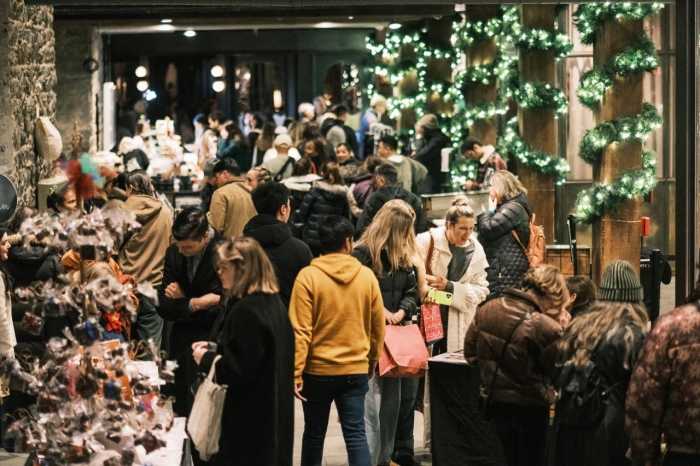
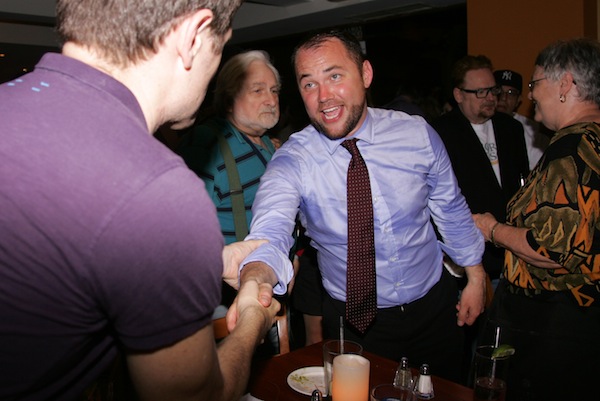
Following a community resource fair, which touted complementary flu shots and smoke detectors, and provided a chance for city agencies and advocacy organizations to hand out information, City Councilmember Corey Johnson hosted and moderated a town hall meeting on Jan. 13 at the W. 13th St. center.
Dozens of residents filled the meeting space to capacity, as they listened to introductory remarks from each of the 14 panelists representing city and federal agencies — including the Office of Emergency Management, the Metropolitan Transportation Authority and the Department of Education. The format was that Johnson asked a few general questions of specific agencies, then read questions submitted by the public.
Audience members wrote their concerns on index cards, which were handed up to the front of the room. However, at certain points things got a bit heated, as passionate audience members shouted out follow-up questions from their seats, or ripped out pages from notepads and walked up to Johnson to submit more questions. Johnson politely but firmly stated that people should hand their questions to the staff members that were collecting them.
The first of Johnson’s own questions was posed to Julie Menin, commissioner of the city’s Department of Consumer Affairs. He asked her to elaborate on the new “big picture items” that New Yorkers were introduced to in 2015.
“We are thrilled to be the agency that implements and enforces the paid sick-leave law, which extended paid sick leave to over a million New Yorkers,” Menin said. “Since we’ve been implementing this law, we have reached $1.3 million in restitution and fines for over 9,000 employees.”
Regarding the NYC Transit ordinance, Menin explained that, “The law went into effect in January. Any company, business or nonprofit that has 20 or more employees must provide commuter benefits to their employees. So this is the use of pre-tax money, and it’s not costing the employer more.”
Asked to talk about some of the disparities in healthcare seen across different neighborhoods, Mary Bassett, commissioner of the Department of Health and Mental Hygiene, noted some unfortunate statistics.
“This city is a city of neighborhoods, but it is also a city that is deeply segregated by income,” she said. “In Brownsville in Brooklyn, which is one of the poorest neighborhoods in our city, the life expectancy is 11 years shorter than in wealthy neighborhoods, like Murray Hill and the Financial District.”
Johnson asked her, “What are some of the things that you are doing…to actually try and decrease these disparities?”
“What we are doing,” Bassett explained, “is ensuring that we focus our most intensive programs — the ones that rely on people, because those are our most expensive programs — in the neighborhoods where the need is greatest. We have a program, for example, called Healthbox, which gives people an added amount of money that they can spend at farmers’ markets, and we’re working particularly in low-income neighborhoods…ensuring that we have been promoting access to health services in these communities.”
In addition, some agencies have embraced user-friendly smartphone applications, which the officials promoted throughout the night.
Reading from an audience member’s index card, Johnson asked Zachary Campbell, M.T.A. assistant director of government, to respond to a situation that many New Yorkers face, namely, when “you could wait forever and not have a bus show up, or a bus finally does show up and you see a sign at the front that says, ‘Next Bus Please.’ ”
“All bus service is scheduled according to ridership of the route, and once we see an uptick in ridership, we will increase service accordingly,” Campbell said. “There are also other tools that customers can use that are really, really helpful. If you haven’t downloaded it, we really strongly suggest the Bus Time app — it has every bus in the city, in real time. You can also text the code at the stop if you do not have the smartphone.”
Similarly, regarding a question on the inefficiency of calling 311 to report issues involving homeless people, Erin Eisenberg, program analyst of the Department of Homeless Services acknowledged the problem.
“I completely understand,” she said. “I go through it myself. I’ve timed it — it’s probably about five minutes just to get through the call. The 311 app is really good. It takes 60 seconds to use the app. It’s GPS based. You scroll down and ‘Report a Homeless Person’ is one of the options on the home screen.”
Other audience queries yielded less clear-cut solutions. For instance, Johnson asked Byron Muñoz, the intergovernmental and community liaison for the Department of Buildings, about how to get D.O.B. to further investigate a complaint, specifically if the complaint is closed because the inspector could not enter the building during his or her visit.
“Because resources are limited, we go out twice, and we attempt two times to gain access, and if there is an illegal situation, we can bring that before a judge,” Muñoz said. “Otherwise, the complaint will be closed, and what you will do is then request for a new inspection, and you can always follow up with my colleagues at the City Council.”
“That is not very user-friendly,” Johnson said in a joking manner, to which Muñoz suggested that he could be contacted directly, then gave his office number and e-mail address to the audience.
Another D.O.B.-related question asked why after-hours variances were being handed out “like candy.”
“What do we do to ensure that people have real livability without being unable to sleep?” Johnson read aloud.
“If you’re experiencing after-hours work that is not allowing you to get the rest that you need, you would contact me or anyone at our department, and we would look at modifying that after-hours variance to a reasonable hour,” Muñoz said. “After-hours variances are most often issued for one category, which is called ‘public safety.’ Public safety literally means traffic conditions,” he explained. “The developer or applicant is saying that, ‘Due to traffic conditions in the area, the density of it is making it unsafe for me to engage in the delivery or removal of debris during certain times of the day.’ ”
After-hours work can take place any time after 6 p.m. and before 7 a.m.
After a few more questions — on topics ranging from improving animal shelters to better managing overflowing street corner trash cans — Borough President Gale Brewer spoke.
“I love constituent issues,” she said. “I’m one of these people who loves to sit in a district office and solve constituent problems.
“Everyone in this audience,” Brewer noted, “has ideas that need to be addressed. You have public servants here on all sides of this podium who solve problems with us, and it’s really an honor to be here tonight.”
Johnson thanked Brewer for crediting him as one of those problem solvers, then concluded the meeting by expressing gratitude for the spirit of collaboration between politicians, agency officials and constituents.
“I say thank you,” he told the capacity crowd, “because, each and every day, I get to walk up the steps of City Hall, and I sort of pinch myself. I can’t believe that I get to engage in and do this kind of work. It’s an honor, a privilege…and I’m grateful that I get to do this kind of work with you.”