


BY YANNIC RACK | One of the most assertive promises of reform candidate Bill de Blasio’s mayoral campaign was his vow to end the city’s horse-drawn carriage industry. Now, more than two years after his original pledge, the mayor has announced a deal that takes an outright ban off the table — replacing it with a sharp reduction in the number of horses, and the construction of a new stable inside Central Park that will mark the end of an era in Hell’s Kitchen.
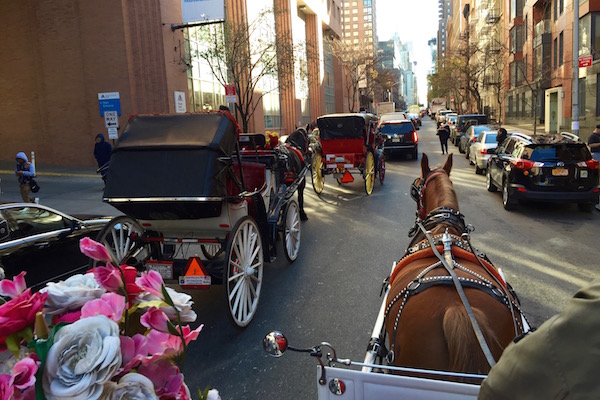
The new legislation, whose main purpose is to remove the horses from Midtown traffic by confining carriage rides to the park, comes after months of negotiations with representatives of the carriage industry. But since the plan came to light, it has united a range of different stakeholders — including parks advocates, pedicab drivers and animal rights activists — in opposition. Even the carriage owners who were brought to the table to find a compromise have found little to their satisfaction.
Over the long holiday weekend, the mayor, City Council Speaker Melissa Mark-Viverito and representatives of the Teamsters union, which represents the carriage drivers, released a joint statement, announcing they had reached “an agreement in concept” on the industry’s future.
By the time a bill was drafted on the night of Tues. Jan. 19, additional provisions included a rule that horses would have to carry microchips to monitor their movements, and receive five weeks of vacation a year.
The City Council, which will have to approve the legislation, has scheduled a hearing to discuss the proposal at a meeting of its Transportation Committee on Fri., Jan. 22.
But the carriage drivers criticize several aspects of the mayor’s proposal, which they say is unfair and would actually mean horses would have to work more, not less — even though the health of the animals is what prompted the discussion about the industry’s future in the first place.
“I have read the bill and it is totally unworkable,” said Conor McHugh, a carriage owner and the stable manager at Clinton Park Stables on W. 52nd St., the largest of the four stables located in Hell’s Kitchen.
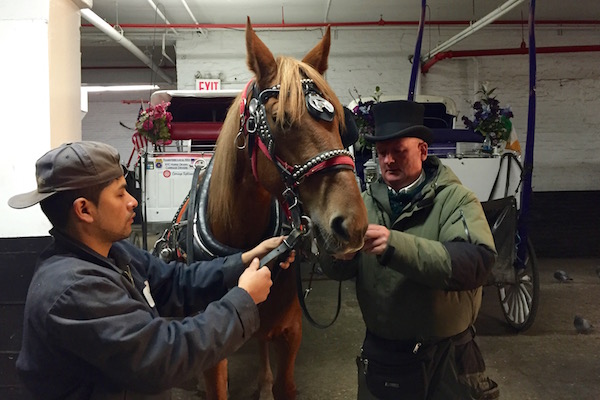
McHugh and other drivers said the plan did not represent an amicable agreement and would, in fact, mean the end of a career for many. Although they support relocation to the park in principle, they remain adamantly opposed to some provisions of the administration’s plan.
Under the current bill, the number of horses licensed to work in the city would be reduced from around 180 to 110 by the end of the year, and eventually cut down to 95 by the time the stable is built (estimated completion date, Oct. 2018). Seventy-five of the horses would then be housed at the stable at any given time, with the remaining 20 on furlough outside of the city.
Each of the 68 carriages currently in operation would additionally be restricted to working only one nine-hour shift in a 24-hour period, starting in Dec. of this year.
The drivers assert that this system, which essentially pairs one horse with each carriage, means that each animal would have to work every day if its owner wanted to drive his carriage as often as possible. (Currently, many of the horses are only used for one shift every other day, because the surplus — there are 180 horses for 68 carriages — means they can be rotated more often.)
“The rationale for capping the number of horses in total doesn’t make an ounce of sense,” said Stephen Malone, who was involved in the discussions with City Hall, and has been driving a carriage in the city for 28 years.
“The horses, believe it or not, were not mentioned very much in our negotiations,” he added.
“These are the people who will tell you they’re concerned about the horses, but now they want to pass a law that would mean the horses have more work,” said McHugh. “How does that make sense?”
The drivers also see no reason to curb their business before a stable is actually built — if the bill passes, around 70 of the horses would already be taken out of the stables by the end of this year.
Malone said that the future of those horses that would be retired was never discussed at any point during the talks.
Parks advocates are also skeptical, questioning what could be a $20 million expenditure to renovate an existing building on the park’s 85th St. Transverse, near the NYPD’s Central Park Precinct.
Councilmember Mark Levine, who chairs the council’s Parks Committee, said he shares the mayor’s goal of getting the horses off the streets, but believes that “more questions still need to be answered about how this proposal would impact Central Park.”
A spokesperson for the Central Park Conservancy referred questions about the proposal to the Parks Department, which didn’t respond to a request for comment. Neither of them are likely to be thrilled to surrender more park space to the horses, however.
“This was not the way public parkland was intended to be used,” Tupper Thomas, the executive director of New Yorkers for Parks, told The New York Times.
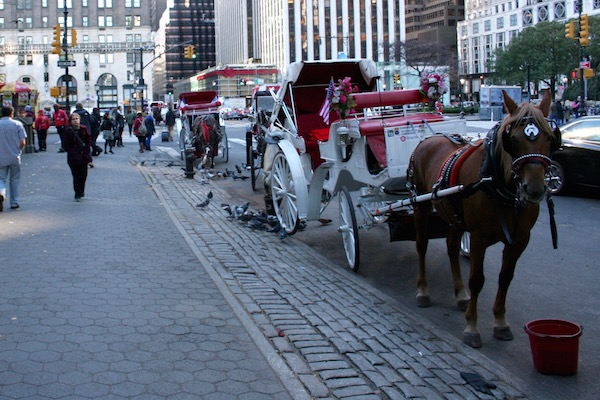
Pedicab drivers are also outraged, because the proposal would ban them from operating in the park below 85th St. — an apparent concession to the carriage drivers, who compete with them — putting many of them at risk of going out of business.
The pedicab drivers, who were surprised by the sudden announcement and described themselves as a “sister industry” to the carriages, protested the stipulation at a rally outside City Hall on Tues., Jan. 19. Some of them said they would consider suing the city if the ban comes into effect.
“De Blasio acts like this is some sort of compromise, but there’s hundreds of jobs at stake,” said pedicab owner Laramie Flick.
“You go above 86th Street and you can take people on a tour of the North Meadow. It’s basically a ban on Central Park, because there’s no way to make a living doing that tour.”
Although Flick drives on the streets as well as in Central Park, he estimates that at least a quarter of the 800 pedicab drivers in the city exclusively rely on the park to earn their livelihood.
“Our industry has been completely left out of the discussion,” said Peter Meitzler, another driver and the co-founder of the New York City Pedicab Owners’ Association.
“There is that infamous saying, ‘If you are not seated at the table, you are on the menu.’ ”
The legislation was so widely unpopular that it even caused one of the carriage owner’s chief critics to weigh in on their side — sort of.
Elizabeth Forel, the president of the Coalition to Ban Horse-Drawn Carriages, said the advocacy group was opposed to the deal because it would preserve the carriage trade at the expense of the horses.
“[This plan] smells like a convenient real estate deal to us,” she said.
Her comment also recalls the origin of this issue for the mayor, who pledged to eliminate the industry in front of wealthy campaign supporters in 2013, before he was elected.
Some supporters of New Yorkers for Clean, Livable and Safe Streets (NYCLASS), the anti-carriage group that contributed generously to de Blasio’s mayoral bid as a result, have been accused by the carriage industry of backing the cause simply so they could snatch up the horse stables, which occupy prime real estate on the thriving West Side.
The group also issued a statement on Tuesday, saying that the deal was promising but did “not go far enough” in protecting the animals.
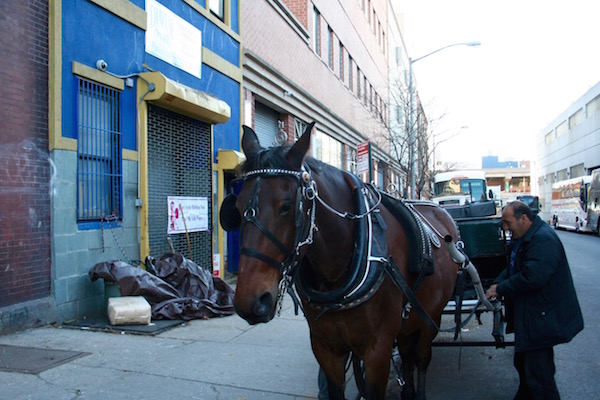
In the same vein, many of the carriage drivers remarked this week that it was ironic that the mayor’s efforts, supposedly spurred by concern for the animals, fell short on precisely that front.
“Under the plan that he’s proposed, the horses would work more,” said Christina Hansen, who does not own a carriage medallion, but drives carriages out of the W. 52nd St. stable, as well as another one on W. 38th St.
“It’s clearly not about the horses, because we told [the mayor about these issues] and tried to explain it to him,” she said. “But he’s not a horse person.”
The Council speaker, Mark-Viverito, told reporters on Tuesday that she felt “confident” the deal would be approved.
Whether or not that’s the case, Levine, whose district borders the northern portion of the park, expressed what many of his fellow councilmembers are likely to echo after they vote on the bill.
“This has been an intense process that has occupied an extraordinary level of time and energy from all sides,” he said.
“Everyone is going to be relieved that we can focus our attention on other issues that are facing the council.”