


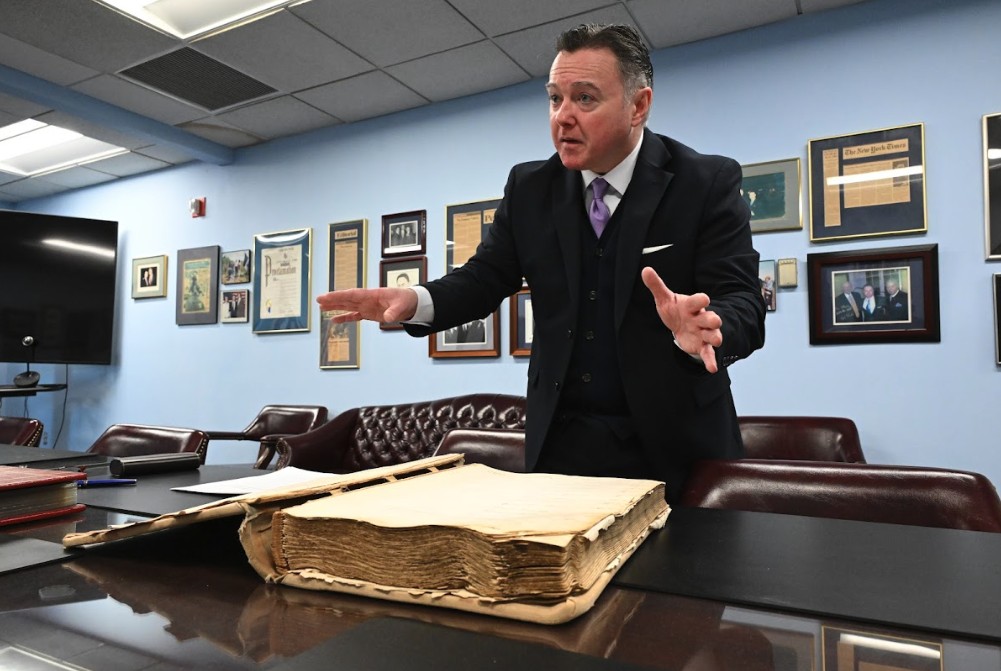
Richmond County Clerk Stephen Fiala said his friends joke that if he wasn’t the chief record keeper for Staten Island, he’d be a monk.
Fiala is in charge of an office that documents roughly 200,000 Supreme Court transactions per year and in 2023, processed around $13 billion in property valuations. According to Fiala, he lives an austere life, eschewing socializing, small talk, Hollywood and sports and instead devotes his attention to the protection and preservation of legal records. For him, working for the people of Staten Island is a higher calling.
Asked to describe his role in one word, Fiala said, “Service.”
“The [property] deed is an instrument, but the reason you exist is a noble endeavor,” Fiala said in describing his responsibilities as Staten Island’s County Register, which includes storing all the borough’s property records and overseeing its property tax collection.
Fiala, a former Republican City Councilman for the south end of the island, has held the post of County Clerk since he left the council in 2001, and has embraced the office’s shift to electronic record-keeping as an extension of his devotion to his borough’s history. Thanks to his stint in the private sector, his tenure as clerk has brought corporate management strategies into the clerk’s office to streamline the customer service experience while tightening the office’s budget.
Though he may have come to his role from politics, Fiala said that he never had much patience for the horse-race qualities of elected office.
“I don’t like politics. I like policy,” he said.
Fiala, 58, views his role of county clerk through an historical and philosophical lens. He’s a Republican in the mold of his role model, Abraham Lincoln. He lives by Lincoln’s aphorism that the “legitimate object of government, is to do for a community of people, whatever they need to have done, but can not do, at all, or can not, so well do, for themselves.”
Most county clerks in New York City wear three hats. Fiala wears four.
He’s the clerk of the Richmond County Supreme Court, which entails keeping records of all Supreme Court cases in the county. He’s the Commissioner of Jurors, responsible for assembling qualified jurists. He’s the Clerk of the County, which puts him in charge of all documents that don’t involve litigation, such as new business and LLC registration. And as County Register, he delivers $200 million in property taxes back to New York State, New York City and the MTA.
The former Richmond County Clerk Mario Esposito personally singled out Fiala as his successor. When Esposito approached him in 2001, Fiala said that he didn’t know what a county clerk did, but he had just cast the deciding vote to uphold term limits in the City Council, effectively voting himself out of a job. “You’ll get to run something,” he remembered Esposito telling him.
“The reality is, I think I’m a better executive than I am a legislator,” Fiala said. “A legislator, you kind of have oversight over everything, but control over nothing. Here I’m not a policymaker. I’m not a legislator. I don’t make laws, but I am here to deliver on them.”
In Fiala’s estimation, to understand the role of county clerk — especially in his role as County Register — one must go back to the 1680s, when the British took over New Amsterdam from the Dutch and renamed it New York. The role of Richmond County Clerk begins, he said, when Thomas Dongan, the British Crown-appointed governor of New York, designated what is now Staten Island to be one of the 10 counties of the colony of New York. That is the beginning of the records that his office contains.
“There are three major threats that we face: fire, water, and time. And when you think about parchment paper, or even this printout,” he said pointing to a sheet of computer paper, “at some point in the future, this print is going to fade,” he said.
Though the daily churn of court documents is constant, Fiala said his goal is to digitize every historical record held by his office.
Those records are the physical manifestation of “the integrity of land ownership” and his job, he said, is to protect them to the highest standard possible.
“If you transfer a piece of your property, or you consolidate, or you modify a mortgage, or you do an extension or an easement, all of these legal issues have very significant collateral consequences to you and your heirs,” he said. “And the only thing that you have as a safeguard is a public record that tells the world. Because where are you gonna wind up? You’re probably gonna wind up in court against somebody saying, ‘No, that corner is mine.’”
In a city where deed theft and property scams are uncovered with regularity, a thorough record is an important defense.
“People come in with palpitations,” he said, adding that it is his job to help ease the stress.
One thing that makes Fiala unique among New York City county clerks is his extensive work in the private sector. Prior to joining the City Council, Fiala spent eight years in international marketing, and two working on brand management for Disney, which gave him a sense of workplace rigor and corporate strategy.
He operates his own “county clerk analytics program,” which collects 200 different performance indicators on a daily basis. He’s cut his staff down from a high-point of 57 to its present level of 50, citing his fiduciary responsibility to the taxpayers.
“This office runs on less than 2 percent administrative over-costs,” he said. “That’s 1.80 cents. That means 98.20 cents of every dollar we collect, because we’re a cash cow, we give back to the treasury.
Though Fiala characterizes himself as “anti-technology” his practical business sense prompted him to advocate for electronic filing when it was still nascent in the court system. He knew the office had to evolve to meet the needs of constituents to become a 24-7 operation that doesn’t require Staten Islanders to take a day off from work to look through a book of property deeds.
His efficiency has not gone unnoticed in city government. He’s been appointed three times to serve on mayoral charter revision commissions, he served on a mayoral panel that reviewed city Board of Election procedures and when Staten Island Borough President Jimmy Oddo was elected, Fiala helped him streamline his office.
As for what his legacy might be, Fiala is acutely aware that administrators don’t share the same public afterlife as politicians.
“Nobody’s going to remember me. There are 39 predecessors of mine, and I am probably the only person in this place who could tell you the names of any of them,” he said.
His duty, as he explained it, is to quietly shepherd his responsibilities to the people of Staten Island to a Lincolnian high standard, and stay true to the three things that ground him: “friends, family and faith.”
“I hope more important than that, when you’re gone, you’d like people to say, ‘He was a good man.’”