


Friday, Jan. 23, marked the 23rd day of Zohran Mamdani’s term as mayor. amNewYork is following Mamdani around his first 100 days in office as we closely track his progress on fulfilling campaign promises, appointing key leaders to government posts, and managing the city’s finances. Here’s a summary of what the mayor did today.
As a major winter storm threatens to dump up to 18 inches of snow across New York City this weekend, Mayor Zohran Mamdani is facing the first major operational test of his young tenure at City Hall — one that has historically exposed gaps in city leadership, particularly around whether all neighborhoods receive the same level of service.
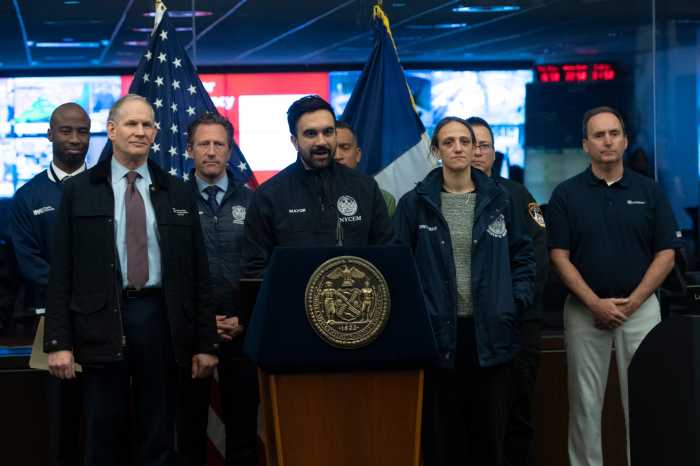
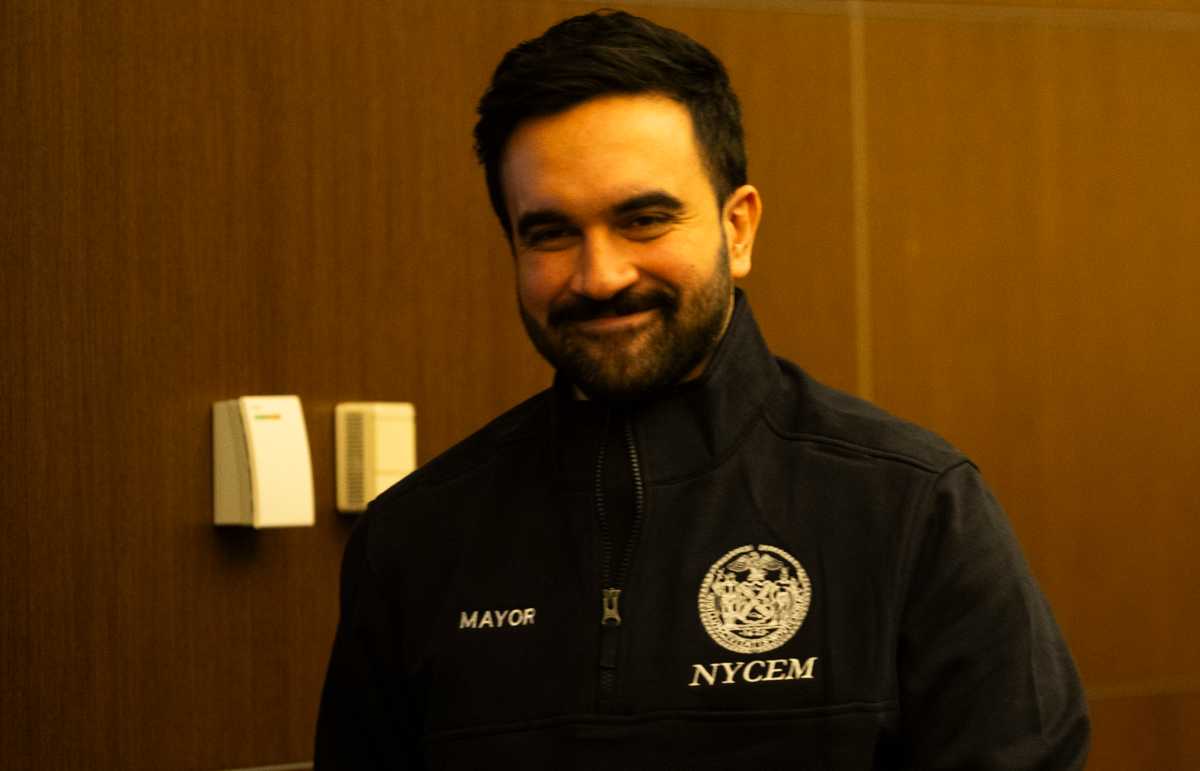
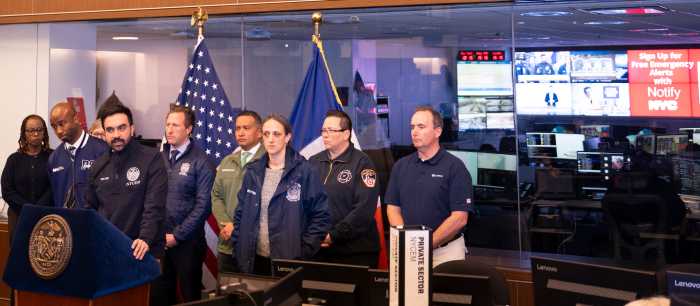
Speaking at a press conference at the city’s Emergency Management Department, Mamdani said city agencies are preparing for widespread impacts beginning Sunday morning and continuing into Monday, with hazardous travel conditions compounded by extreme cold.
“We are working together to ensure that our streets are being kept clear,” Mamdani said, adding that the city’s response would reach “every community, every neighborhood, every part of New York City.”
The latest forecast from the National Weather Service indicates New York City could see between 12 and 18 inches of snow, with wind chills making temperatures feel as low as minus 10 degrees.
Winter storm is Mamdani’s first operational test
For Mamdani, the storm represents an early and highly visible challenge. Snow response has long been a political flashpoint, with past mayors criticized when plowing appeared uneven or delayed, particularly in the outer boroughs. Most famously, in 1969, Queens was left unplowed for days after a blizzard and tarnished Mayor John Lindsay’s reputation. Many Queens residents alive to experience it have never forgotten.
More recently, during a November 2018 snowstorm that dropped an insignificant amount of snow, then-Mayor Bill de Blasio’s administration faced scrutiny over the city’s slow response, which snarled evening commutes and left some neighborhoods less cleared than others. The city’s top emergency management official at the time, Joseph Esposito, was fired amid the fallout.
At Friday’s press conference, Mamdani emphasized that the city’s snow response would be citywide and uniform, with sanitation crews and equipment deployed across all five boroughs as conditions worsen.
The Department of Sanitation began applying a brine to highways and major roadways at 6 a.m. Friday, Mamdani said, a process that sprays a saltwater solution to prevent ice from bonding to pavement.
As snow begins to fall, more than 2,000 sanitation workers will move to 12-hour shifts, deploying roughly 700 salt spreaders at the first snowfall and activating about 2,200 plows once two inches of snow accumulates — a threshold officials expect to be reached Sunday morning.
Internally, the city will monitor plowing and salting using the Department of Sanitation’s “Blade Runner 2.0” system, which tracks operations in real time. Mamdani said the system is intended to ensure that no neighborhood is overlooked. Residents can track where and when the city’s plows and salt spreaders have traveled on the PlowNYC tracker.
“No New Yorker is made to feel that depending on their zip code or their neighborhood, they’re going to receive a different level of service,” he said. “You’re going to receive the same level of service across the city.”
Earlier Friday, Gov. Kathy Hochul declared a statewide State of Emergency ahead of the storm, citing extreme cold and heavy snowfall expected to impact NYC through Monday.
“Up to a foot of snow Downstate, it could be paralyzing in a dense area like New York City,” Hochul said during a press conference in Albany. “They have not seen snow totals like this in years.”
Hochul confirmed that she spoke directly with Mamdani and said the state is prepared to provide mutual aid if the city requests assistance with plowing or other operations.
“Our State of Emergency that is now in effect [allows us] to literally go into the streets of New York if they call and need our assistance with plowing or whatever they may need,” Hochul said.
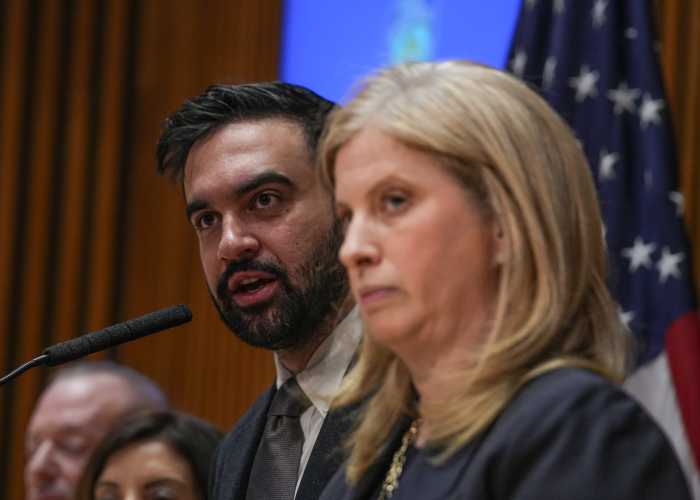
Deputy Mayor for Operations Julia Kerson said the city has not yet declared its own emergency but is prepared to do so if conditions worsen, noting that such declarations are primarily used to impose traffic restrictions.
“Our emergency declarations largely allow for restricted traffic,” Kerson said. “We’ll be monitoring roadway conditions and then determining if those additional restrictions are necessary.”
To limit travel during the storm, Hochul authorized all state employees to work remotely on Monday and encouraged private employers to follow suit, a move aimed at keeping roads clear for emergency vehicles and snow removal crews.
Asked at the press conference whether city workers would be allowed to work remotely, Mamdani said uniformed services would report in person as usual, while other city employees would receive agency-specific guidance from the Department of Citywide Administrative Services. He said those decisions would depend on snowfall totals and roadway conditions, which are expected to become clearer by Sunday.
On school operations, Mamdani said students and families will know by noon Sunday whether classes will be held remotely or in person on Monday.
Separately, Hochul announced that early voting scheduled to begin Sunday ahead of the Feb. 3 special elections will be suspended, with the city’s Board of Elections adding hours later in the voting period to make up for the loss.
The city races affected include the Queens Assembly seat vacated by Mamdani and Manhattan’s District 47 state Senate seat, vacated by Brad Hoylman-Sigal, who has taken office as Manhattan borough president.
Extreme cold and code blue
In addition to snow, the storm is expected to usher in a prolonged period of extreme cold, with temperatures remaining below freezing for several days.
A Code Blue is already in effect, triggering expanded outreach to unhoused New Yorkers. Speaking earlier on the Weather Channel, Mamdani said city workers are proactively canvassing streets to connect people with shelter rather than waiting for individuals to seek help.
“We’re not waiting for people to come to us,” Mamdani said, adding that outreach efforts are being doubled due to the cold.
He also urged residents to complete errands before the storm and to limit travel as conditions worsen.
“I would encourage everyone to spend as much time at home as possible,” Mamdani said during the interview. “Don’t leave it as the day to get your new winter coat or your groceries. That’s today.”
Unnecessary travel, he warned, could complicate snow removal and emergency response efforts.
Childcare: Immigrant outreach

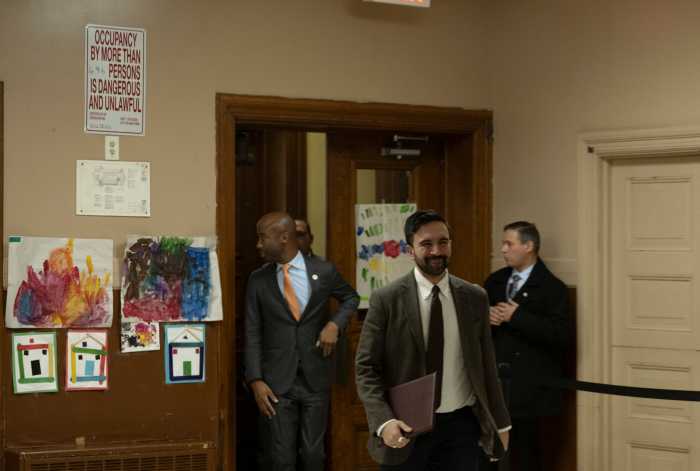
Later Friday afternoon, Mayor Mamdani hosted a roundtable of ethnic and constituency media to discuss the city’s 3‑K and Pre‑K programs, addressing questions about language access, wait lists, and outreach to immigrant communities, many of whom are shaken after the detainment of a 5-year-old boy and his father in Minnesota made national headlines this week.
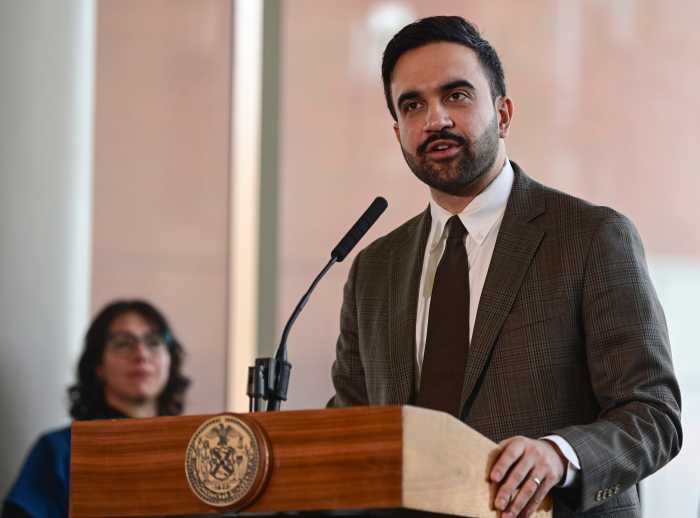
“These are resources that belong to New Yorkers,” Mamdani said, stressing that families should feel welcome and protected when applying for early childhood education, regardless of background. “These are not programs that are going to ask the immigration status of any one of the children. All of those children are New Yorkers. They should all be enrolled in Pre-K and 3-K no matter where they were born or where they come from.”
According to multiple reports, federal agents in Minneapolis detained 5‑year‑old Liam Conejo Ramos and his father as they returned home from preschool on Tuesday, a case that has drawn national outrage. In light of the incident, Mamdani sought to soothe immigrant families’ concerns in NYC: “We are proud to be an immigrant city. We are proud of the incredible tapestry that is New York … and this is one example of a city program that we are encouraging everyone to apply to, to see themselves as a part of.”
During the roundtable, Mamdani emphasized that 3‑K and Pre‑K programs are open to all New Yorkers and that families do not need to provide sensitive documents such as green cards or visas to enroll. He underscored the city’s sanctuary policies, which bar Immigration and Customs Enforcement from entering schools or other city properties without a judicial warrant, offering reassurance to parents concerned about federal enforcement. “No matter how many words come before the final two, all of the descriptions end with New Yorker. That’s who they are. That’s what they deserve,” Mamdani said.
Enrollment in 3‑K and Pre‑K is open to any child turning three or four in 2026, and applications submitted by the February 27 deadline are guaranteed to result in an offer of a seat, city officials said. “If you apply by the deadline, you will get a seat,” Deputy Chancellor of the Division of Early Childhood Education Simone Hawkins told reporters, adding that the city is expanding capacity this year to provide options closer to families’ homes.
Families can apply online at MySchools.NYC, by phone at 718‑935‑2009, or in person at one of the city’s 11 Family Welcome Centers.
The online portal is available in 13 languages, and phone support provides interpretation in over 200 languages to ensure accessibility for families with limited English proficiency. “For families who may not be sure what an early childhood program looks like, we encourage them to visit programs in their community,” said Emmy Lis, executive director of the Mayor’s Office of Child Care.
The mayor and his team also addressed concerns about waitlists. Families who do not receive their first-choice placement are automatically added to a waitlist for preferred programs while securing a guaranteed seat elsewhere.
Offers can shift throughout the year as additional spots become available, and city officials are adding capacity in neighborhoods where families have previously had limited options. “We are adding additional 3‑K spots across the city to ensure that families get an option that works for them,” Lis said.