

In her State of the State address, Gov. Kathy Hochul laid out her agenda for New York’s future — lowering costs for working families while making strategic investments in artificial intelligence, biotechnology, and quantum computing to fuel long-term economic growth. For that vision to succeed, New York must confront its costly legal climate, which undermines affordability for families and makes it harder for innovative companies to invest and grow here. Luckily, part of Hochul’s plan aims to reduce sky-high insurance premiums that drain household budgets by reining in opportunistic lawsuits.
And yet, as the governor advances a pro-growth agenda, legislators risk undermining it by piling on new regulations and expanding litigation in ways that raise costs, inject uncertainty, and drive investment elsewhere.
Innovative sectors building medical breakthroughs and developing next-generation technologies thrive by taking risks — testing new ideas, pursuing creative solutions to complex problems, and pushing the boundaries of what is possible to deliver better, revolutionary outcomes for patients and consumers. That work depends on an environment that creates fertile ground for and rewards innovation, not one that forces researchers and developers to think twice because success may invite expensive, punitive litigation that benefits enterprising attorneys and their allies more than the public.
New York’s life sciences sector is already an engine of economic growth. Research and development not only advances the public good through life saving therapies, but also supports high-paying jobs and creates pathways for start-ups. Hochul has made meaningful investments to strengthen this ecosystem, and just announced the Bolstering Biotech Initiative to support the full pipeline from discovery to commercialization. These initiatives are exactly how New York can retain talent and cement its place at the forefront of biomedical and digital innovation.
But that depends on a policy environment that is predictable and rational — not one that encourages legal uncertainty and speculative lawsuits.
New York’s liability climate makes the state less affordable and less competitive. A recent report finds that laws that promote litigation are a top reason New Yorkers pay some of the highest insurance premiums in the country, including healthcare costs roughly 12% above the national average and auto premiums more than 50% higher. At a time when families are already weathering an affordability crisis, these are self-inflicted costs we cannot afford.
Hochul is confronting this problem head-on. Her proposals to rein in excessive auto liability payouts and her decision to veto elements of the trial lawyers’ legislative agenda are about controlling the high cost of living in New York and promoting a climate where businesses are willing to invest, take risks, and bring new ideas to market.
Hochul recently negotiated a nation-leading AI framework establishing clear transparency and safety expectations. That kind of thoughtful, targeted approach provides guardrails without smothering innovation. Yet, as the ink dries, the Legislature is signaling interest in layering on new AI regulations, including proposals with expansive private rights of action — legislative language that allows profit-motivated law firms to file lucrative lawsuits to enforce complex regulations.
Regulation by litigation raises costs, chills innovation, and creates uncertainty for companies trying to navigate fast-moving, highly technical fields. Importing that model into AI — and by extension the life sciences and healthcare technologies increasingly powered by AI — risks driving investment and breakthroughs to states with more predictable legal environments. The result would ultimately be fewer jobs, fewer startups, and fewer lifesaving innovations developed here in New York.
If Albany wants to help working families, grow the economy, and secure New York’s place as a leader in AI and life sciences, lawmakers should follow Gov. Hochul’s lead — not undermine it.
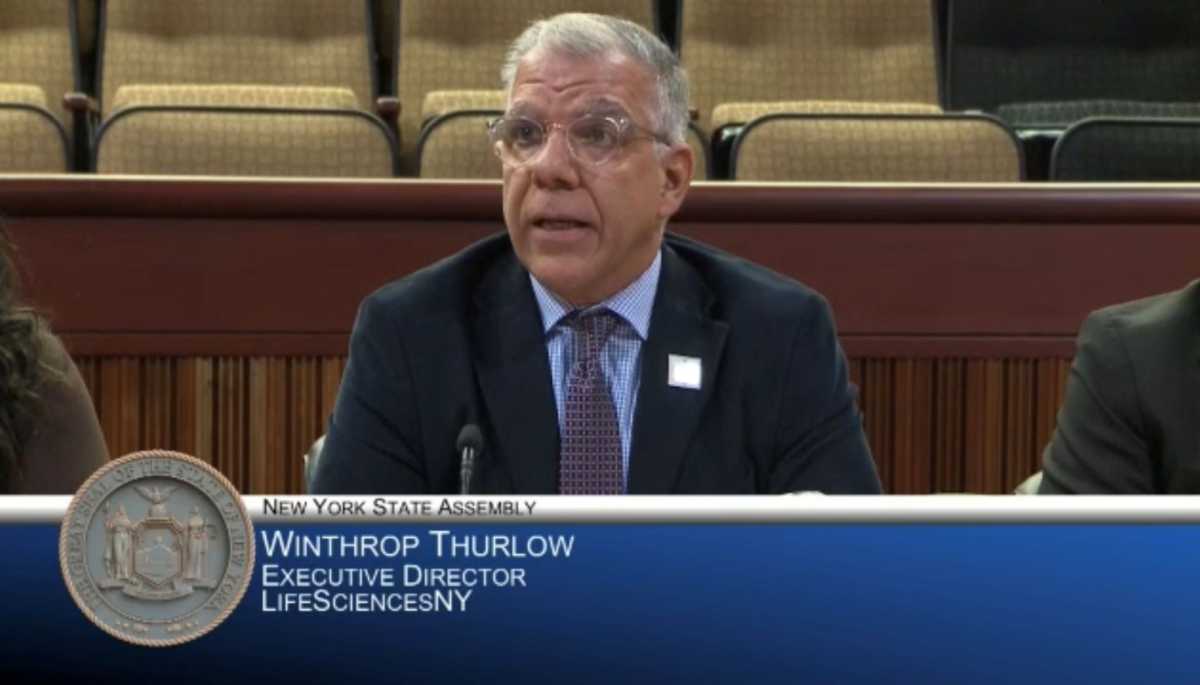
Winthrop “Win” Thurlow is executive director at LifeSciencesNY, a membership organization that advocates for New York’s medical device and life sciences industry. Members range from startups to established multinationals and include the state’s leading universities.