



Incoming First Deputy Mayor Dean Fuleihan said Monday the Mamdani administration intends to push ahead with its sweeping affordability agenda without breaking the city’s bank.
The affordability agenda, including rent freezes and expanded child care, will move forward even as Fuleihan acknowledged that tight budgets, union negotiations, and slow city hiring could complicate delivering quick relief for New Yorkers.
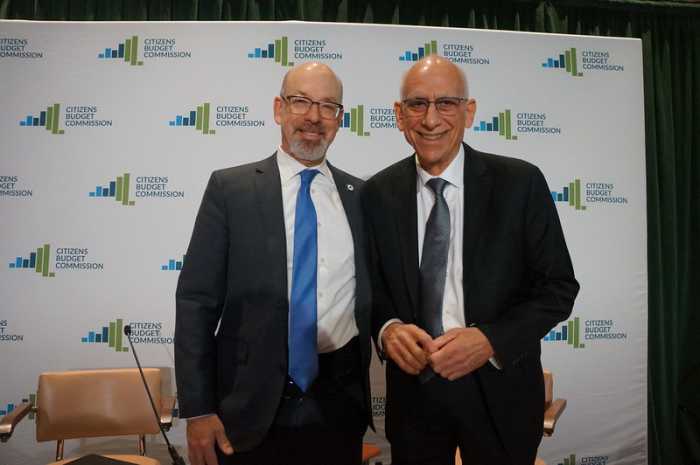
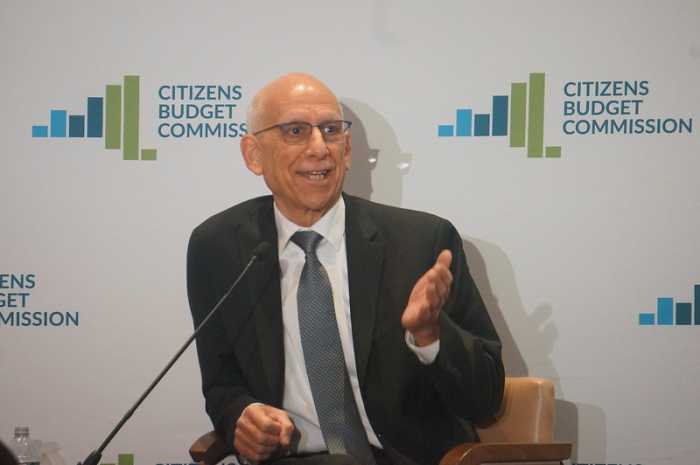
Speaking at a Citizens Budget Commission breakfast in Midtown and later talking with reporters on Dec. 15, Fuleihan stressed that while voters endorsed Mayor-elect Zohran Mamdani’s promises on housing and child care, the administration must still balance the budget, negotiate with labor unions, and work with Albany before funding major expansions.
“There’s a very aggressive agenda on affordability,” Fuleihan said, “but there’s also day-to-day operational issues. And he is committed to excellence… and you will see day-to-day changes in those operational issues that have consequences for every single New Yorker.”
Fuleihan, a veteran of city and state government with a career dating back to the 1970s, struck a pragmatic tone at the CBC event. He repeatedly emphasized fiscal discipline even as he defended the ambition of Mamdani’s agenda.
The incoming first deputy mayor previously served in the same role for then-Mayor Bill de Blasio between 2018 and 2021 — acting as a key adviser on managing the NYPD, the Department of Education and the Department of Investigation.
During his tenure under de Blasio, Fuleihan personally oversaw several powerful agencies, including the Office of Management and Budget, the Office of Labor Relations, and the Office of Climate Policy and Programs, an experience he said informs his approach to the city’s current fiscal and operational challenges.
The incoming first deputy mayor said the administration will continue the city’s long-standing practice of producing a balanced budget under generally accepted accounting principles when the preliminary budget is released Feb. 1.
“We are going to continue the tradition — there’s going to be a balanced budget under Generally Accepted Accounting Principles,” he said. “That has been the standard since 1982. That’s the foundation.”
Fuleihan says Mamdani admin will work within state tax policies
Fuleihan said discussions with the state government on corporate and personal income tax policies are ongoing and will influence how the city’s preliminary budget takes shape in the coming month, saying Hochul’s budget plans will “give us a sense of our relationship with the state,” adding that no final decisions have been made.
During his campaign, Mamdani had proposed raising taxes on both corporations and millionaires to pay for his signature policy items — something the Gov. Hochul had long said she no intention of approving.
Much of his ambitious agenda hinges on a state increase in the corporate tax rate to match New Jersey’s 11.5%, which he has claimed will generate $5 billion for the city.
Fuleihan said the administration will continue planning its budget with state revenue assumptions in mind: “I think it’s also fair to say if things are in the governor’s budget, historically, those have been reflected got the city budget.”
While Hochul had long resisted raising the corporate tax rate to fund city initiatives, she has recently signaled a willingness to revisit the issue. She has remained firm, however, that individual income taxes will not be increased.
Fuleihan also weighed in on property tax reform, highlighting the administration’s goal of greater fairness across the city’s property tax system. “We know there’s an unfair system, and as a class, co-ops are undervalued,” he said, while acknowledging that some co-ops face the same equity challenges as single-family homes.
He emphasized that the administration will need to balance reform with the realities faced by struggling homeowners. “We need to come up with a way to do that so that burden does not become front and center,” Fuleihan said, adding that any transition to a more equitable system would be a top priority for the new administration.
“I can’t imagine a stronger statement to say that our administration takes this seriously than the mayor-elect raising this in the White House, that New York City property tax, when they were discussing housing, is one of the things that has to be addressed,” he said.
More administration appointments to come
Asked about the pace of building out the new administration, Fuleihan said personnel announcements are imminent.
“You’re going to get appointments” this week, he told CBC President Andrew Rein, describing the effort to assemble a senior team capable of executing the administration’s priorities.
Mamdani has not revealed any major appointments to his incoming administration since announcing that the sitting police commissioner, Jessica Tisch, would remain in her role nearly a month ago.
In the week after the election, Mamdani announced Fuleihan’s appointment, as well as that of his longtime aide Elle Bisgaard-Church as his incoming chief of staff.
On housing, Fuleihan reaffirmed Mamdani’s pledge to freeze rents for the city’s stabilized tenants, calling it a core campaign commitment. He also highlighted the recent passage of citywide housing ballot measures that Mamdani endorsed late in the campaign, saying they will “allow housing development to happen at a faster pace” by cutting through bureaucratic barriers.
Pressed on concerns that a rent freeze could worsen the finances of distressed rent-stabilized buildings, particularly older properties, Fuleihan acknowledged the risk but offered few specifics. “There are landlords that are struggling,” he said. “We recognize it.” He said the administration intends to address those challenges alongside tenant protections.
Budget pressures loomed over much of the discussion Monday morning. Asked whether the administration would be willing to cut or shrink programs that are not delivering results in order to fund new priorities, Fuleihan said yes, pointing to Mamdani’s previous pledges to enact procurement reform and more efficient service delivery.
Prior to the election, Mamdani proposed a plan aimed at curbing “redundant and duplicative spending” across the Department of Education’s $40 billion budget, roughly $10 billion of which is spent annually on outside contracts. The plan, which Mamdani called “curing procurement,” involves auditing the department’s top vendors and largest contracts, consolidating internal procurement offices, establishing contracting hubs in each borough, and introducing a vendor rating dashboard to boost accountability.
Mamdani projected these steps could cut redundant spending by at least 10% and reduce retroactive or emergency procurement by 30%, potentially saving $1 billion to $3 billion annually.
Fuleihan said Monday that the incoming administration believes there are opportunities to find savings without undermining core services, including improving the city’s procurement and reimbursement systems and addressing chronic hiring delays that have left agencies understaffed. More than 70,000 people have expressed interest in city jobs, he said, but rigid processes and unfilled positions have hurt service delivery across agencies.
Labor negotiations are also another looming challenge. Fuleihan told reporters that new union contracts and potential productivity measures will not be reflected in the upcoming preliminary budget, but will instead be part of longer-term negotiations.
“We want to work with our labor partners to make sure that government is being delivered efficiently,” he said. “We also have to deliver an appropriate wage because they also struggle through the affordability crisis. And some of those wages are significantly low.”
Finding labor efficiencies is “part of the question,” Fuleihan said. “We do believe the workforce actually is trying to deliver the very best service, and it’s, it’s our responsibility to make sure that we listen to their needs, as well as the business community.”
Transportation policy also surfaced during the breakfast event. Asked by former City Council Speaker Corey Johnson about Mamdani’s plans for the Department of Transportation, Fuleihan said, “We need a department that’s actually committed to” the city’s Streets Plan, the law Johnson introduced in 2019 requiring street redesigns to prioritize safety, buses, and pedestrians.