New York Mets president of baseball operations David Stearns admitted that executing the deal that sent long-time outfielder Brandon Nimmo to the Texas Rangers for second baseman Marcus Semien was “a little bit more challenging” than other trades because of what the 32-year-old has meant to the franchise.
A homegrown product who was drafted in 2011, Nimmo has long been a fan favorite and a fixture of the outfield for the last decade. But this year’s extended collapse over the final three months that resulted in a postseason miss was all that Stearns needed to see to know that significant changes had to be made.
“What we did last year wasn’t good enough, and running back the exact same group wasn’t the right thing to do,” Stearns said on Monday afternoon. “As we went into this, we believed and still believe that we have to be open to anything. We shouldn’t be in a spot to take anything off the table. If we’re able to put transactions together that make sense for the team, we have to consider them regardless of what names might be involved.”
And so sending Nimmo down to Texas was the first big move of what is expected to be an incredibly busy offseason.
How the Nimmo deal came together
Mandatory Credit: Bill Streicher-Imagn Images
The Rangers have had consistent interest in Nimmo as a steady, veteran presence to add to an otherwise young outfield featuring Wyatt Langford and Evan Carter — two talents that should be franchise cornerstones for some time.
News, events, culture and more — delivered to you.
Thank you for subscribing!
The Mets, meanwhile, have seen Nimmo’s value diminish after just three years of an eight-year contract. With five years and $102 million remaining on his deal, injuries, particularly a nagging neck issue, have diminished his defense, transforming him from a passable center fielder just a few seasons ago to a questionable corner outfielder. Despite hitting a career-high 25 home runs in 2025, it wasn’t good enough for Stearns, who has maintained a desire to improve the Mets’ defense this winter.
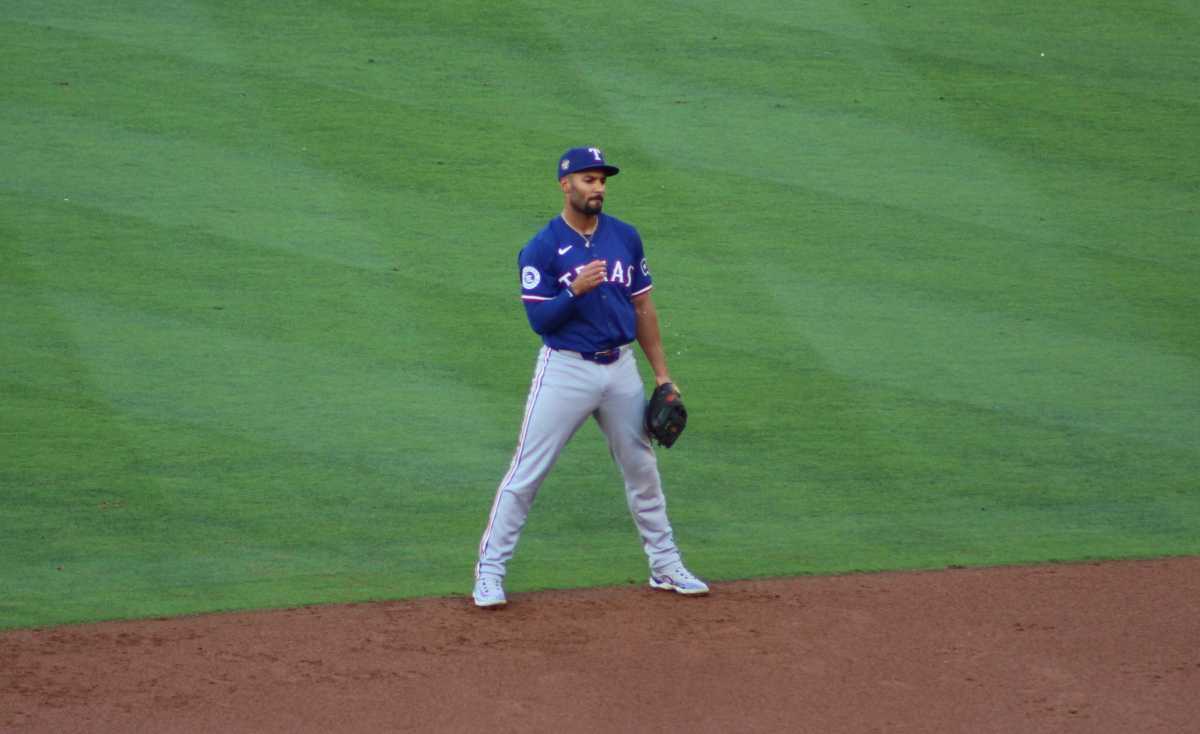
It’s why Semien was such an attractive choice, even with his offensive numbers dipping and a foot injury limiting his 2025 to 127 games. His 7 outs above average still ranked within MLB’s 92nd percentile, and he won a Gold Glove as recently as 2024.
“Marcus brings an elite level of defense,” Stearns said. “He’s one of the best defensive infielders in baseball and has been for a number of years. He’s a winner. He brings a winning drive and determination that we think will fit well in our clubhouse. And he balances our lineup from the right side, which we were seeking to do.”
Talks between the Mets and Rangers did not pick up momentum until the end of Major League Baseball’s GM meetings from Nov. 10-13 in Las Vegas, which then extended into last week.
Semien had a limited no-trade clause, with the Mets being one of his approved teams. Nimmo, on the other hand, had a full no-trade clause, meaning he had to green-light any prospective trade.
“Brandon’s a pro. He’s the ultimate pro,” Stearns said. “He was very respectful, considerate throughout this process. He took time to digest everything, took time to speak to his representation, his family to determine what was best. Ultimately, he decided to accept the trade… It was something we had to think about, no question. Both in terms of fan reality and the fan relationship with Brandon. But we have real relationships with Brandon and our players have real relationships with Brandon… that is a part of this.
“That certainly makes decisions like this a little more challenging than they otherwise would be. But at the end of the day, I felt like this was the right decision for the organization.
What they are expecting from Semien
(Photo by Gordon Donovan/NurPhoto)NO USE FRANCE
At 35 years old, with three years and $72 million remaining on his contract, Semien has enough uncertainty accumulating over him. Once a 45-home-run hitter four years ago with the Toronto Blue Jays and a perennial 25-plus-homer guy when healthy, he batted .230 with a career-worst .669 OPS, along with 15 home runs and 62 RBI.
Stearns made it clear that this move had little to do with his bat, although he does expect “some bounceback” when healthy and within a deeper lineup than what the Rangers had to offer this season.
“I think there are some underlying aspects of what he does that are encouraging for us offensively,” Stearns said. “I also think it’s normal that this is a player that can contribute to winning baseball in a variety of different ways. The bat might not lead the way at this point in his career. We think there’s likely some bounceback in his offensive profile, but what we’re counting on at the top of his skill set is the contributions he can make defensively and how he can perform on the bases. That will help us win games.”